Church of St. Paraskeva, Busk
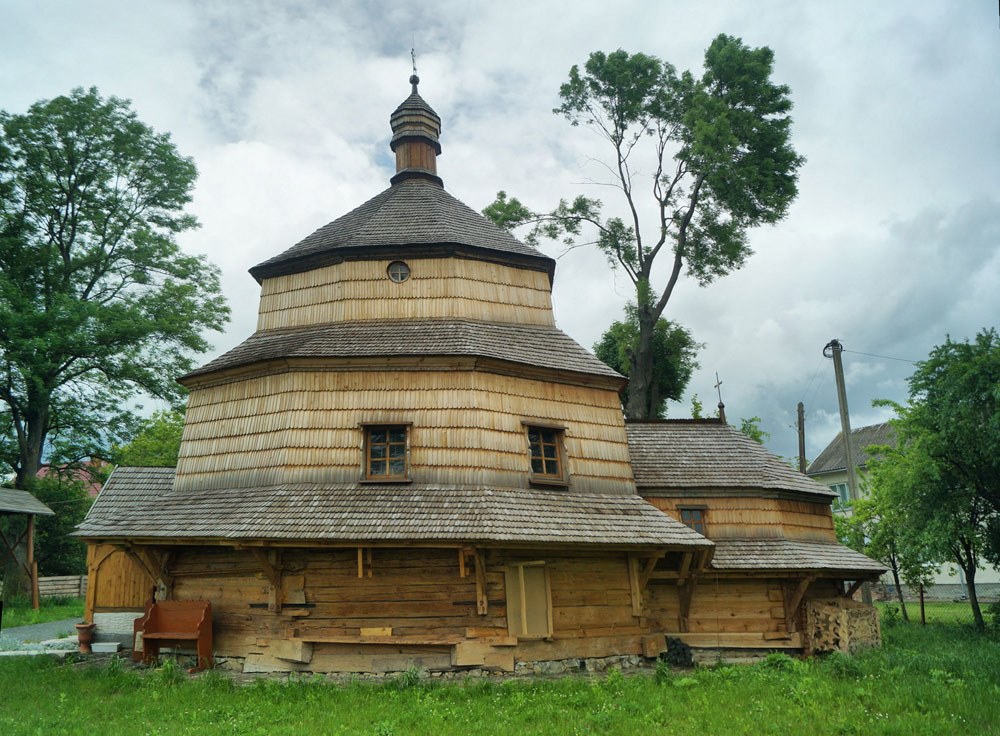
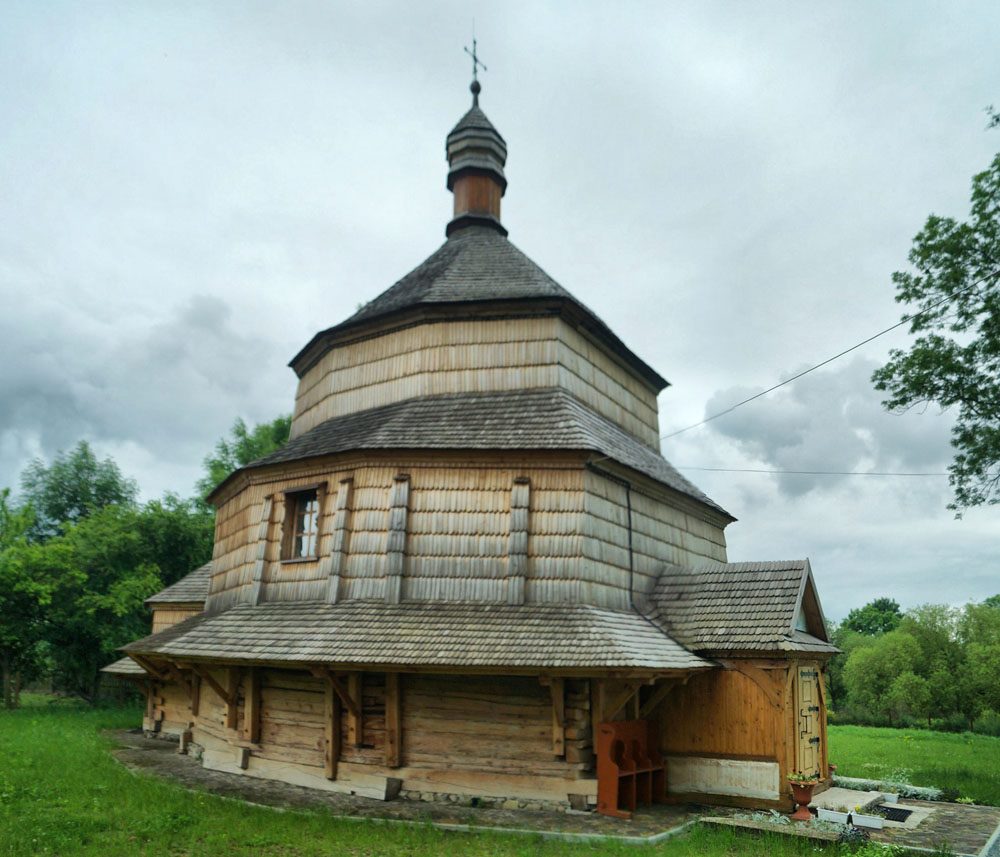
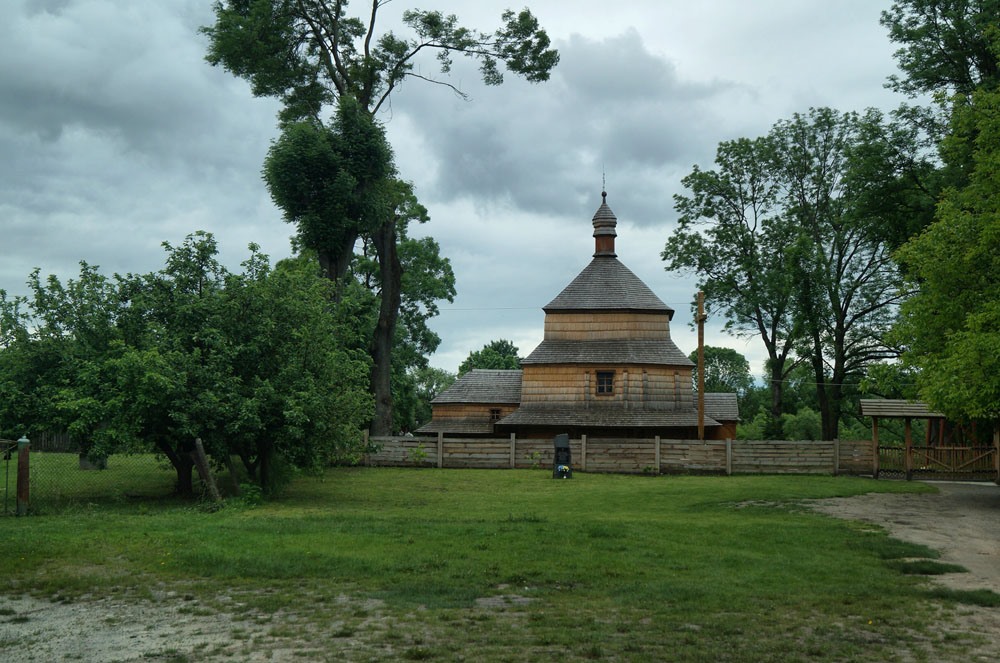
TheChurch of St. Paraskeva is a wooden sacred building in the city of Busk, Lviv region. It is located in the historic suburb of Dovha Storona in the northeastern part of the city. The church is included in the register of architectural monuments of national importance under the protection number 441/1. The church is not permanently functioning.
It was built in 1708 in the suburb of Dovha Storona (today: Shashkevych Street) according to an inscription on the doorway to the Babynets (translation from "Inscriptions on Wooden Churches" by V. Slobodian): "Under the protection of the Holy Spirit, the church was built this year 1708, May 19 ...". Toward the end of the eighteenth century, a folk craftsman painted the drum and the upper part of the walls using the technique of glue mural painting.
The first reconstruction of the church took place in 1807, when the walls of the altar log were raised to install a new, higher altar. In 1833, the artist Vasyl Leponovych painted two canvases for the Babynets. It is possible that in the early nineteenth century the Babynets was completed without being connected to the nave. The old doors with the jambs and the porch were moved to the western side of the Babynets. In 1889-1890, the church painting was updated by the artist M. Sirskyi. In the early twentieth century, a vestry was added to the north side of the altar. In 1963, the church was granted the status of an architectural monument. In 1983, restoration work was carried out to reconstruct the original appearance according to the project of architects Mohytych I. The Babynets and the sacristy were removed, the level of the altar walls was lowered to the original mark, and the former windows were opened. Thus, the monument has been restored to the appearance of a two-story, one-story church, which originated from Old Russian rotundas.
Today the church is in a state of disrepair. In 2007, the church was even disconnected from the electricity supply to avoid a possible fire from an electrical short circuit. The roof shingles need to be replaced, as well as some of the beams, which have either rotted or been severely damaged by pests, causing holes and cracks in the walls and the church itself to lean slightly. In 2007, design and estimate documentation was prepared for the restoration of the church, but no funds were allocated for the restoration.
In 1860, Fr. Omelian Petrushevych, the father of the president of the Western Ukrainian People's Republic, Yevhen Petrushevych, was appointed the church's pastor. It is likely that the future public and political figure and president of the ZUNR was baptized in this church.
The church was built according to the canons of folk architecture of the Galician school. It is a wooden two-storeyed church. It is built of pine beams. It belongs to a rare type of centralized buildings that resemble a rotunda in their plan-spatial structure. The central octagonal log house is elongated along the east-west axis, with a faceted five-walled log house adjacent to it from the east. The central volume is covered with an octagonal hipped roof, which is placed on an octagon with two creases and is completed with a blind lantern. The central and eastern log cabins are surrounded by a roof on attached brackets. The roof is shingled. The choirs are located in the central log house above the arch.
Archaeologists have been working on strengthening the foundations. Petro Dovhan, a researcher at the Institute of Archeology of the Ivan Franko National University of Lviv, who, together with members of the Buzhany society, is conducting an archeological study on the territory of the church, reported finding 80 ancient coins, two silver rings, and a window frame at the excavation site.