Church of St. George, Verkhnye Syniovydne
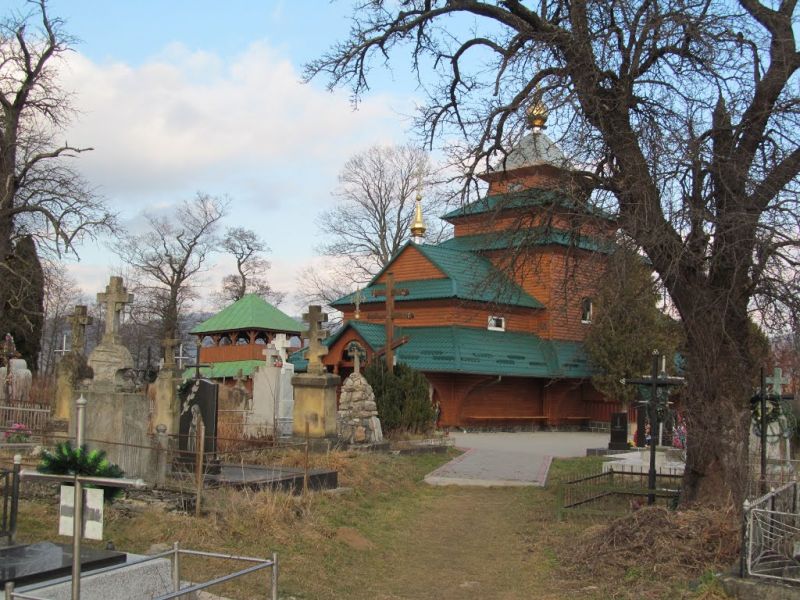
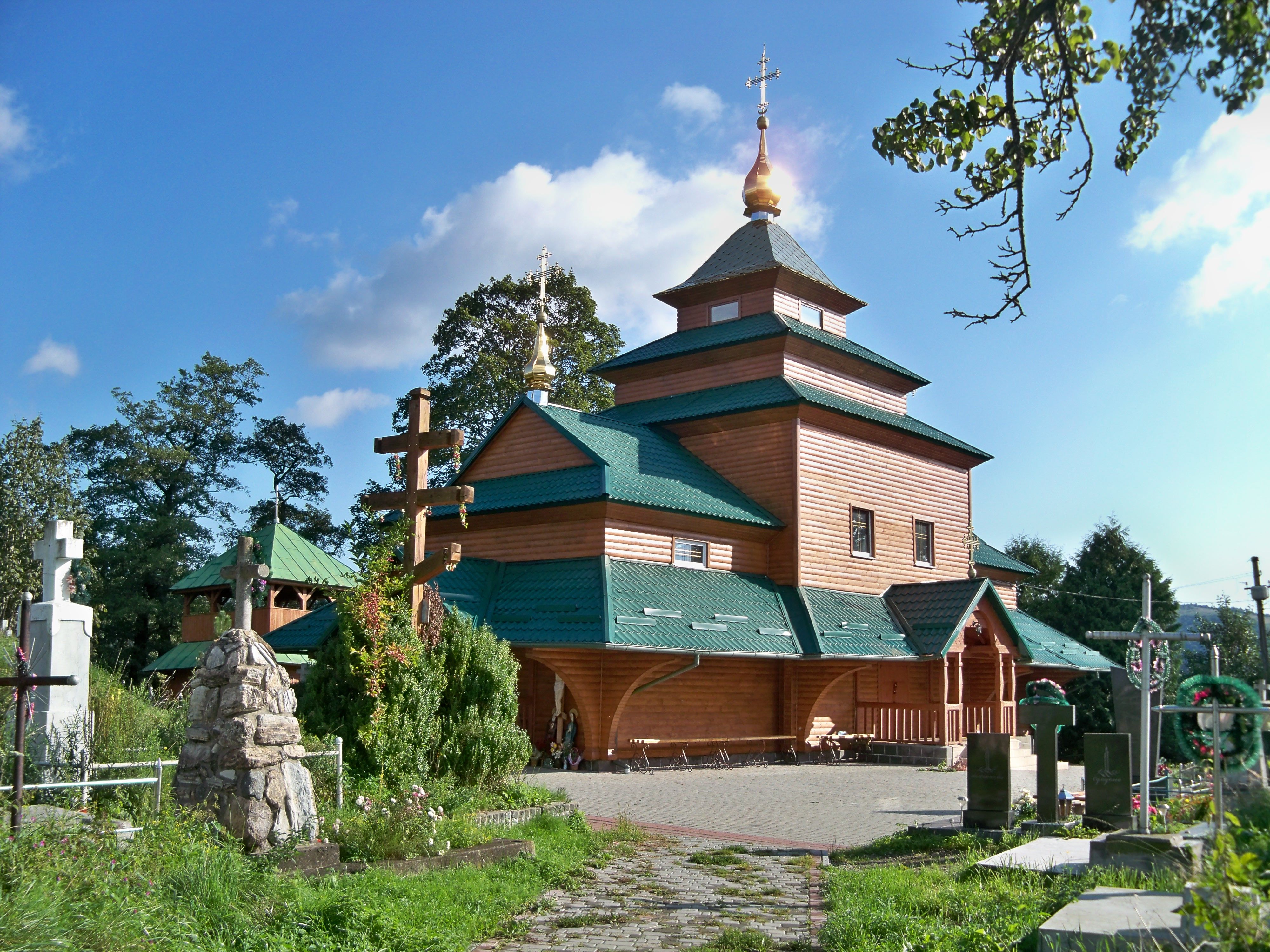
A wooden church, recognized as a historical and architectural monument, stands on the Golden Mountain. Originally, the mountain served as a signal watchtower. Later, a fortified Synevid Monastery was built on it, where Danylo Halytskyi stayed. The Church of St. George, also called St. George's Church, was built on the site of the Monastery of the Blessed Virgin Mary.
The Church of St. George in the village of Verkhnye Syniovydne is a unique monument known for its rich history. Historical sources indicate that a monastery of the Holy Virgin once existed on the site of St. George's Church. It is likely that this church was finally destroyed by a Polish nobleman in 1597. The locals built a church on the site of the monastery and named it after St. George. It was described in detail in the monograph "Ukrainian Wooden Churches" by art historian M. Dragan.
According to legend, it was here, in the monks' cells, that Grand Duke Danylo Halytskyi spent the night in 1240. He was on his way to Hungary to negotiate a marriage between his son and Queen Constance. When he woke up in the morning, he learned that Kyiv had been taken and sacked by the hordes of Batu Khan.
According to the scientist, the Church of St. Jura belongs to the earliest churches known to us from the time of Ukraine-Rus. There is an assumption that this building resembled the architecture of the famous Church of the Holy Virgin. Due to its emergency condition, St. George's Church was dismantled in 1938, and a new church was built on the site and consecrated on July 4, 1943. The architectural plan and appearance are similar to its predecessor, but it is not an exact copy. The construction was led by Mykola Barabash, a resident of Synevidchany, and designed by architect Yevhen Nahirnyi.
The new church-chapel, which was intended for funeral rites, was named after the Holy Virgin, the fortress of the Holy Virgin. The bell tower has been restored since the 18th century, but it has lost its original appearance and, consequently, its original architecture and beauty. According to the stories of old-timers, there was another old church in the village on the square, which until the 1940s was called the "cemetery". Even before the outbreak of World War II, several stone tombstones were preserved. From time to time, some of the relatives would put wreaths and flowers on the graves. In 1860-70, the church burned down as a result of a lightning strike. The community decided to build a brick church on the same site. Bricks and other building materials were brought in, but due to the fact that in 1880 the construction of a new highway began, they decided that the church should stand near the highway, so they exchanged a plot of land with Tymko Turchyn and in 1882 began construction of a new large brick church, the largest in our neighborhood. It was consecrated on January 19, 1886. At first glance, it looks like a Latin church, but in fact the architecture was borrowed from Zakarpattia.
The building, which began to decay, underwent numerous repairs and restorations. It was completely rebuilt in 1939. But despite this, the wooden church has retained its original appearance, so it is still a vivid example of Galician architecture. Today it is under the protectorate of the Kyivan Patriarchate.
The church was closed from 1946 (1948) to 1988. The following year it was re-consecrated in honor of the Virgin Mary. In 2005, the church acquired a throne, which stands in the central part of the church. It is made in the Gothic style.
The shrine is located on a ridge near the cemetery. It is a three-story, one-story church in the Boyko style. The main axis has an unconventional north-east-south-west direction. The altar and chancel are slightly narrower than the nave. The building is surrounded by a wide porch. The entrances to the church from the west to the narthex and from the south to the nave are covered with gable roofs on wooden pillars. The walls under the chancel consist of an open log cabin, and above the chancel they are vertically planked with planks with platbands (the nave is planked only). During the last renovation in 2006, all windows were replaced with plastic ones, and the roofs were covered with metal tiles. The nave is completed by a four-bay nave with two folds, covered with a pyramidal top with a crown.
Two priests are buried in the altar crypt: "о. Julian Levynskyi (1868-1944), parish priest of Synevidsk Vyzhnyi from 1918 to 1944. Grateful parishioners".
Another tablet: "Here rests the parish priest of Synevidsko Verkhne, Fr. Ivan Klyufas (1894-1965)." To the west of the church there is a wooden two-tiered bell tower covered with a tent roof dating back to 1790.
An old cemetery is located next to the church. By the way, the ruins of the old monastery and the remains of earthen fortifications, so attractive to lovers of antiquities, have been preserved to this day.
Accommodation around Church of St. George, Verkhnye Syniovydne:


Nearby hiking trails near Church of St. George, Verkhnye Syniovydne:
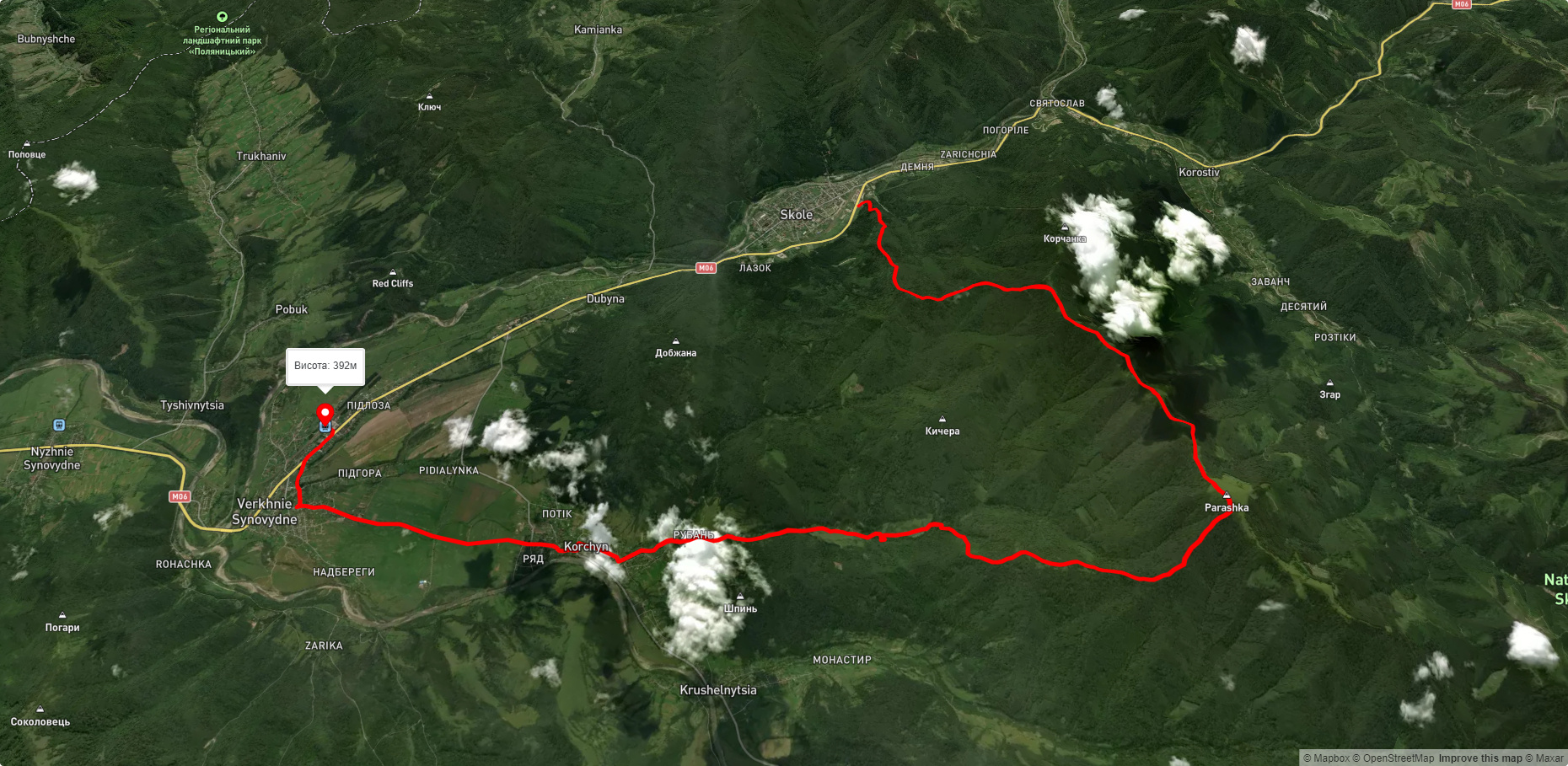
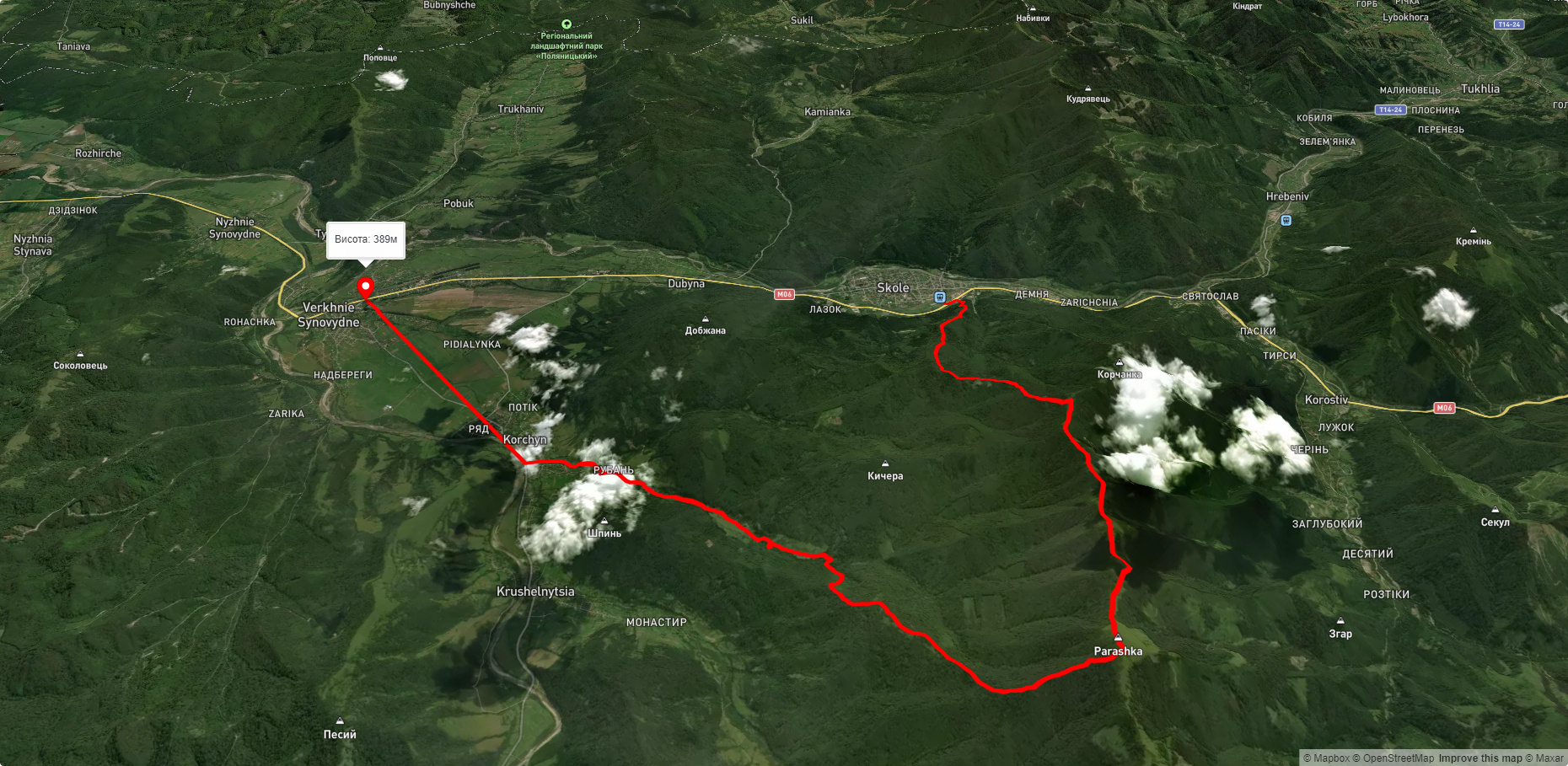
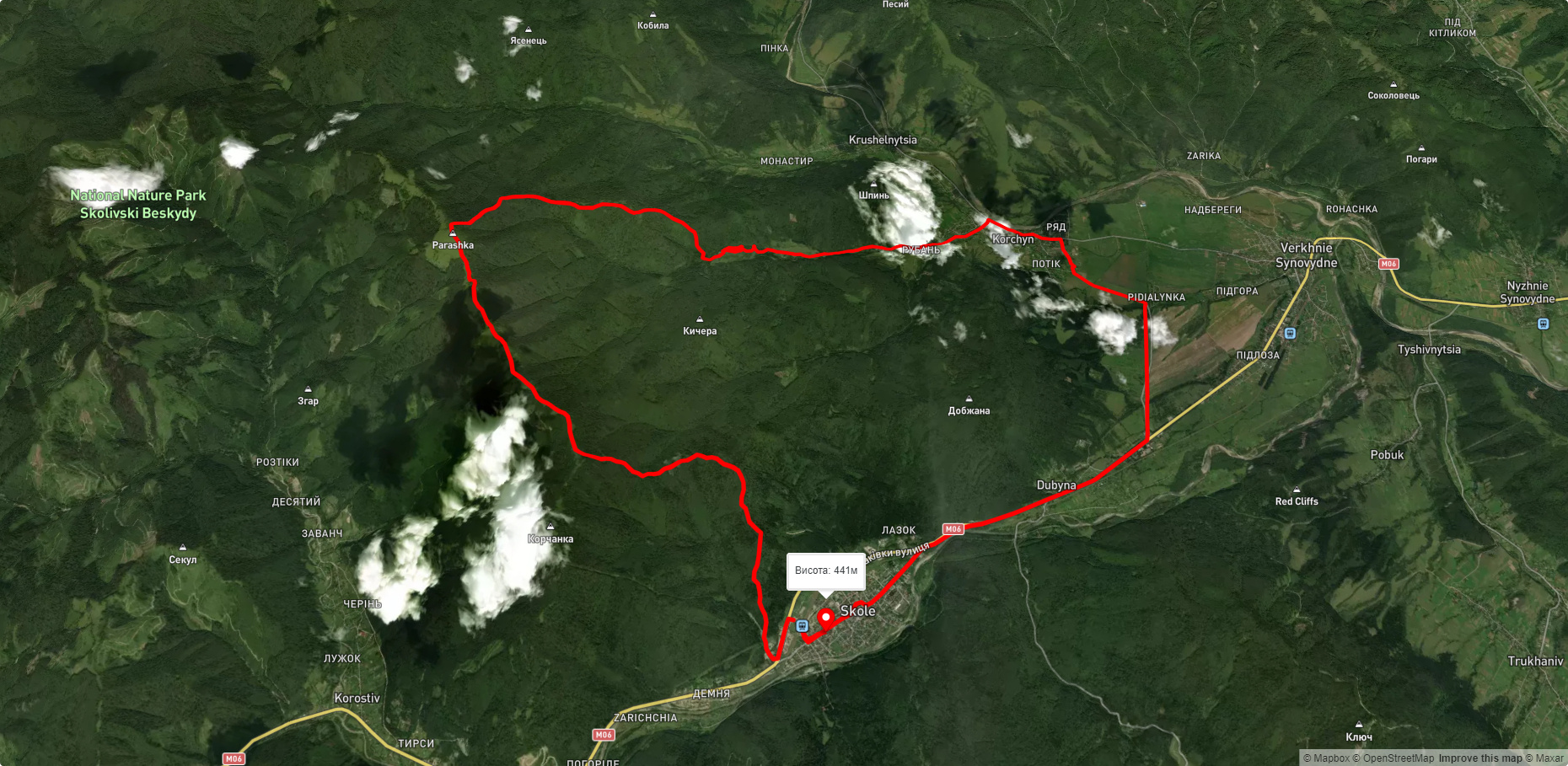
Які маршрути проходять повз Church of St. George, Verkhnye Syniovydne?
Пропонуємо пройти такі туристичні (пішохідні) маршрути через/біля Church of St. George, Verkhnye Syniovydne: м. Сколе, через г. Парашка, вдсп. Гуркало, с. Корчин до с. Верхнє Синьовидне, м. Сколе, через г. Парашка, вдсп. Гуркало, с. Корчин до с. Верхнє Синьовидне, м. Сколе, через г. Парашка, вдсп. Гуркало, с. Корчин до м. Сколе, с. Кам'янка, через г. Лопата, м. Сколе, г. Парашка до с. Крушельниця, с. Труханів, через г. Ключ, оз. Журавлине, вдсп. Кам'янка до м. Сколе, м. Сколе, через г. Лопата, вдсп. Кам'янка до с. Дубина