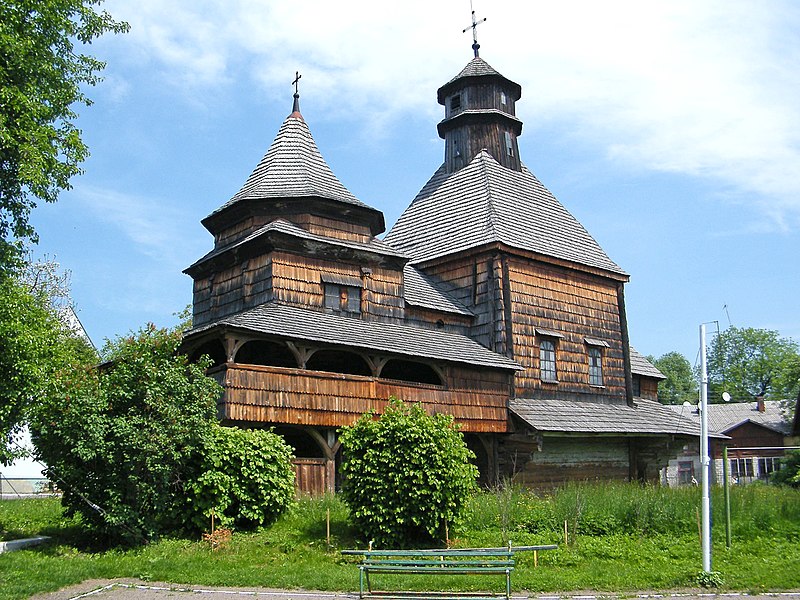
Church of the Exaltation of the Holy Cross, Drohobych
Drohobych is located about 70 kilometers from Lviv. This ancient and beautiful city is famous for its salt production and a large number of architectural and natural monuments. One of the symbols of Drohobych is St. George's Church, which is a UNESCO World Heritage Site. Next to this church is the equally interesting wooden Church of the Exaltation of the Holy Cross, an architectural monument of national importance, with protection number 378/1. It is located in the suburb of Zvarychi at 16 Zvarytska Street. Since 1987, the church has been a part of the museum complex of the Department of Wooden Architecture Monuments of the Drohobych Museum.
TheChurch of the Exaltation of the Holy Cross in Drohobych is considered one of the best examples of Galician wooden architecture and was once the parish church of local salt miners. The first mention of it dates back to the end of the 15th century. But in 1499, the church disappeared in a fire after a Tatar army attacked Drohobych. Later, it was decided to build a new church on the site of the old one. It is not known for certain when exactly the Church of the Exaltation was built. However, researchers believe that the church was built in 1661 (as evidenced by an inscription at the entrance to the choir).
The history of this church is closely connected with the priest Vasyl Hlibkevych, who painted miraculous icons, lived and ruled here. The church was first mentioned in documents in 1496. In 1499, it burned down during a Tatar attack on the city. Old sources do not have an exact official date of construction of the existing church; the year 1661 was often mentioned, and this date was used in the early registers of architectural monuments of the Ukrainian SSR, and an inscription has been preserved at the entrance to the choir: "created on the 6th day of July, 1661". Now, according to the inscription found on the nave bow, the official date of construction is 1613. Although some researchers suggest that in 1613 it could have already been rebuilt, so according to their version the date of construction falls on the end of the 15th century - beginning of the 16th century. In 1961 the church was closed. The church was restored in 1970-1971 (by architects Ivan Mohytych and Ihor Starosolskyi, artists A. Erko, Petro Lininskyi, and Natalia Slipchenko) and turned into a museum object.
Although it is now a museum, the church is closed almost all the time, awaiting restoration. The only exception is the church holiday on September 27, when a service is held in the church.
The church is three-domed and was originally one-story. In 1661, the chapel of St. John the Baptist was built on the emporium above the narthex with access to an open outdoor gallery, making it two-story. After the reconstruction, the church acquired some unusual features due to the fact that the emporium (chapel) is not located directly above the narthex, but is pushed forward in the western direction and hangs on pillars outside the walls of the narthex. The church's peculiarity is its unusually wide porch, which covers only the altar and nave of the church, and the Babynets is surrounded by a huge open gallery with a gully located at the level of the choirs. Above the nave, in the center of the church, a middle log house with a tetrahedral pyramidal top rises from the outstretched wings of the dome as a clear prism. The low five-walled altar emphasizes the scale of the large central part of the church. The church's facade bears an inscription engraved in 1711: "It is like standing in heaven in the holy church." Some changes were made during the renovation of 1715.
From the 15th century, the log cabins of the altar, nave, and narthex have been preserved to the height of the crowning cornice. The chancel and arcade are newer. They were destroyed and rebuilt. Perhaps because of a fire, because there are burnt beams, as if the church caught fire from lightning (burning from above). The church was thoroughly repaired in 1715, and weighted (put on a new foundation) in 1823.
In the Church of the Exaltation of the Holy Cross, the ratio of the heights of the premises and their spatial unification were solved in an original, new way. This was facilitated by the construction of an emporium on the second tier. Before entering the church, the visitor must pass through a low narthex, its height is 2.25 meters. When one enters the narthex from the low vestibule, one immediately perceives, in contrast to the vestibule, the great height of the nave, about 12 m, and the deep perspective from the nave into the nave and through the triangular cutout in the eastern wall of the nave into the altar room. The church is 17 meters long.
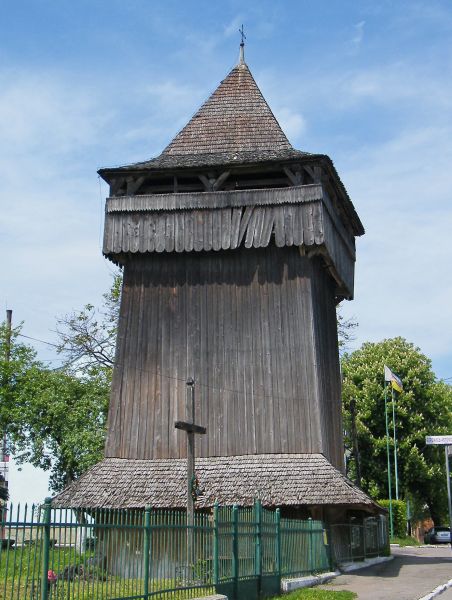
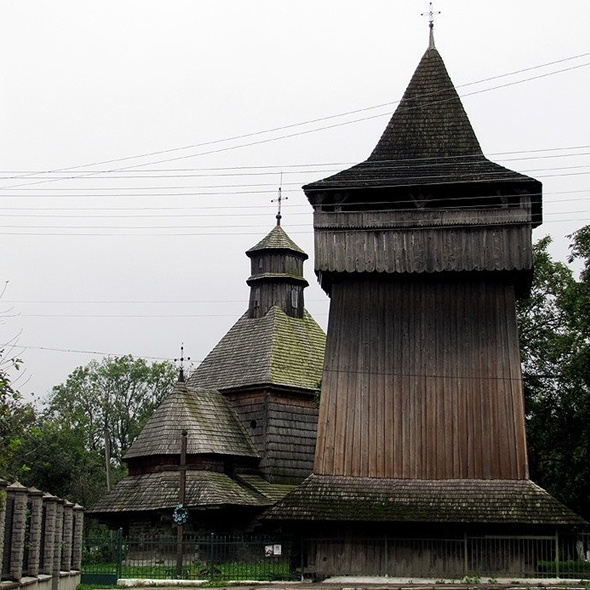
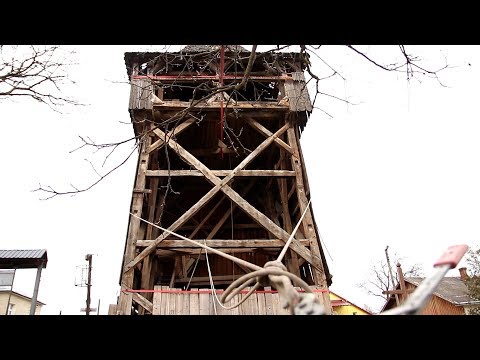
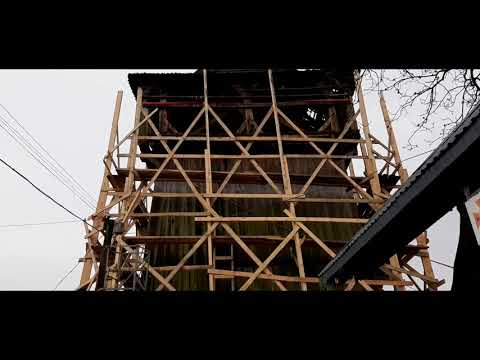
To the northwest of the church there is a three-tiered pillared bell tower of the defensive type, covered with a high tent, its height is 25 m. A tall, wooden, square in plan, three-tiered, frame building covered with a tent roof. It was built in the second half of the 17th century. On the third tier, under the tent, there is an arcade with voice boxes for releasing the sound of bells and a pitched roof that resembles a defensive tower. The walls are lined with boards, and at the level of the first tier the bell tower is surrounded by a canopy.
The Church of the Exaltation has something that is not repeated anywhere else in Galician churches: preserved paintings in the altar area. The interior of the Church of the Exaltation also impresses with its austere simplicity and grandeur. The church's mural paintings date back to different times: the altar has a painting from the early 17th century by the master Hryhorii (according to other sources, the author of the older part of the iconostasis is Fedko and his student), and the chapel on the emporium was painted in 1672 at the expense of Ivan Kobrynovych. In 1735, the wall separating the nave and the altar was painted on the theme of the Martyrdom of the Apostles. At the entrance to the church, there are also ancient paintings with the faces of saints. There are few windows in the church, so they give little light and the strong local colors of the paintings are softened by the semi-darkness, from which the gilded details and silver flanks of the icons sparkle.
There is no precise information about who was the author of the Vozdvyzhensky murals, but their connection with a certain circle of artistic works should be pointed out. In terms of style and character, even "handwriting" and small details, these paintings are closest to the engravings of Heorhiy, a master of the first half of the seventeenth century whose work was associated with Lviv. In Heorhiy's engravings for the Gospel of 1636, published in Lviv at the printing house of Mykhailo Slyozka, there are many characters with the same large facial features, and the forms of the ornament are monumental.
The iconostasis is four-tiered, pyramidal, and of different periods. The iconostasis of the chapel, which no longer exists, was painted in 1669 by the pop painter Stefan Medytskyi. Separate icons "Christ with the Apostles" and "The Virgin Mary" were painted in 1694 by his son, painter Ivan Medytskyi. The altar icon of St. Nicholas was painted by Fr. Vasyl in 1746, and the altar icon of Christ the Vineyard Worker was painted by Vasyl Hlibkevych in 1753. The carvings of the iconostasis use motifs of Renaissance art.
The Church of the Exaltation of the Holy Cross in Drohobych has been rebuilt several times, so it has not survived to this day in its original form. However, today this wooden church is one of the best examples of Galician folk architecture. Of particular value are the ancient paintings with the faces of saints that adorn the walls of the church gallery, the entrance to the church, and the portals in the exteriors.
In 1961 the church was closed, and 10 years later it was restored. At present, the Church of the Exaltation of the Holy Cross is still closed (another restoration is planned). However, there is only one day when a church service is held in the church - on September 27. Since 1987, the church has been part of the Drohobychyna Museum Complex.
Accommodation around Church of the Exaltation of the Holy Cross, Drohobych:


Which trails pass by Church of the Exaltation of the Holy Cross, Drohobych?
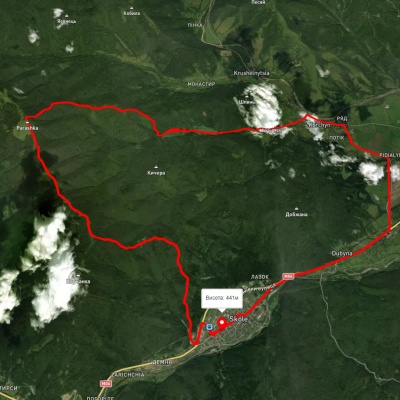
We suggest these hiking trails through or near Church of the Exaltation of the Holy Cross, Drohobych: Sopit village, via the Sopit polonynas to Sopit village, Korchyn village, via Hurkalo Waterfall and Mount Parashka to Krushelnytsia village, Kamianka village, via Mount Lopata, Skole and Mount Parashka to Krushelnytsia village, Korchyn village – Hurkalo Waterfall, Skole, via Mount Parashka, Hurkalo Waterfall and Korchyn village to Skole, Skole, via Mount Parashka, Hurkalo Waterfall and Korchyn village to Verkhnie Synovydne village


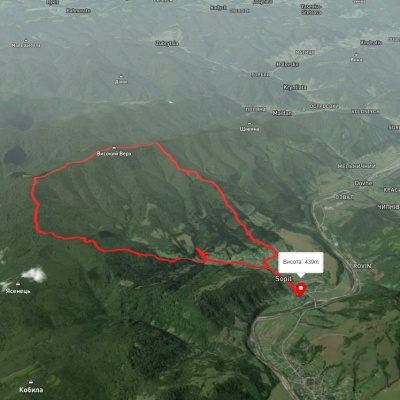
Sopit village, via the Sopit polonynas to Sopit village
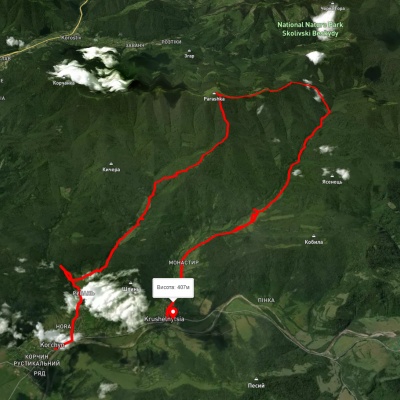
Korchyn village, via Hurkalo Waterfall and Mount Parashka to Krushelnytsia village
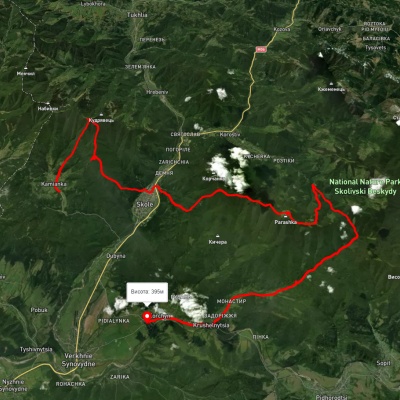
Kamianka village, via Mount Lopata, Skole and Mount Parashka to Krushelnytsia village
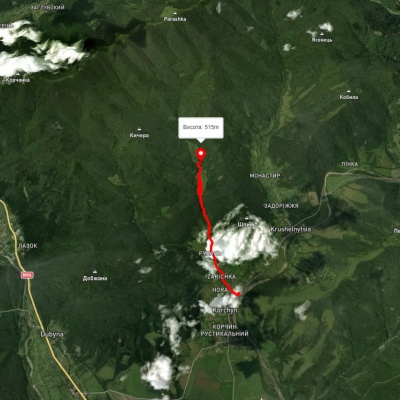
Korchyn village – Hurkalo Waterfall