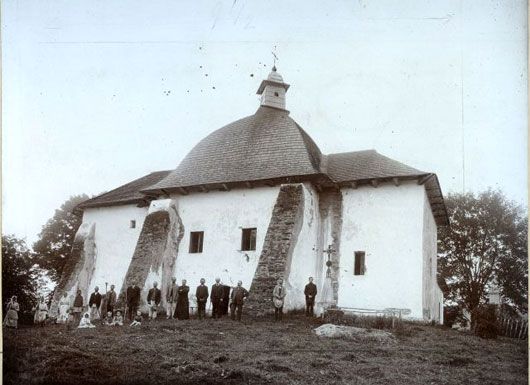
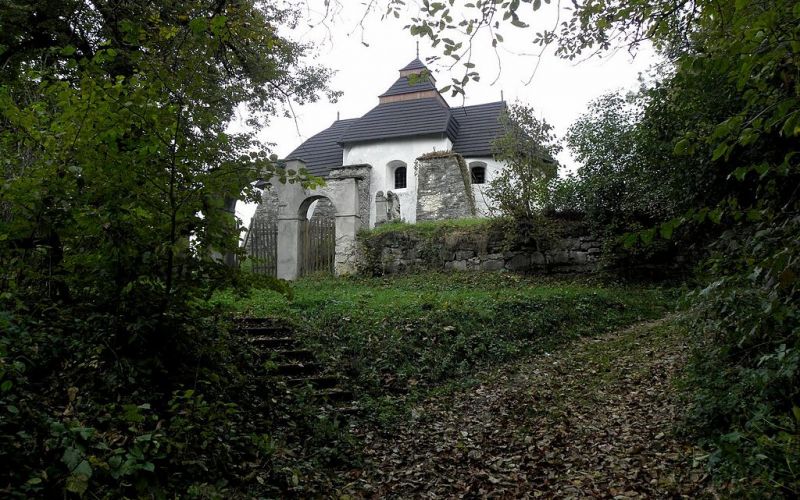
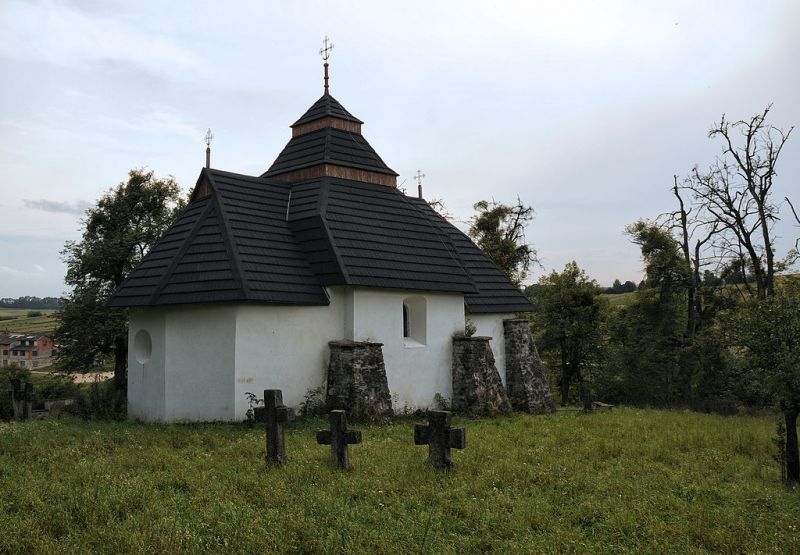
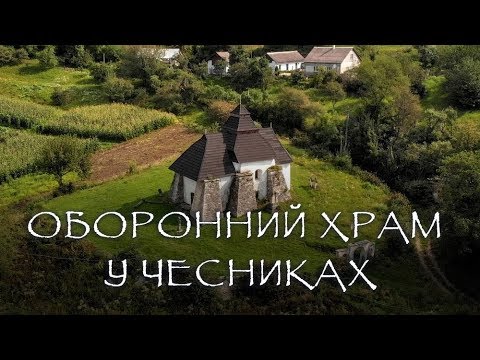
On the mountain that landscape-wise dominates the territory of the village, stands the ancient church of St. Nicholas (the name commonly used among the residents of Chesnyky - "Ascension"). This ancient and revered place of Power has a distinctly positive (protective) energy. Even upon first acquaintance with the architectural monument that now stands at this site, it is noticeable that it resembles churches built in the first centuries after the Mongol invasion of the 13th century. Powerful buttresses made of rough stone support the massive squat cube, the walls of which were constructed with a defensive function in mind. There are sources that claim that the church in Chesnyky is even older - dating back to the 12th - 13th century. Archaeologists also suggest that the Christian temple of the Ascension was built, as was often the case at that time, on the foundation of an ancient pagan shrine. The official first mention of the church of the Ascension in the village of Chesnyky dates back to 1598. However, researchers are convinced that it was built much earlier.
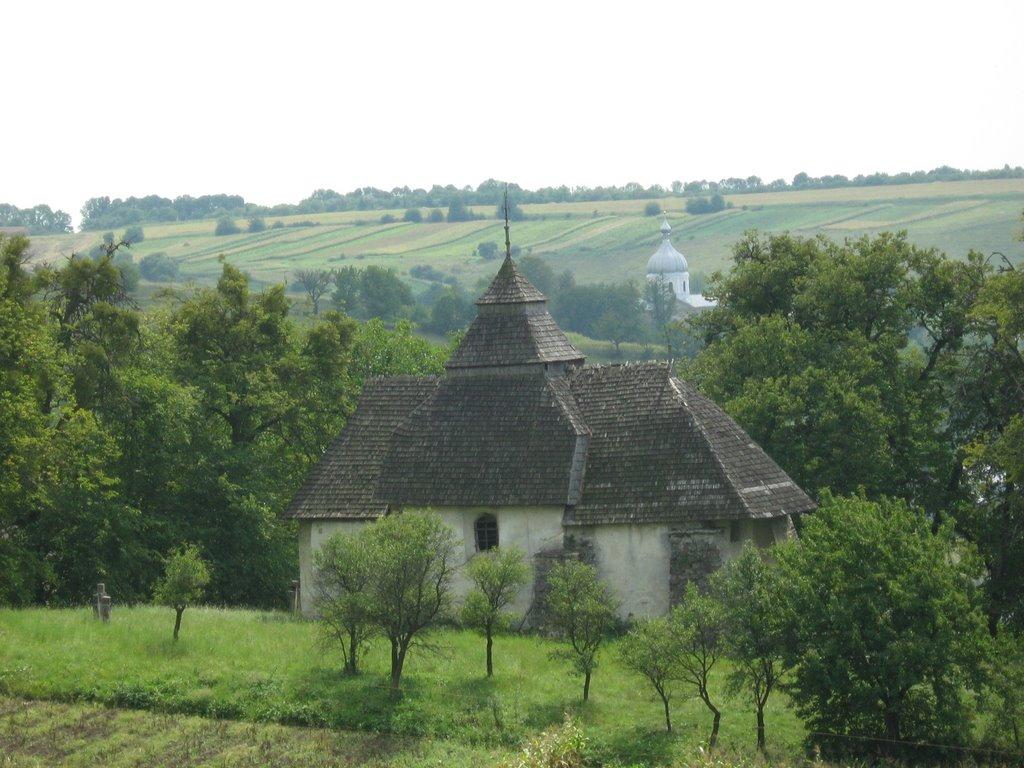
The church rests on a circular platform, paved with stones, which most likely served as the foundation for a defensive wall. Everything indicates that this temple witnessed the darkest times in the 14th and 15th centuries when Ukrainian villages were constantly on the lookout for attacks from Crimean and Nagay horse brigands. When every church, if necessary, turned into a fortress, whose strong walls and gracious energy provided protection not only for peasant families but also for livestock, which were hidden from Tatars and robbers behind the defensive perimeter. The walls of the church of the Ascension were additionally surrounded by a moat and rampart, making it a "hard nut to crack." A local legend tells of the knight Jan Chesnovsky, who from the church bell tower of the Ascension temple timely spotted a band of Tatar robbers and, with the help of the villagers, repelled their attack. In honor of the knight, the mountain near which the armed clash took place is named Janova.
There is unrefuted evidence that the cult purpose of this place dates back to very ancient times, even before the baptism of the Galician land. In particular, the platform on which the temple stands resembles altar platforms dedicated to Khors and other solar deities of the pre-Slavic pantheon. People lived in this area as early as the 1st millennium BC. The remains of ancient settlements were first uncovered by a flood caused by the Hnyla Lypa River in 1853.
Solar motifs are present in the decoration of the stone crosses set up near the temple. The mystical octagonal rose (rosette, star) in the center of the cross can also be interpreted as a sacred sign of the sun. Undoubtedly, the symbolism of the flower in the center of the cross is universal and pre-Christian. The cross here represents the intersection of the material world (the horizontal of the cross) with the Spiritual vertical. The renunciation of earthly passions and the discovery of inner harmony allows one to ascend to the Earthly Paradise - the Spiritual vertical, to embark on the Spiritual path.
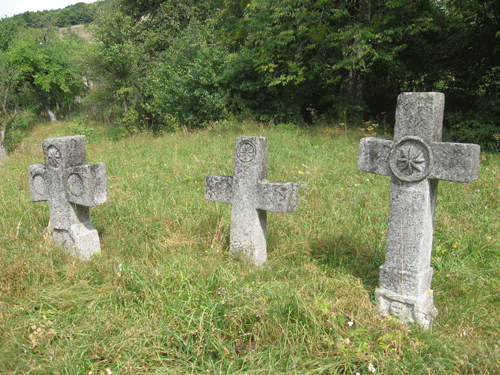
The flower (lotus) in the center of the cross is a yantra for meditation among Buddhists. The eight-petaled flower in the center of the cross is a mystical pre-Christian symbol of earthly Paradise and cyclical time from Birth to Death-Resurrection-Rebirth. The rose in the center of the cross is also a symbol of Islamic mystics - Sufis. This symbol was adopted by medieval European mystics-healers - Rosicrucians. Furthermore, the eight-petaled flower also represented a kind of calendar among the Celts. Among the Celts, the year was divided into 8 periods, symbolizing cyclical time - from Birth and growth to the period of wisdom, fading, and then - Death-Resurrection-Rebirth. And the circle around the flower is a symbol of cyclical time. (Let us recall the Celtic cross with the circle-calendar).
Legend of the Rosicrucian Monk
There is an ancient legend that somewhere in the area of Chortova Hora, there is a secret burial of a member of the Order of the Knights of the Rose and the Cross, who came to the Galician lands in the late seventeenth century, gathered unique medicinal herbs from the area, and cared for the health of the local residents. Perhaps he was hiding from persecution, or perhaps he came at the invitation of like-minded individuals - it is not known for sure. This legend resonates with the mention of a mysterious monk who, during an epidemic, allegedly advised villagers to eat garlic and also prepared special healing garlic tinctures, which supposedly gave rise to the toponym "Chesnyky." The fact that the place of Power is marked by crosses with roses, characteristic of the burials of members of the order of wandering healers, seems to confirm this legend.
Source: News Agency http://firtka.if.ua/