Bernardine Monastery, Hvizdets
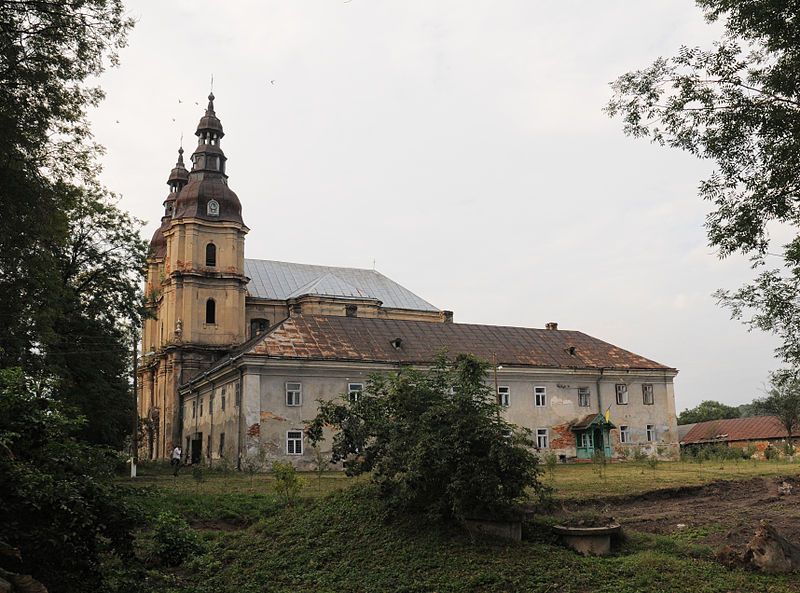
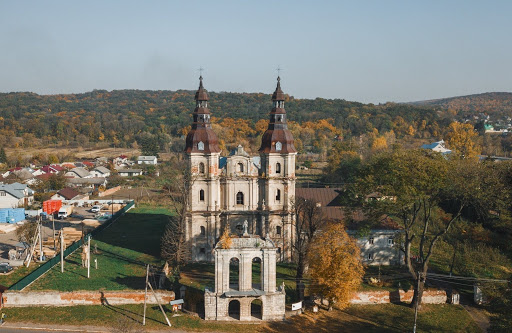
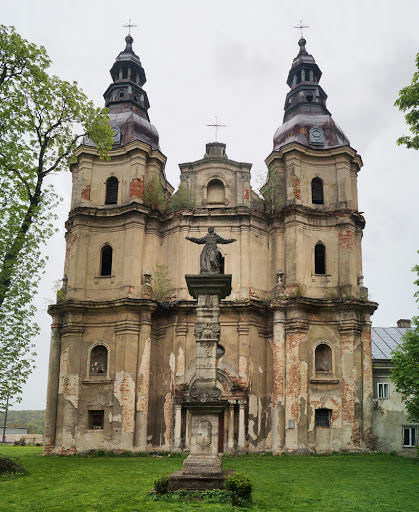
The Bernardine Monastery and Church in the village of Hvizdets, Ivano-Frankivsk Oblast, was built in 1723-1735 in the Baroque style and is located to the north of the former market square. It is now surrounded on all sides by private buildings, but the large area around the complex itself is still free. A wide street runs in front of the facade, and the rear part of the territory faces the railroad with a smooth slope, where the village's railway station is located.
The first mention of the parish in Hvizdka dates back to 1475, when the first wooden Catholic church was founded. It existed for about 150 years, but in the early 17th century, when destructive Tatar attacks on our lands became more frequent, the church was destroyed and fell into disrepair. This lasted for about 100 years, until in the early 18th century a favorable situation arose for the restoration of the shrine.
In 1715, the owner of the town, Prince Michał Puzyna, received the consent of Lviv Archbishop Jan Skarbko to settle nuns in this place. In the same year, a wooden church was built. Subsequently, Sofia Puzyna of the Potocki family took care of the development of the monastery. In 1728, this wooden church was destroyed by fire, and as a result, it was decided to build a new brick church, which, with some alterations, still exists today. The construction of the church, which was completed in 1735, was supervised by Father Jablonowski. Between 1735 and 1742, the interior was decorated, and in 1759 a column with a statue of St. John was installed in front of the facade. During the 18th century, numerous donors from among the nobility donated funds for the church's decoration, new altars were built, paintings and gilding were done.
In the middle of the 19th century, the Horodenkiv Deanery was founded and in the period 1870-1900 it intensively developed and expanded its activities. In particular, churches were built in the surrounding villages, served by priests from Hvizdets. Unfortunately, most of these churches have not survived; they were destroyed or completely rebuilt during the Soviet era.
Historical documents show that in 1838 and in 1880 the church underwent restoration and renovation work. However, in September 1888 the church was severely damaged by fire. As a result, the roofs and the Baroque tower were lost, and as a result, restoration and renovation work continued until 1892. In particular, the altars were replaced with new ones, the modern entrance portal dates back to 1890, and the organ to 1896. The sisters from the Yazlivtsi Convent also contributed to the decoration. Unfortunately, very soon, in 1896, another fire broke out here again, and the church had to be rebuilt once again. The gate bell tower that we see today was completely restored in 1899-1902. The church's towers and roofs were significantly damaged during the First World War. Shortly after the war, they were rebuilt according to the design of Jerzy Kosiński, at which time the church was restored to its original Baroque tower finials.
The church survived the German occupation during World War II without major losses, but the church bells were confiscated for melting. After the end of World War II, the monastery's premises were used as a construction warehouse, later as a granary, and in the cells, first as a hospital, then as a music school, and a library. With the proclamation of Ukraine's independence in June 1992, the church was re-consecrated. Now it is a functioning church, but as of 2018, almost no restoration work has been done due to lack of funds.
The Bernardine Church of the Immaculate Conception of the Virgin Mary in Hvizdka is a brick, plastered, single-nave church with a short transept. The church, measuring 36x15 meters in plan, is mostly made of brick, but some elements are made of stone. The baptistery and the monastery building are adjacent to the presbytery on the south side. The most richly decorated exterior is, obviously, the façade of the church, with intricate Baroque curves. The lower tier of the façade contains small windows, and the most eye-catching feature is a small but exquisite portal with four Corinthian columns. In the upper part of the portal, on a small pediment, there is a niche where there was probably a painting, relief, or table. The lower tier is also decorated with several more round and faceted pilaster columns. The second tier of the façade, separated from the first by a cornice, is somewhat simpler. It repeats the curves and columns of the first, but has much larger windows and small stone vases on the cornice. Between the towers is a small pediment decorated with images of the All-Seeing Eye and the Eucharistic Chalice. There is also a central niche where the figure of the Blessed Virgin Mary once stood, and small volutes along the edges. The façade used to be decorated with wooden figures, but now there are only empty niches: the figure of the Virgin Mary was taken inside, and the rest are in the art museum in Ivano-Frankivsk.
The two identical towers of the church are currently covered with tin, have a complex tiered shape, and are topped with crosses. The lower tier of the towers is masonry, quadrangular with curved sides, similar to the walls below. The tin is rusted and needs to be replaced. The decoration includes octagonal light drums on wooden columns, blind pseudo-lucarnes, and small oval windows. The tops of the towers, although added much later, fit surprisingly well into the overall appearance of the church, as they correspond to the original Baroque tops. From the side of the nave, which is much narrower than the façade (niches were formed behind the towers), the church looks powerful and austere. It is practically devoid of decoration, with only small pilasters enlivening the walls. The corners of the transept are slightly rounded, the upper tier has large rectangular windows, and the lower tier has only small windows. This arrangement suggests that in the past this church was not deprived of certain defensive functions, like many other slightly older churches. The sanctuary is supported by powerful buttresses, and a large auxiliary room is attached to the side. The low hipped roof over the nave is fortunately in good condition; it looks like the tin was replaced with a new one not long ago. The signaling tower at the intersection of the nave and the transept is missing, or perhaps it was lost.
The interior of the church has preserved little of its former grandeur. In the transept and presbytery, the walls are separated by numerous pilasters that support the cornices protruding above them. The nave, presbytery, and transept have rectangular windows surrounded by frames, while in the lower part of the nave the windows are rather small and oval. There is a door near the sanctuary that leads to the cells; this entrance is decorated with an interesting carved portal. The organ choirs are supported by two columns; only a wooden frame remains of the once majestic organ. A small oval window can be seen above the pediment. In general, the church is dominated by vertical lines, as if it is rushing upward, with only countless cornice projections dividing it into tiers both externally and internally. Inside, there are remnants of moldings and murals, mostly geometric, but the most valuable are several wooden altars and a wooden cauldron. The most remarkable is the main altar, decorated with numerous columns, with figures of saints on top, and a statue of the Virgin Mary in the center, which was apparently once a globe. The side altars in the transept are also highly artistic, designed in the same style as the main one. The altars retain the remains of gilding. The vaults are crossed, riddled with numerous cracks...
The building of the Bernardine monastery cells is 20x30 meters in size, brick, plastered, two-story, and together with the church forms a miniature square courtyard with several small trees. From this courtyard along the walls there are internal corridors with windows, behind which cells are located. On the ground floor, there is a service room in the western part and rooms in the southwestern corner. The southern wing of the monastery housed an office, a salon, an archive, etc., and the eastern wing housed a kitchen and a hayloft. The second floor is occupied mainly by rooms with hallways, and in the eastern wing there is a storeroom and a salon. Inside the monastery are curved cross-shaped vaults. Several small, but pretty, lucarnes still survive on the rusted roof of the building. As of 2018, the premises still house a children's art school and various institutions. The second floor was significantly rebuilt, the rooms were redesigned, and some of the vaults were destroyed and replaced with modern ceilings.
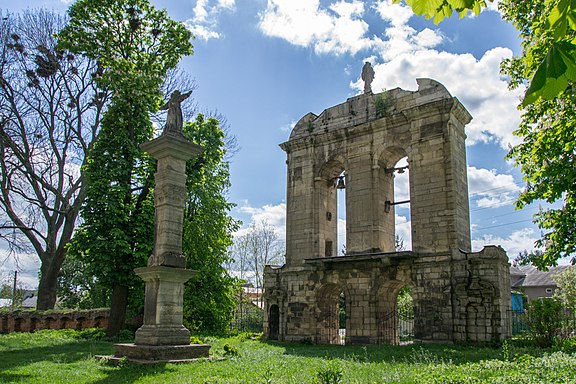
In front of the church facade, in the center, stands a relatively low, massive column with the figure of St. John of Dukla (1759). The column is two-tiered, mounted on a wide stepped pedestal, reminiscent of similar but much more "slender" structures, such as those in Pidhirtsi or Pidkamin. It contains several cornices and capitals with stone carvings, and St. John himself stands in monastic clothes, in a prayerful pose with his arms outstretched.
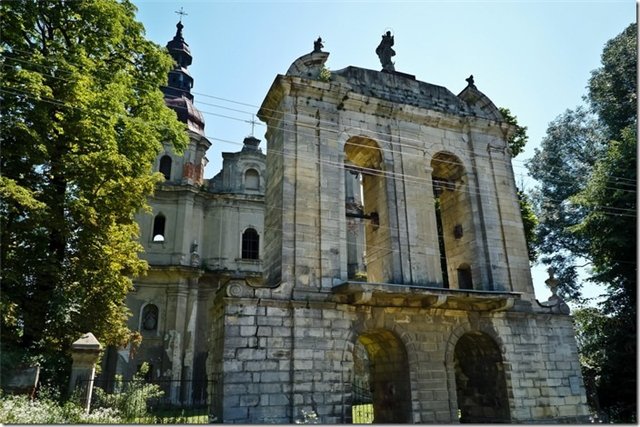
An integral part of the complex is the gate bell tower (1776 - 1778), which was rebuilt, as mentioned above, at the turn of the nineteenth and twentieth centuries in the Neo-Baroque style. It is made of brick, has two tiers, and two entrances, with its upper part being much narrower and divided by pilasters. Unlike the church, the bell tower is made of stone. The lower tier has two small passageways with arched ends, closed by wrought-iron gates. It is decorated with rustication, which, despite its regular shape, imitates a "wild" stone. To the right and left of this tier are small volutes and one decorative vase, the other has not survived. From the inside of the building there are two more entrances in the form of portals, one of which leads up a spiral staircase to the balcony where the bell ringers stood while performing the melody. The other portal is deaf and was made purely for symmetry (such attention was paid to "insignificant" details in ancient times!) The second tier of the bell tower is made of rectangular stone blocks that form rectangular pilasters and two high openings for the bells. The bells were arranged in two tiers. The building culminates in an elaborate cornice, with a stone figure of the Virgin Mary in the center and two angels-putti on the sides. The Virgin stands on a ball symbolizing the earth, with a serpent and a crescent moon at her feet, and a halo of stars above her head (most of the stars have unfortunately not been preserved). The bell tower looks very harmonious, and is in fact a unique, perfect architectural work.
The entire monastery complex is surrounded by a brick and plaster wall mixed with a metal fence on the columns. The left, ancient part of the wall from the north is made of brick and contains a number of niches. Previously, they apparently housed stations of the Way of the Cross. On the sides of the bell tower there is a wrought-iron fence on masonry pillars, one of which still has a beautiful wrought-iron cross. On the right, from the side of the cells, there is another entrance; once there was a gate, but now only dilapidated columns remain. The large territory of the monastery is cleared of thickets, and some other artifacts can be found here, such as ancient burials or a stone vase. In general, such a layout of monasteries is typical for those times, one has only to recall similar buildings in Terebovlia, Ternopil, Rava-Ruska, Zbarazh, and many other towns in Ukraine.
The complex of the Bernardine monastery with the Church of the Immaculate Conception of the Virgin Mary in Hvizdka, Kolomyia district, is without exaggeration one of the most impressive buildings not only in the region but also in the entire country. Given their outstanding historical and artistic value, as well as their venerable age, the monastery and church, like a similar complex in Horodenka, are architectural monuments of national importance. Today, the church and monastery need urgent restoration and renovation work, and the walls of the complex are badly damaged and threaten to collapse. There is information that the left side of the large courtyard is being encroached upon by a nearby enterprise, which should not be allowed in any case.
Location on the map
Comments
Places to stay nearby
All stays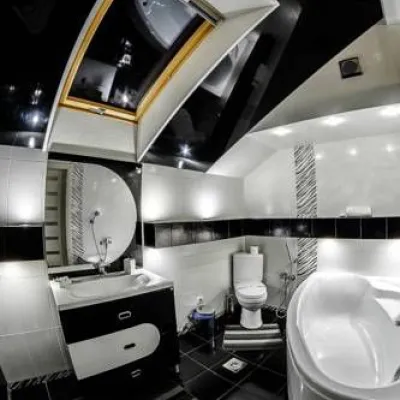 HotelHotel "Diamond De Luxe" MykulychynKolomyia19 km from Bernardine Monastery, HvizdetsParkingWi‑FiPetsNearby: Pysanka Museum in Kolomyia 300 mCity lake in Kolomyia 1.1 km
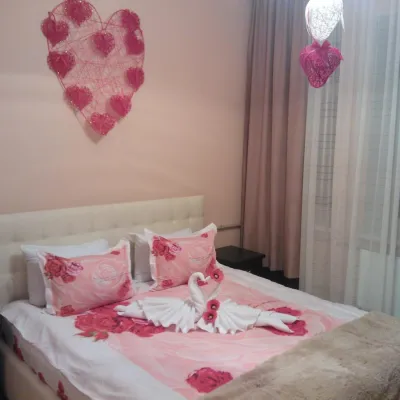 HotelHotel "Pysanka" KolomyiaKolomyia19 km from Bernardine Monastery, HvizdetsParkingWi‑FiTransferNearby: Pysanka Museum in Kolomyia 100 mCity lake in Kolomyia 900 m
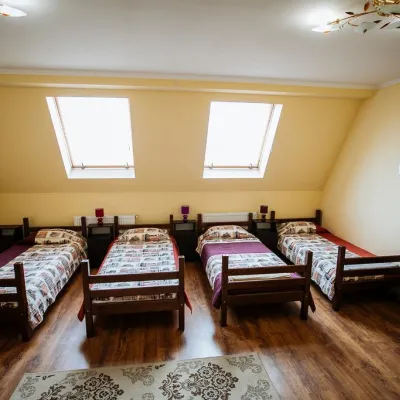 HostelHostel "Hetman"Kolomyia19 km from Bernardine Monastery, HvizdetsKitchenTransferNearby: Pysanka Museum in Kolomyia 200 mCity lake in Kolomyia 1.1 km
Nearby attractions
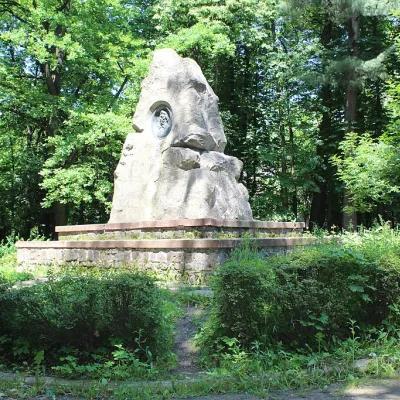 NatureCity Park of Culture and Recreation named after Kyrylo Tryliovskyi, KolomyiaKolomyia18 km from Bernardine Monastery, HvizdetsThe Park (Kyrylo Trillivskyi Park) is a park-monument of landscape art of local importance in Ukraine.
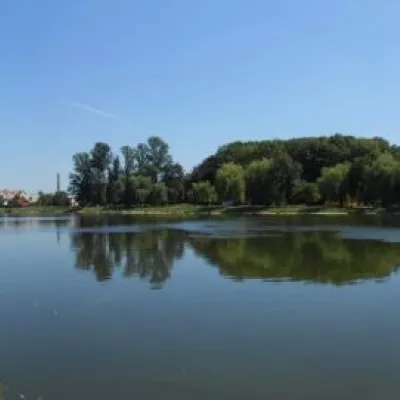 LakeCity lake in KolomyiaKolomyia18 km from Bernardine Monastery, HvizdetsAfter touring the city, it's a good idea to relax and unwind by the water. The city lake is a good place for this.
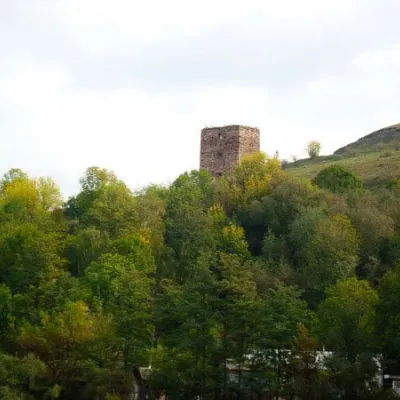 CastleRakovets Castle, RakovetsHorodenka24 km from Bernardine Monastery, HvizdetsEvery year there are more and more people traveling around Ukraine in search of unique castles. There are many "promoted" castles, such as Mukachevo Castle, St.