Assumption Cathedral (Russian Church), Chernivtsi
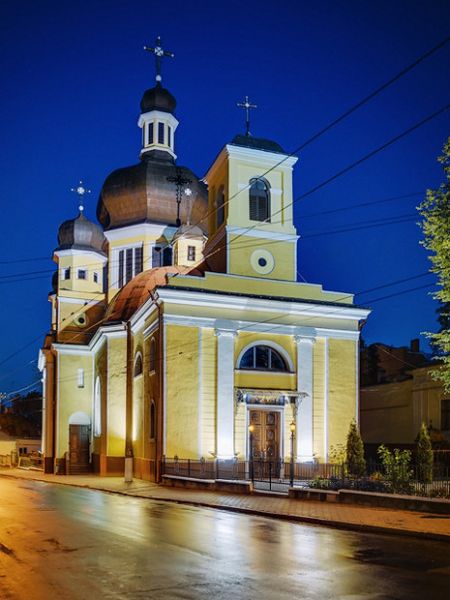
At the beginning of the 19th century, there were so many Greek Catholics in Chernivtsi that there was not enough space in the chapel. Therefore, the Assumption Cathedral was built, which is also popularly called the Russian Church.
The construction of the church is associated with the name of a Moldovan boyar of Russian (Ukrainian) origin, Tadei Turcul. At the beginning of the 19th century, he was one of the richest people in the then Bukovyna. After his death, he bequeathed large donations to the Rusyns (as Ukrainians were called in Austria-Hungary) and the Greek Catholic community for the construction of the church.
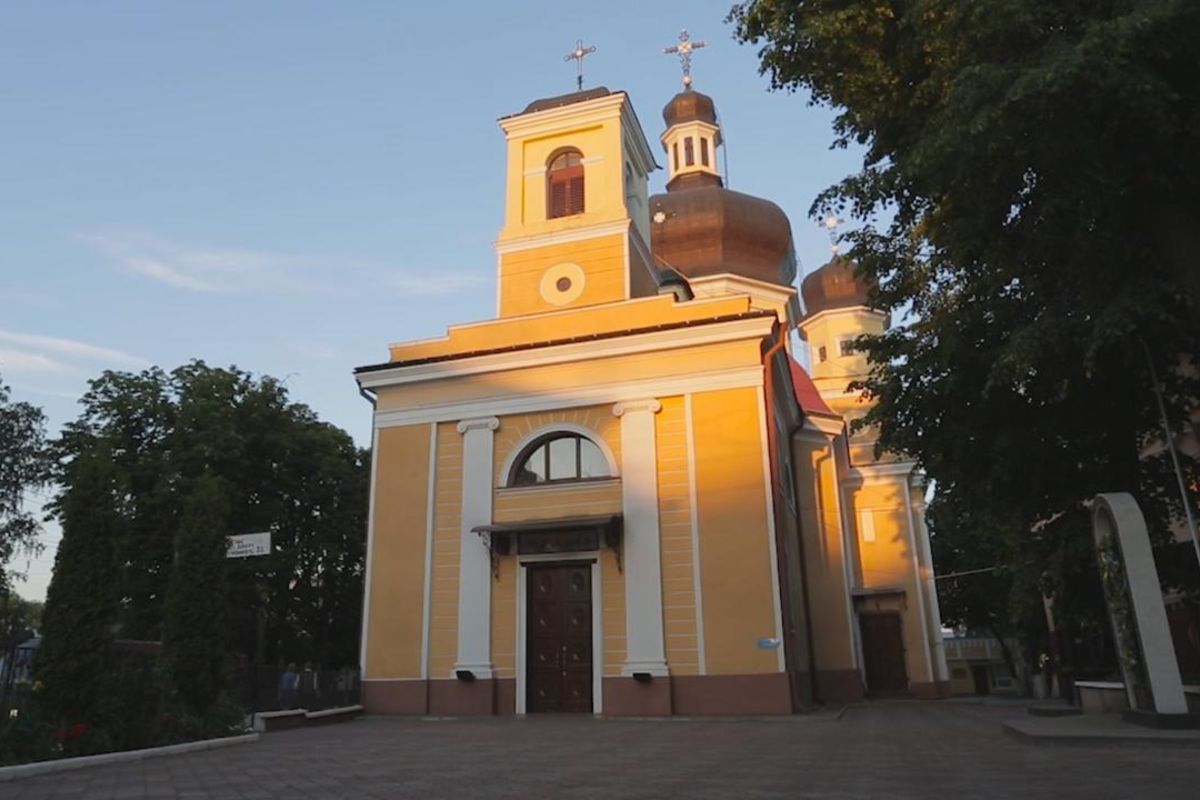
The church was built in the 20s of the 19th century in the Empire style, which was popular at the time. In the early years, it was named after St. Thaddeus in honor of the church's founder. But eventually it was re-consecrated as the Church of the Assumption of the Blessed Virgin Mary.
As this church eventually became too small for the parishioners, it was decided to rebuild it. The project was designed by Volodymyr Zalozetskyi. After the rebuilding, the church acquired the features of Ukrainian Baroque and has remained so to this day. Only the front part of the facade remains of the original church.
After Bukovyna became part of the USSR, the church was first transferred to the Orthodox Church, and in 1961 it was closed and turned into an industrial warehouse. It was officially transferred to the Greek Catholics of Bukovyna only in 1991. To this day, the Church of the Assumption remains the main Greek Catholic church in Bukovyna.
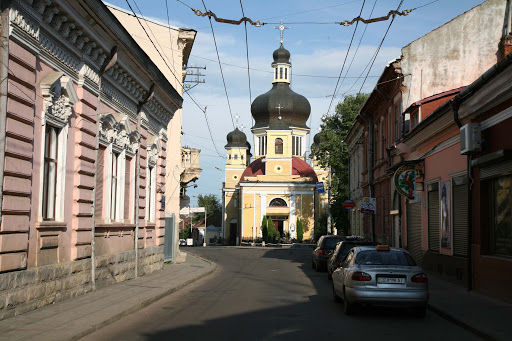
The exterior of the church consists of an old part that was preserved after the church was rebuilt, and a newer part that was actually the result of the rebuilding. The old part of the church is made in the Empire style, while the newer part has features of Ukrainian Baroque. The church is famous for its interior decorations. The main shrine of the Assumption Cathedral is the miraculous image of the Mother of God of Chernivtsi.
The church's iconostasis from the 19th century and 2 altars from the same period have also been preserved. They were returned to the church from the neighboring St. Nicholas Church, where they were kept during the Soviet period.
The Russian Church in Chernivtsi is located at 28 Ruska Street, in the very center of the city. Chernivtsi is conveniently accessible by train from Lviv, Kyiv, or Odesa, or by car from Ivano-Frankivsk, Ternopil, and Kamianets-Podilskyi. There are also regular bus services from these cities.
Openinghours: the church is open from morning until 18:00.
Chernivtsi is the capital of Bukovyna. One of the most beautiful and pleasant Ukrainian cities. Here is one of the most beautifulrailway stations in the country, theChurch of St. Paraskeva of Serbia, the Church of the Exaltation of the Cross, the house-ship, the City Hall (every day at 12:00 a trumpeter plays the melody of "Marichka" from the tower), the Art Museum, then Kobylianska Street, the German Folk House, the Armenian and Assumption Church (the oldest stone Ukrainian Greek Catholic Church in Chernivtsi), the Theater Square and the Kobylianska Theater. Kobylianska Theater Square, Jewish People's House, Chernivtsi University (included in the UNESCO World Heritage List), Turkish Square (Chernivtsi has been a part of Turkey, Modova, Romania, Austria-Hungary, the USSR, Rus, and Ukraine), and a large rover,cozy streets and cobblestone streets, the so-called Drunken Church, Nazariy Yaremchuk's house, then another house-ship, two houses with the same number (Olha Kobylianska lived here), the house where Volodymyr Ivasyuk lived, the pink church - the Cathedral of the Holy Spirit.
Chernivtsi sights
- St. Nicholas wooden church (from 1607, restored in 1954);
- stone Church of St. George on the Bitterroot (1767 in the Baroque style);
- wooden Trinity Church in Muggles (one thousand seven hundred and seventy-four), moved in 1874 to Kłokuchka;
- wooden Assumption Church on Kaleczanka (1783);
- City Hall with a two-story, 45-meter-high Empire-style tower (1843-1847, architect A. Mykulych), now the City Council;
- Ukrainian Greek Catholic Church (1825-1830 in the Baroque style);
- Byzantine-style cathedral (1844-1864, architect Roll);
- Church of St. Paraskeva in the pseudo-Romanesque style, completed in 1662 (architect A. Pavlovsky);
- residence of Bukovyna metropolitans - since 1956 one of the buildings of Chernivtsi University);
- Armenian Gregorian Church (1869-1875, architect J. Hlavka);
- Chernivtsi University building (1874-1875);
- Jesuit church in the Neo-Gothic style (1893-1894);
- Railway station (1898-1903) in the Art Nouveau style;
- the City Theater (1904-1905, architects F. Fellner and G. Helmer) in the Viennese Baroque style with Art Nouveau elements (now the O. Kobylianska Music and Drama Theater), etc.