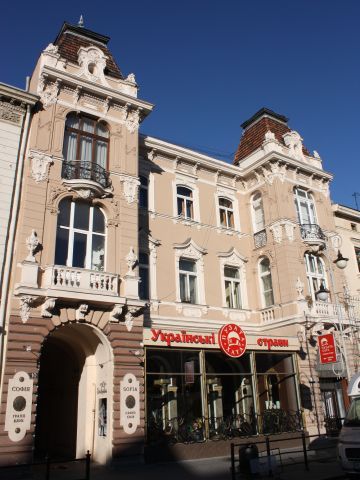
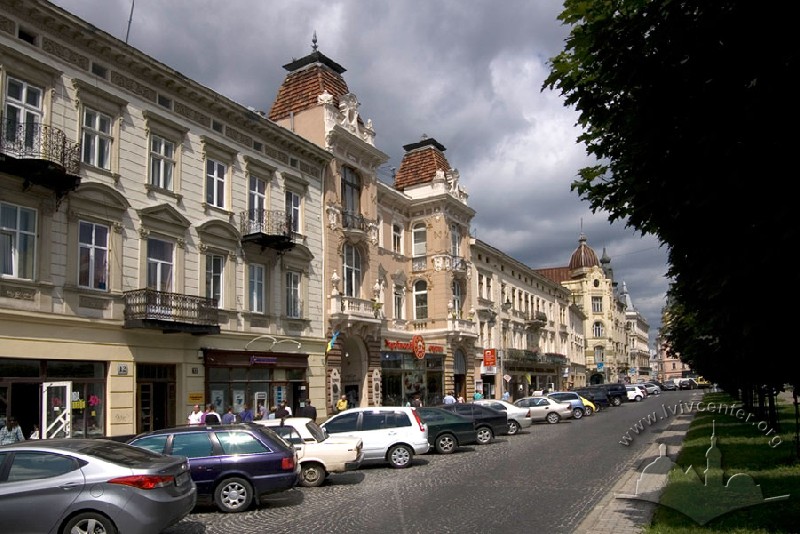
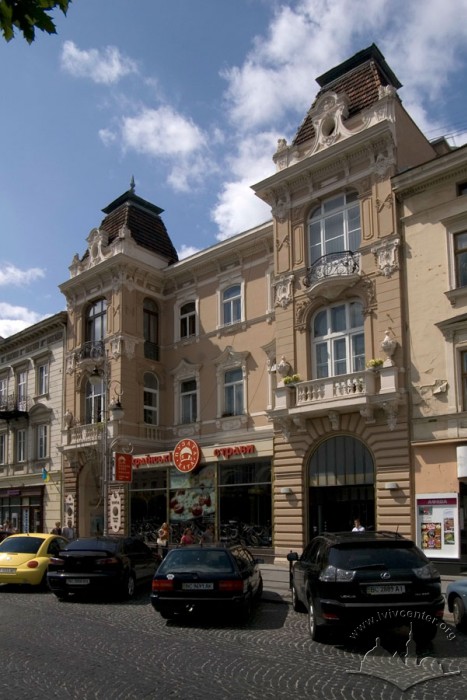
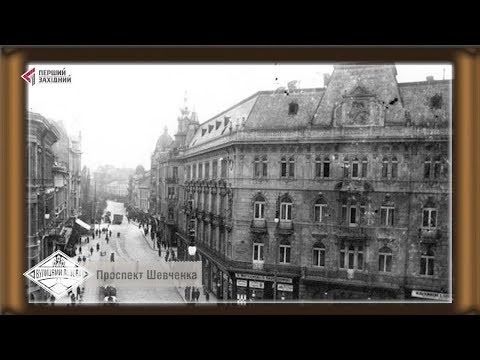
Zalewski's house, Lviv
Candy shops in Lviv were extremely popular until 1939. Even the poor could taste the delicacies: the leftovers from cake trays cost a penny.
Perhaps the most popular was the candy shop opened by Ludwig Zalewski at 22 Akademichna Street (now 10 Shevchenka Avenue) in 1903. Zalewski's name was a hallmark of Lviv, and he was called the "chocolate king." And for good reason, because the sweets from the candy shop were sent to Warsaw, Paris, and Vienna every day.
Ivan Franko, Mykhailo Hrushevskyi, and Józef Piłsudski drank coffee and tasted sweets in Zalewski's candy shop.
"...I was most attracted to Zalewski ' s candy shop on Akademichna Street. Since then, to tell you the truth, I have never seen candy shop windows decorated on such a grand scale anywhere in the world. It was essentially a large stage framed in a metal frame, where the scenery changed several times a year, serving as a backdrop for impressive sculptures and allegorical figures made of marzipan. Some great naturalists, the Reubens of the candy industry, realized their fantasies on it, especially before Christmas and Easter, when miracles frozen in almond mass and chocolat appeared behind the windows. Sugar St. Nicholas was racing on his sleigh, and avalanches of goodies were pouring out of his lintel. Hams and fish in a galette, also marzipan and cream-filled, rested on glazed half-bowls. Even the slices of citrine that shone through the galette were a work of candy carving. I remember herds of pink pigs with chocolaty eyes, a wide variety of fruits, mushrooms, ouden, plants, some caves and rocks. One had the impression that Zalewski could recreate the entire Cosmos in sugar and chocolat, decorating the sun with peeled almonds and the stars with glossy glaze" (Stanisław Lem, "High Castle").
The building was designed by architect Jan Schultz. Since 1930, the ground floor was occupied by Zalewski's candy shop with interiors decorated in the Art Deco style. In Soviet times, there was a confectionery shop here, which in the 1960s was called Svitoch. In 1972, the Chocolate Bar was opened in the basement of Svitoch. A bathhouse with a swimming pool in the back of the courtyard, the St. Anne's Bathing Facility, was built in 1887. In Soviet times, it was bathhouse No. 2. Now (in 2009) it is the "Grand Club Sofia".
The "chocolate king's" business closed in 1939. In Soviet times, the building housed a confectionery shop (known as Svitoch since the 1960s). In 1972, the Chocolate Bar was opened in the basement of Svitoch.
Now the former candy store, which attracted Lviv's bohemians, is a fast food restaurant.