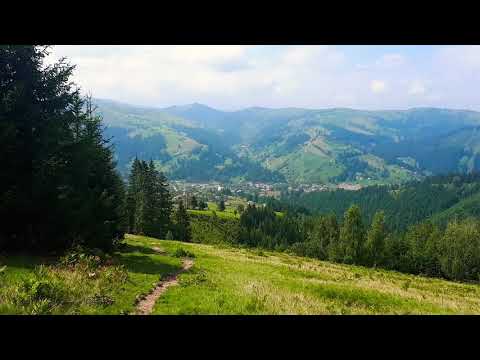
Dykhtynets
Dykhtynets is a village in the Chernivtsi region, Putyla district, Ukraine. According to the 2001 census, the population of the village together with the surrounding villages amounted to 3883 people. Over the past 650 years, the territory of Northern Bukovyna (Chernivtsi region) has been part of various states: for 415 years (1359-1774) it was part of the Moldavian principality, (Shipyn land, Kimpolunsky (Dovhopolsky) district) for 143 years (from 1775 to 1918) - of Habsburg Austria and Austria-Hungary;
for almost 25 years (in 1918-1940 and 1941-1944) - Romania. For 48 years (1940-1941 and 1944-1991) the northern part of Bukovyna was part of the Ukrainian SSR, and then the USSR. Since 1991, Chernivtsi region has been a part of independent Ukraine.
Administrative division of the Bukovyna Hutsul region under Austria.
During 1785-1787, Bukovyna Hutsulshchyna was governed by a military government. By order of Emperor Joseph II, on February 1, 1787, Bukovyna was annexed to Galicia as a district (circulus) and was subject to the Galician governor until 1849. In that year, Bukovyna was separated from Galicia and granted autonomy. Bukovyna became a separate principality with a separate administration, which was liquidated in 1851. In 1859, Bukovyna was again annexed to Galicia as a separate district, although in 1861 the administration's dependence on Galicia was eliminated, and a separate regional government was formed, headed by the regional president, Greek-Armenian Bishop Yevhen Hakman.
In 1867, according to the reorganization of the administrative administration, Bukovyna, like Galicia, was divided into 11 counties, which in 1868 were called county starostas. According to this administrative division, which survived until the early twentieth century, Hutsul Bukovynian settlements were included in the 9th largest county, Vyzhnytskyi, which covered two judicial districts with centers in Putyliv and Vyzhnytsia. It included the following villages: Ploske, Serhii, Stebni, Shpetky, Toraki, Kiselytsi, Koniatyn, Dykhtynets, Dovhopillia, Yablonitsa, Ust-Putyla, Vyzhnytsia, Bachna, Oleksandrordorf (founded in 1863), Katerynodorf (founded in 1863).), Katerynodorf (founded in 1869), from which the villages of Chereshenka, Mezhybrody, Roztoky, Shipit, and Vyzhenka later separated.
The first archival mention of the village of Dykhtynets is found in documents from 1774, when its population was already more than 1000 people. However, some scholars of the Chernivtsi National University disagree with this date and have some information that Dykhtynets was part of the Roman Empire and was its outpost many centuries ago, meaning that the village is much older. One of the confirmations of this fact is the discovery of a treasure trove of ancient Roman silver coins in the neighboring village of Ploska. The name of Dykhtynets village probably dates back to the time when oil was extracted from wells in the village and processed into tar and kerosene. Until the beginning of the twenty-first century, in the village of Dykhtynets (Malyi Dykhtynets), half-filled deep wells were preserved, from where oil was once taken with large buckets and processed in the simplest ways. (Already in the Soviet Union, geological exploration was carried out, which indeed proved the presence of small nonindustrial oil reserves in our region, which lie at a shallow depth. And in Lopushna, Vyzhnytsia district (about 20 km across the mountains), there are commercial oil deposits that are being successfully developed and the oil is being processed).
According to another version, "Dykhtynets" comes from the German words "dicht" and "netz" (there are still signs on old buildings of the early twentieth century with the inscription "Dichtnetz"), which according to this version means "dense net". (This probably refers to dense forests or a dense network of streams that flow into the Putylka River). On the territory of the village, the Putylka River has 9 tributary streams, which turn into raging rivers in case of heavy rains. During the devastating flood of July 2008, the water level in the Putylka River rose by 7 meters! Then the road in the village of Roztoky was destroyed and the road connection with the regional center was completely interrupted for 3 weeks.
Life in the village of Dykhtynets during the nineteenth century
In the first half of the nineteenth century, the owners of the land, as well as the peasants, were landowners M. Romashkan and brothers M. and H. Aivas. For the right to use the land, the peasants performed feudal duties, the amount of which was regulated by forcibly concluded agreements. According to one of them, dated 1828, each of the 83 serfs was obliged to pay the landowner Romashkan from 2 to 20 florins per year, bring 2 barrels of vodka from the village of Ispasa to the lord's taverns; hand over 12 skeins of linen yarn; mow and hay the landowner's hay, and repair the lord's buildings. In addition, the serfs paid state taxes, paid an in-kind tax for the maintenance of the village priest, the so-called mariyash, and served 2 days of serfdom a year in favor of the village starosta. Landlords also had such tools of economic oppression of serfs as easements and the right of propinquity. That is why 5 taverns were opened in the village for 150 yards. Alcohol was often forced on the peasants. As the residents of Dykhtyn complained along with other peasants of the Rusko-Kimpolunsky district in 1843, "they are forced to buy drinks in taverns, which is why they are so much in debt that their houses and land have been taken away from them."
The landlords also had the so-called right to mill. It had existed since Bukovyna was part of Moldova. A peasant was forced to grind grain only in his lord's mill. And when the distance from the estate to the mill exceeded one mile, peasants were allowed to grind at home on millstones, but even in this case they were obliged to pay the lord 15 crucifixes per year.
Dykhtynets was subordinated to the Putyla dominion in terms of judicial proceedings. It was headed by a lord (at different times it was Aivas, Flondor, Dzhurdzhuvan) who judged the peasants. His assistant was a mandator.
What you should know about Dykhtynets
- It was famous for the brothers of Oleksa Dovbush who fought with him for justice and a better life;
- the mood of the inhabitants has always been marked by a rebellious spirit - the population actively participated in the peasants' uprising led by Lukian Kobylitsa (1843-1844);
- the mother of the famous Ukrainian writer Yuriy Fedkovych was a native of Dykhtynets village;
- many fragments of Yuriy Illienko and Ivan Mykolaychuk's movie masterpiece "White Bird with Black Mark" were filmed here. The hard life, way of life, customs of the peasants of Bukovyna and the inhabitants of Dykhtynets village in the 40s of the twentieth century can be viewed here;
- Since the 90s, our picturesque village has been chosen as a vacation spot by People's Artist of the USSR Edita Stanislavivna Piekha, who came here almost every summer with her grandson Stas for many years;
- In the fall of 2013, about 3700 people live here, two schools and a kindergarten are functioning;
- in the fall of 2012, Dykhtynets school celebrated its 150th anniversary!
When the village was described in the first documents (1774), it belonged to the Moldavian principality. In 1775, after the Russo-Turkish War (1768-1774), Austria annexed Bukovyna. Since 1775 Dykhtynets has been part of the Duchy of Bukovyna.
Since 1918, Dykhtynets, like the rest of Northern Bukovyna, has been occupied by Romania. At that time, the majority of the village's population was Ukrainian.
On June 28, 1940, Northern Bukovyna was annexed to the Ukrainian SSR as a result of the Soviet annexation of a part of Romania in 1940. During 1941-1944, Northern Bukovyna was again under Romanian rule. In 1944, Northern Bukovyna was again occupied by Soviet troops. The pages of the village's history are well reflected in the collective monograph published in 2013 under the general editorship of Professor P.P. Brytskyi, Yuriy Fedkovych Chernivtsi National University, "Bukovynians in the Tragic Years of World War II: Articles, Memoirs, and Documents" (author - Mykhailo Hrytsiuk) (pp. 112-133).
Monuments.
Dykhtynets St. Demetrius Church, built in 1871, is one of the oldest churches in the Putyla region. According to legend, St. Dmytro's Church once stood on the site of St. George's Church, but in the mid-nineteenth century it was dismantled and moved to the village of Ispas. The historical monument, which survived two World Wars, is now one of the most beautiful churches in the Hutsul region. The area of the church is 105 square meters. The walls are decorated with many icons, including the icon "The Last Judgment" painted in 1930. There is a bell tower on the territory, where among the new bells there is a bell made in 1890 (according to documents, it was brought from Vienna) and a bell made in 1919 (brought from Bucharest and presented to the church by brothers Semen and Vasyl Hrytsiuk). At the entrance to the churchyard, next to the beautiful gate, there is a chapel that has been recently restored. There are three crosses for the blessing of water, one of which is associated with the year of construction of the church. Nearby are two cemeteries of the nineteenth and twentieth centuries. The first priest of the church was Hryhorii Kantemir. At different times, Hryhorii Balosheskul, Stefan Malanchuk, Stachii Volynets, and Avksentii Vozniuk served in the church, people known not only in the Putyla district but also far beyond its borders. Since August 19, 2000, Father Dmytro (Fedorashchuk) has been the rector of St. Dmytro's Church. In recent years, the village church has been significantly renovated. A new fence and gate were built, the walls of the church were restored, a new cross for the blessing of water was erected, and a room for ceremonies was built. All these works were carried out by the Khrystchuk brothers. Today, St. Demetrius Church is an architectural monument of national importance. (Materials from the Seven Wonders of Putylshyna website)
Ostryva Rock. The monument to the "three Chekists" was dismantled in March 2020.
Dykhtynets is the name given to the tar that was produced here long ago and which flowed down in streams during rains. I don't know why one of the local streams is called Myshia. It's beautiful here, like everywhere else in the Putyla region. When you approach the village from the direction of Vyzhnytsia, on the right, right next to the road, you will see the so-called "Rock of the Three Chekists" - the local Hutsuls seem to not care about the Chekists, Shukhevych, or the Dalai Lama. As long as the sheep were healthy. I don't know what exactly the Chekists did-or, rather, what exactly the "fascist Ukrainian nationalists" did to the Chekists. I was much more interested in the St. Dmitry's Church from 1871. As far as Putylshchyna is concerned, it is a very old church. It is also unusual. It has two towers on the western façade, which makes it look like a kind of church-like building. It's very nice. According to the four-volume book, the towers could have been added later. The church is made of wood on a stone foundation, three-story, and is dedicated to the MP. It is half armored and half bright green - Hutsuls like it bright and shiny. In May 2010, the lower part of the walls of the church in Dykhtynka (the part not covered with tin) was not green, but the natural color of wood.
We recommend visiting in Dykhtynets


Trails nearby Dykhtynets
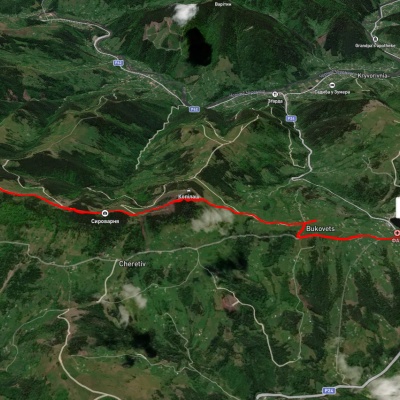
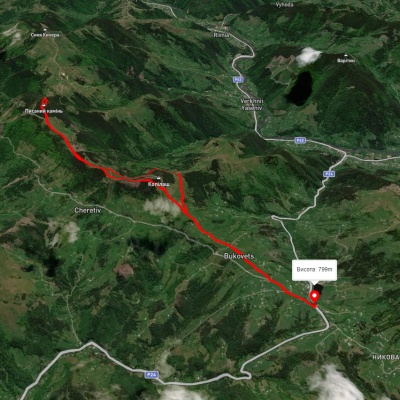
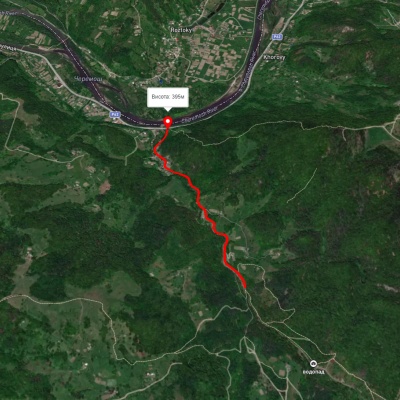
Which hiking trails pass through or near Dykhtynets?
We suggest these hiking trails through or near Dykhtynets: Pysanyi Kamin – Bukovets village, Bukovets village – Pysanyi Kamin – Bukovets village, Smuharski Waterfalls, Nimchych Pass – Protiate Kaminnia, To Dovbush Chambers, Kosmach village, via Mount Rotylo, Mount Hrehit and Mount Bila Kobyla to Bukovets village