St. Nicholas Church, Lviv
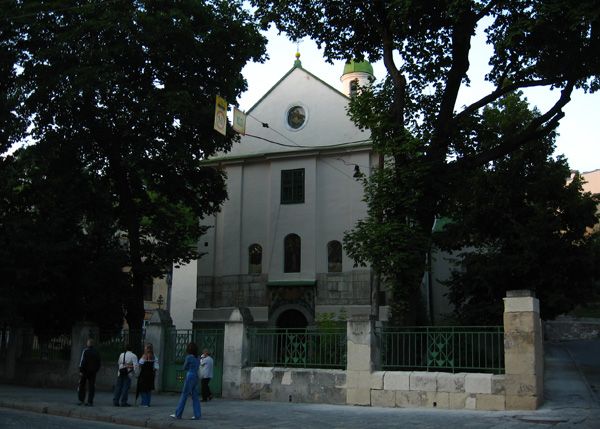
TheChurch of St. Nicholas, Archbishop of Myra of Lycia, Miracle Worker is a religious building in Lviv, a functioning church of the Orthodox Church of Ukraine, an architectural monument of national importance. It is traditionally considered the oldest church in the city. It is located near the Vysokyi Zamok mountain, under the Budelnytsia mountain at 28, Bohdana Khmelnytskoho Street (former Volynskyi Trakt).
The church of white hewn stone, built near the foot of the Kniazha Hill together with the first settlements, is perhaps the first in Lviv. The dedication of the church to St. Nicholas, who is the patron saint of merchants, and its location near the gates to the old torgovytsia (market) suggest that the founders of the church were ancient Lviv merchants. However, there is also a historical tradition that the church was a court house for the princes of Galicia-Volhynia, a princely tomb, and a center of social and political life in early Lviv. The tradition was probably inspired by the text of a princely privilege, the authenticity of which was not in doubt for some time and was refuted only in the nineteenth century.
Archaeological excavations conducted in 1978 showed that the church was founded in the thirteenth century. The date of the church's construction is not known for certain and is the subject of many interpretations and guesses. The location of the church on the territory of one of the oldest historical districts, its planning structure, and the documentary tradition that dates back to Prince Lev's privilege to grant land to the church in 1292, suggest that the building could have been constructed in the early period of the city's history, between 1264 and 1340.
At the same time, the opinion of the inauthenticity of the privilege, which is established in modern scholarship, leaves a wide horizon for assumptions about the earliest history of the building. In particular, some scholars suggest that Prince Danylo could have been the founder of the church. At one time it was the main princely church located near the castle of the rulers of Galicia.
Traces of the fortifications of that time have not been preserved, but it is known from the chronicles that have survived to this day that there was a princely treasury in the courtyard near the church. From there, in the 1340s, attackers from the other side, led by the king of a neighboring state, took up spears and swords against the defenders of the Galician principality, destroyed the castle, and stole two golden crowns, a throne decorated with diamonds, precious crosses, a princely cloak, and other valuables.
Another assumption is that this church was an Orthodox cathedral before the Poles conquered Lviv. Documents show that the church of St. Nicholas was the owner of fields and estates, and King Sigismund granted the church's rector jurisdiction, meaning that the church was given the right to collect taxes on its lands and even hold court.
Thus, in 1471 the church was exempted from taxes, and in 1543 the parish was exempted from the castle court. Since 1544, the St. Nicholas Brotherhood has existed at the church. During the revival of the Orthodox Church, St. Nicholas Church played a significant role as a center of faith and education. However, a fire in 1623 damaged the church, and throughout the century it suffered regular damage from Tatar raids.
Since 1700, the church has belonged to the Ukrainian Greek Catholic Church. After the Lviv pseudo-council in 1946, the church was illegally transferred to the jurisdiction of the Moscow Patriarchate of the Russian Orthodox Church.
During the celebration of the church's feast day, the pastor's sermon, delivered in 1956 in Lviv, said: "How many storms have swept over our city during this long period of its existence! Everything has been washed away by the flow of time. Only this holy temple, under the special care of St. Nicholas, has remained as a witness to the Christian faith of our fathers, grandfathers, and great-grandfathers." Amidst the tumultuous events, St. Nicholas Church managed to survive for more than seven centuries and wait for the right to serve the faithful in the Ukrainian Autocephalous Orthodox Church, which was unanimously supported by priests and laity in Lviv in December 1989.
In 2018, the church was transferred to the Orthodox Church of Ukraine. Archaeologists believe that the foundations of the church are one of the oldest buildings in the settlement, built on the model of Byzantine architecture.
The monument has not retained its original appearance. Only fragments of the walls remain of the original church. It was replaced by extensive reconstruction after the fires of 1623 and 1800, when the shingle roofs, dome, and bell tower above the Babynets burned down. The building was erected on an old cemetery, which confirms the existence of an older, possibly wooden church on this site.
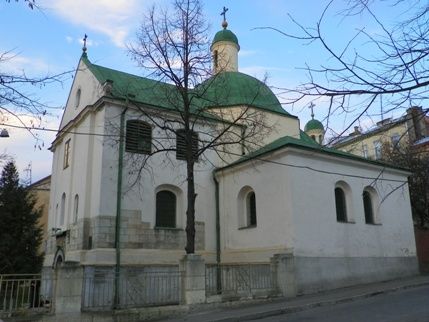
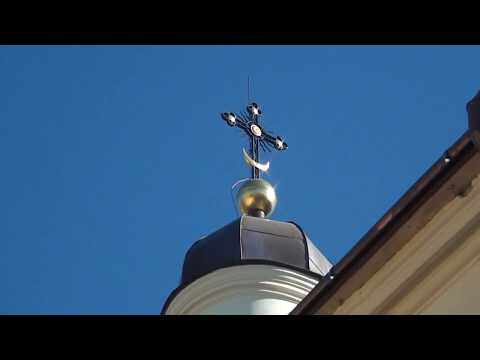
The church is a kind of cruciform building with a square nave, around which the volumes of the altar with a semicircular apse in the east, a rectangular nave, and side chapels, also with semicircular apses, are grouped. The nave and the altar part of the cross-domed church are crowned with lantern domes typical of Ukrainian architecture. The three-dimensional layout of St. Nicholas Church brings it closer to the ancient churches of Kievan Rus and has analogues in the architecture of the southern Slavs. The plan, the lower part of the stone walls, and the apses open from under the plaster, built of hewn blocks of white limestone, remain from the 13th-century building. The use of hewn white stone in construction was widespread in the XII-XIII centuries in Galicia-Volhynia.
In the second half of the seventeenth century, the church was rebuilt and the work was completed in 1701, as evidenced by an inscription on the arch of the main nave. In 1776, a sacristy was added.
However, the church was not spared from disaster: a fire destroyed the ancient iconostasis in 1783, and a fire in 1800 caused the church to receive two new domes and a tin roof. However, after the additions and alterations, it retained the main features of the ancient architecture-the plan of the Greek equal-armed cross and the central dome. In this way it resembles Orthodox churches in southern countries, combining the traditions of Balkan and Armenian architecture.
The mix of the classical Byzantine-Russian cross-domed plan with Romanesque construction techniques creates a new original style characteristic of the architecture of ancient Galicia.
In 1926, a stone fence with iron bars was built around the church, designed by Oleksandr Lushpynskyi.
In 2017-2018, the church was restored, with about 5.5 million UAH allocated from the Lviv city budget. During the repair work, the roof was completely replaced (as the roof had already been destroyed) over the church itself with a new copper roof. In addition, the engineering networks, i.e. sewerage and drainage, were replaced. The retaining wall and fence were also strengthened, and the grounds were landscaped and paved with natural stone.
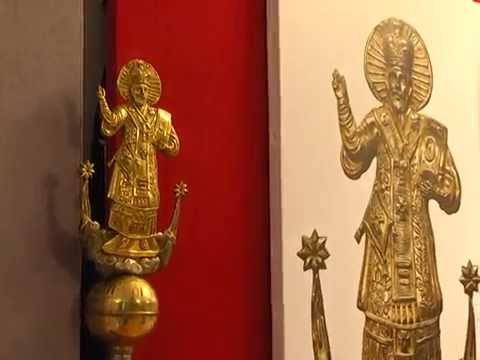
Among the ancient monuments of art preserved here are the icon of St. Fyodor of Tiron (XVII century) and the icon of the Mother of God, which is a valuable work of Lviv painting of the first half of the XVII century, close in style to the school of the artist Fedir Senkovych. The church houses the relics of St. Nicholas the Wonderworker, which were presented to the church by Patriarch Joachim V of Antioch during his stay in Lviv, the 1719 Peter Mohyla reliquary, and a 1760 banner with the image of St. Nicholas on one side and Jesus Christ with the congregation on the other.
Another Lviv shrine belonging to the church is the icon of St. Nicholas the Wonderworker. The saint is depicted in Byzantine vestments on a gilded background. The church also has an icon of St. Theodore of Tyre from the former church of St. Theodore, which stood near St. Nicholas Church. The icon of St. Theodore of Tyrone is a memorial to the churches destroyed in Lviv.
The frescoes on the main facade of the church depicting St. Nicholas, the Crucifixion, St. John, and the Virgin Mary were painted in 1924 by Ukrainian artist Petro Kholodnyi.
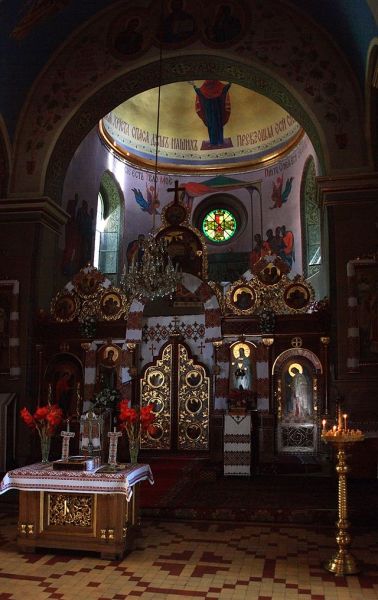
The modern iconostasis was made in the pseudo-Byzantine style in 1947-1949; the wall paintings in 1955-1957 were commissioned by Fr. Vanychytskyi and designed by Fr. Volodymyr Yarema and were made by artists Carlo Zvirynskyi, Stanislav Servetnyk, M. Tkachenko, and V. Masiutko. In 1990, the church's paintings were unsuccessfully repainted, so they need professional restoration.
In 2014, wooden sculptures of angels were found on the bell tower of St. Nicholas Church. According to art historians, these are most likely the works of the outstanding Johann Georg Pinsel (mid-eighteenth century). The sculptures were restored by specialists.
At the initiative of the clergy, the community of St. Nicholas Church, the King Danylo Art Foundation, and scholars studying the history of the oldest Orthodox church in Lviv, the exhibition "Treasures of the Princely Church of St. Nicholas in Lviv" was created.
St. Nicholas Church is located at 28 Bohdana Khmelnytskoho Street. It can be reached from the center of Lviv on foot or by tram #5 and #6 (Staryi Rynok Square stop). A little further down Khmelnytskoho Street is another shrine of the Lion City, the Monastery of St. Onufriy, where the first printer Ivan Fedorov found eternal rest.