St. George's Cathedral, Lviv
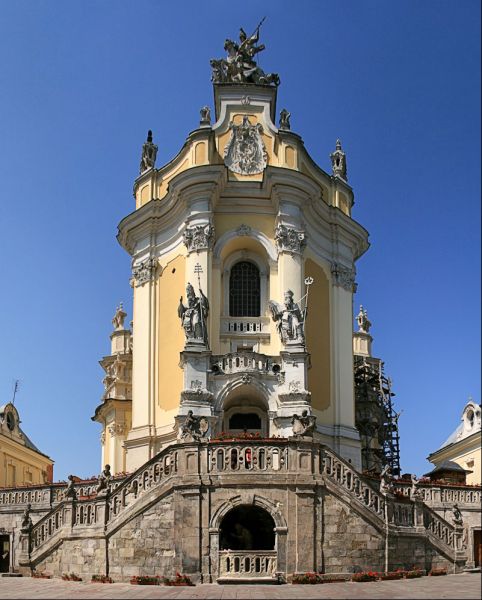
At the top of Sviatoyurska Hill, St. George's Cathedral, the main Greek Catholic cathedral of Lviv and the Lviv Archdiocese, rises above the city, designed by Austrian architect Meretyn, and crowned by a sculpture by Ivan Pinzel. For centuries, it was the residence of the metropolitans of the Ukrainian Greek Catholic Church. The Baroque and Rococo monumental architectural ensemble with distinctive national features (1744-1762) is considered the main shrine of Ukrainian Greek Catholics. It is located on St. George's Hill at 5 St. George's Square. The height above sea level is 321 meters.
According to legend, monks lived on Sviatoyurska Hill in the early days of Christianity. In one of the caves lived a hermit named Vasylko. He was unkempt, with a long and thick beard. He was the uncle of King Danylo. Later, around 1280, the king built the first wooden church here. A defensive Basilian monastery was built nearby.
After the capture of the Galician city by Polish King Jan Casimir, the wooden St. George's Cathedral in Lviv burned down. The only monument left of the old church is the bell from 1341, often called the Dmytro. It is written on it that its ringing was heard by Dmytro Petko, who ruled the Galician state after the death of Prince Yuriy Boleslav. Polish King Casimir III built a new stone church on this site in 1363-1437.
In 1539, St. Basil's Basilian Monastery became the seat of the Galician-Lviv bishops, and the church became the cathedral church. The first stone church of St. George was built simultaneously with the Armenian Church. Both churches are built by the same master. St. George's Cathedral in Lviv has witnessed many historical events. In 1655, the camp of Hetman Bohdan Khmelnytsky was located on the square in front of the church, and in 1672 the cathedral was destroyed by the Tatars.
In 1673, by the decision of Bishop Joseph (Shumlyansky), the miraculous icon of the Blessed Virgin Mary, which is one of the oldest weeping icons, was solemnly transferred to St. George's Cathedral from the Terebovlia Basilian Monastery. As for the origin of the icon of the Blessed Virgin Mary, it can be stated that it has long belonged to the Rymbal family, which inherited the priestly rank in Terebovlia from generation to generation. In 1700, a separate chapel of the Intercession of the Blessed Virgin Mary was built for the icon, placing it on a beautifully decorated throne.
The present-day St. George's Cathedral was built in 1744-1760 according to the project of the well-known architect Bernard Meretiner. Decorative work in the cathedral lasted until 1780. The representative altar of St. George's Cathedral was made by the sculptor Sebastian Fesinger. On the facade there are sculptures by Ivan-Georgy Pinsel. The interior of the church was decorated by sculptor Mykhailo Filevych. The authors of the majestic compositions were the famous artists Yurii Radyvylivskyi, Francisk Smuglevych, Luka Dolynskyi, and Erasmus Fabianskyi. The Terebovlia Miraculous Icon of the Virgin Mary was moved to the newly built cathedral.
Opposite the cathedral are the Metropolitan Chambers, built in 1760-1762 by Clemens Fesinger. Other components of the St. George's architectural ensemble are the chapter houses (nineteenth century) and the bell tower (it houses a bell from princely times), built in 1828 by architect Hayek. Throughout its existence, St. George's Cathedral has undergone reconstruction and restoration work many times (1850, 1866, 1911, 1933, 1950, 1987, and 1996).
After the restoration of the Galician Metropolitanate in 1808, St. George's Cathedral became the archdiocesan cathedral. Therefore, in 1817, the Basilian Fathers moved their monastery from here to the monastery of St. Onufriy. An important event took place in St. George's Cathedral in Lviv on October 14, 1836, the day of the glorification of the Terebovlia miraculous icon of the Virgin Mary: on that day Markian Shashkevych preached a sermon in Ukrainian, initiating the spiritual revival of our people in the western Ukrainian lands under the protection of the Blessed Virgin Mary.
In 1946, after the Lviv Pseudo-Council, the St. George's architectural complex was for a long time subordinated to the Russian Orthodox Church. On August 19, 1990, it was returned to the UGCC. In April 1991, the head of the UGCC, Cardinal Myroslav Ivan (Lubachivsky), arrived here from Rome. The following year, in August, the remains of Patriarch Josyf Slipyj were transported from the Vatican to the crypt of St. George's Cathedral by a military plane of the Armed Forces of Ukraine.
Since 1998, the Cathedral, together with the Ensemble of the Historic Center of Lviv, has been a UNESCO World Heritage Site. The cathedral itself is part of a complex: a Baroque cathedral (1745-1770) with a bell tower (bell from 1341), a Rococo building with classicist porticoes of the metropolitan chamber (1761-1762), chapter houses, a terrace with two-flight staircases, an openwork fence around the cathedral courtyard with two gates in the courtyard (1771), and walls surrounding the chapter houses and the bishop's garden (1772).
During his visit to Ukraine on June 25-26, 2001 , Pope John Paul II visited the chambers of St. George's Cathedral during his visit to Ukraine. He prayed in front of the restored Terebovlia Miraculous Icon (the restoration work was done by Yaroslav Movchan and his son Danylo) and personally laid golden crowns on the heads of Jesus and the Blessed Virgin Mary depicted on the icon.
On August 21, 2005, the seat of the head of the Ukrainian Greek Catholic Church was moved from Lviv to Kyiv. However, the St. George's complex has not lost its historical and spiritual significance. At all times of the year, domestic and foreign pilgrims come here to honor the miraculous icon of the Virgin Mary, a copy of the Shroud of Turin, the relics of the saints [the Apostle Peter, St. Nicholas, St. Charbel, St. Anthony of Padewski, St. Panteleimon the Healer, Valentine, Josaphat (Kuntsevych), and Mykola (Charnetsky)] and visit the crypt-tomb of the UGCC hierarchs [Sylvester (Sembratovych), Andrey (Sheptytsky), Joseph (Slipyj), Volodymyr (Sterniuk), and Myroslav Ivan (Lubachivsky)].
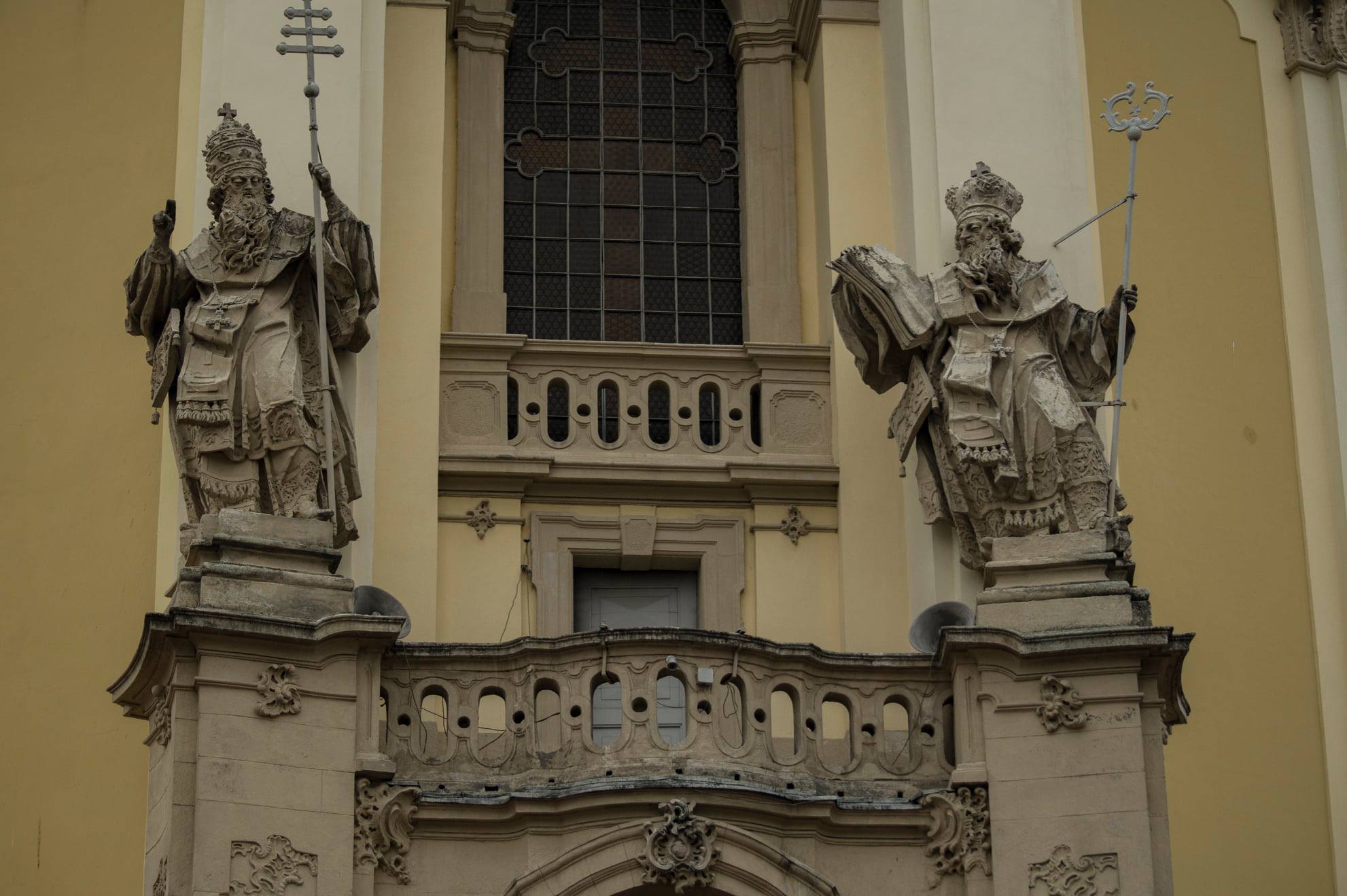
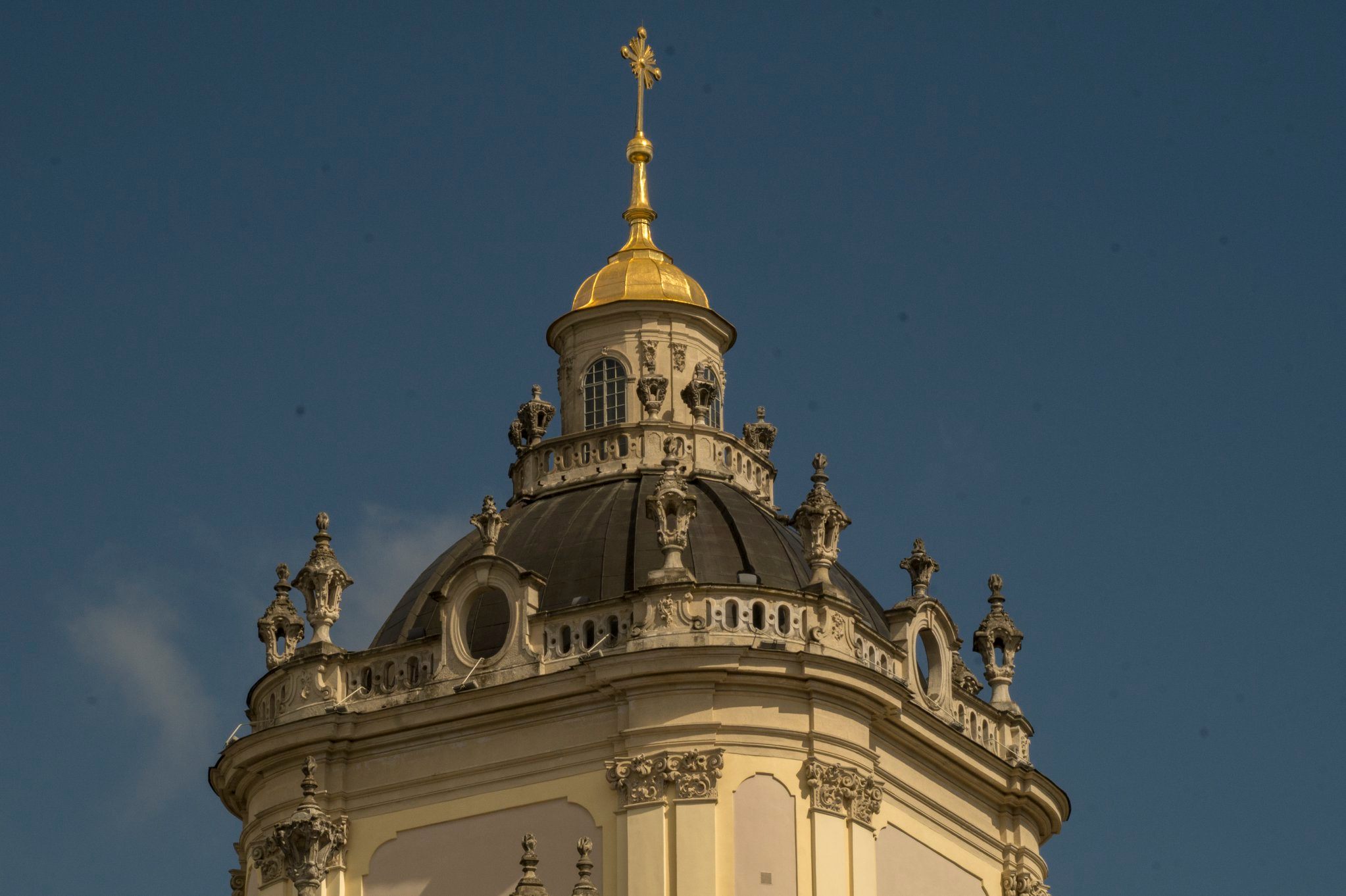
Today, this cathedral impresses with its unusual appearance, in particular its architectural complex. It does not open to the viewer immediately, but gradually. St. George's Cathedral is built on a Greek equilateral cross with four chapels between the cross's frames and miniature domes under the roof, in the center with a large dome on a wide drum supported by spring arches. The top of the building is covered by a cornice. Numerous pilasters, paired (on the drum) and doubled on the walls of the cathedral, topped with stone rococo lanterns, give the building a slender appearance. At the entrance to the cathedral, there is a paired staircase with a Rococo openwork balustrade decorated with vases and fetters. The façade has statues of Metropolitans Athanasius and Leo on both sides of the main entrance, a balcony above the entrance, a tall window, a porch with the Sheptytsky coat of arms and an attic, and an equestrian statue of St. George the Serpent by the German sculptor Johann Georg Pinsel. The courtyard in front of the cathedral is closed by two rococo gates decorated with allegorical figures symbolizing Faith and Hope, the Church of Rome, and the Church of Greece.
When you enter the church, the first thing that catches your eye is the light, unconventional, transparent iconostasis and beautiful Ukrainian embroidery. The interior of the cathedral was painted by S. Fabianskyi (1876), Y. Radyvylivskyi created the large composition "The Bishop" and "The Appearance to the Apostles," and M. Smuhlevych painted the altar composition "The Sermon of Christ," which was brought from Vilnius with the assistance of Katarzyna Kossakovska, and "Christ the Pantocrator" in the bathhouse; L. Dolynskyi painted the vicarage icons, oval icons of the prophets, and 16 scenes of feasts. The sculptural frames of the two entrance gates and the decoration of the entrances and numerous lanterns belong to M. Filevych. In 1942, M. Osinchuk carried out general conservation and painting of the walls and cleaning of the images. Different artists worked on the construction of the complex in different styles: Baroque, Rococo, and Classicism, but they managed to achieve an organic synthesis of Baroque architecture and sculpture, details of fanciful Rococo ornamentation of cornices, balustrades, atticas, capitals, sculptures, vases, stairs, porticoes, subordinating all the constituent elements to the integrity of the fine arts culture of that time in Europe.
The ensemble occupies a unique place in the artistic culture of the Ukrainian lands also because it has preserved and now hides within its walls many outstanding historical and artistic monuments of different times, including those that are among the most important and representative of their era. However, due to historical circumstances, most of them are now outside the church: in the Andrey Sheptytsky National Museum, the archival collections of the Onufriyivsky Monastery, the Central State Historical Archives of Ukraine in Lviv, and the Vasyl Stefanyk Lviv Scientific Library.
It is easy to get to the cathedral. Take tram #6 from the train station. At the second stop you need to get off. Then you can choose several routes: if you go down Sheptytskikh Street, you will go straight to the cathedral. You can also go down Horodotska Street, turn right, and you will see St. George's Cathedral in Lviv.