Ruins of the Golden Rose Synagogue ("Space of Synagogues"), Lviv
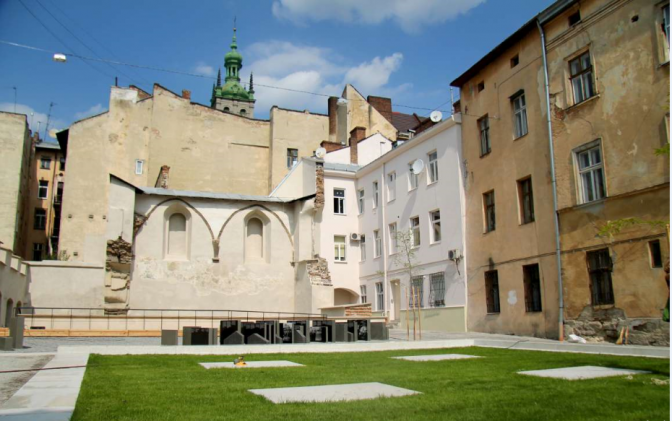
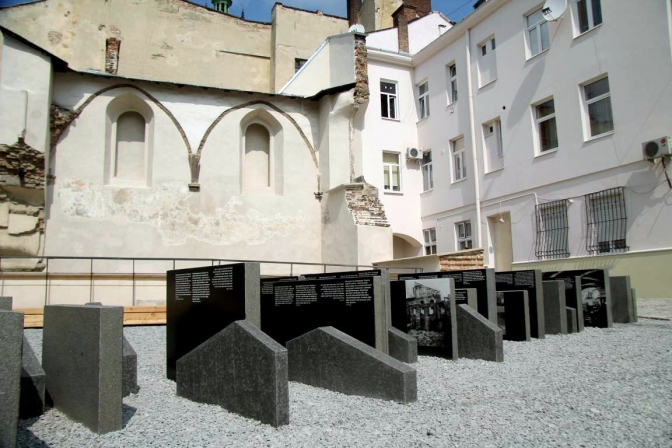
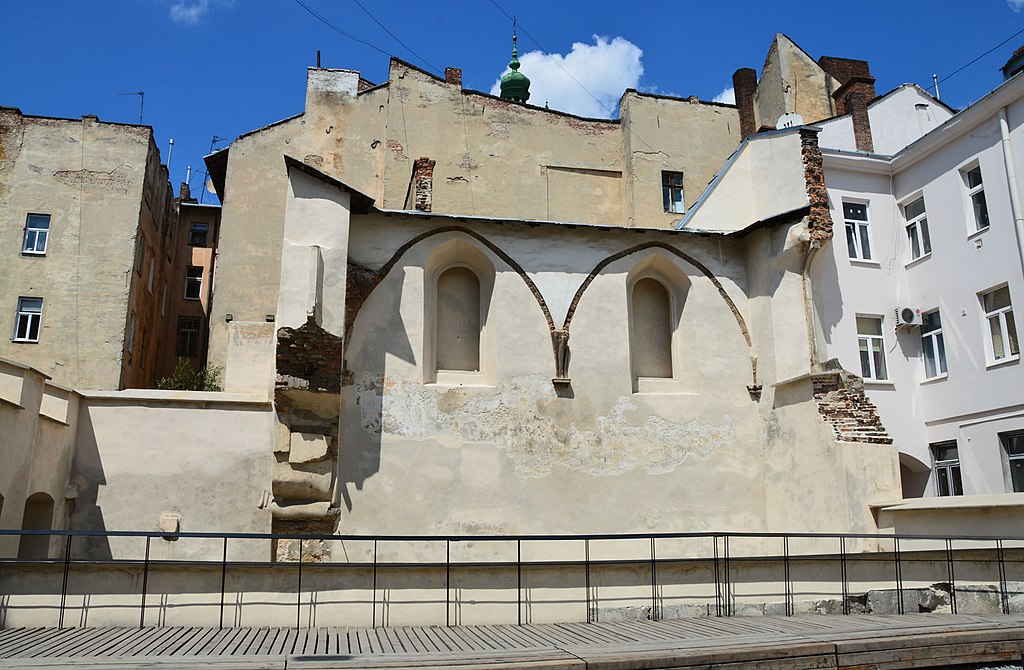
The ruins of the Golden Rose Synagogue (Turei Zahav) in Lviv are one of the oldest Jewish shrines in Ukraine. The building is an architectural monument made in the Renaissance style. "The Golden Rose is considered to be the most striking example of the history and architecture of Galicia. From the 16th to the 20th centuries, the Golden Rose was the main object in the Jewish quarter, as well as the center of cultural and spiritual life of the townspeople.
The brick city synagogue was built in 1592-1596 by the Italian architect Pavlo Shchaslyvy with the participation of Ambrosiy Prykhylnyi and Adam Pokora. The synagogue's founder was a wealthy Lviv merchant, banker, and royal financier, and the head of the city's Jewish community, Itzhak Nakhmanovych (Isaac ben Nachman). The architects gave the building the features of Renaissance architecture with reminiscences of Gothic. This was the second city synagogue in Lviv, for the construction of which the authorities did not give permission for a long time. Eventually, the Roman Catholic archbishop, giving permission for its construction, ordered "that the infidel Jews not build a synagogue that is prominent and valuable, but an ordinary, medium-sized one" (according to the established rules, a synagogue was not allowed to be taller than other buildings in the city). At the end of the sixteenth century, the Jesuits decided to build a monastery in Lviv and chose the site where the synagogue stood. In 1603, King Sigismund III granted them this plot, and the court confiscated the building. However, the passage to the building was through the house of Mordegai Nakhmanovych, who forbade the Jesuits to pass through his property. The legal dispute between the Jesuit order and the Jews of Lviv continued, and the synagogue was returned to the Nachmanowicz family in 1609.
This building was the center of social life in the medieval Jewish quarter and one of the most beautiful synagogues in Eastern Europe. In 1914, students of the Architecture Department of the Lviv Polytechnic, Kalikst Krzyżanowski, Mieczysław Rzepiecki, Zygmunt Sperber, and Fryderyk Tadanir, under the direction of Adolf Szyszko-Bohusz, took measurements of the synagogue as a class assignment. The inventory drawings, supplemented by an article by Tadanir, were published in a yearbook dedicated to the work of Polytechnic students. In 1920, Zygmunt Sperber exhibited the Golden Rose's drawings at an exhibition of Jewish artists in the kahal building. In the 1930s, it was studied by specialists who made architectural measurements and photographic records.
During the German occupation on 14 August 1941, and over the next few days, a number of synagogues in Lviv were set on fire. The Golden Rose was burning at the same time. Later it was completely destroyed by the Nazis. The remains of the synagogue were declared an architectural monument of local significance (No. 513-lv). It is included in the Program for the Restoration of Outstanding Historical and Cultural Monuments of Ukraine (approved by the government of Ukraine in 1999).
The synagogue was located in the back of the courtyard, surrounded by buildings on three sides. It was built of brick and stone, small in size and almost square in plan (11*9 meters). In 1601, a one-story porch was added to the west, and an extension with a prison and servants' quarters was added to the south. A gallery for women was later arranged above these annexes. A staircase mounted on the western façade led to the gallery.
The style of the building is transitional from Gothic to Renaissance. The main hall is covered by a system of Gothic cross vaults with nerves supported by Renaissance consoles. There were two lancet windows on three walls under the ceiling. The floor of the prayer hall was recessed below street level, because the building was not supposed to be higher than Lviv churches, but the architects wanted to make it at least majestic from the inside, as is customary for churches. The Aron HaKodesh, in the form of a Renaissance stone portal, was located on an elevation near the eastern wall. At the same time, the exterior of the synagogue facades was crowned with a high Renaissance arcaded attic with volutes and dentils.
The Jewish religious community Turei Zahav has repeatedly expressed its belief that the Golden Rose synagogue should be restored. The head of Turei Zahav, Meilach Sheikhet, claims that in 2013 a program for the regeneration of the Jewish section was adopted, which was "approved at all levels, including UNESCO" and provided for the support of a "grant from the US Ambassador." According to the program, the entire Jewish quarter in Lviv is to be completely restored.
Excavations of the Golden Rose began in 2007. The monument was included in the program for the restoration of outstanding historical and cultural monuments of Ukraine approved by the government in 1999. In July 2015, at the request of the city authorities, the conservation of the surviving remains of the Golden Rose Synagogue began.
In 2010, the Lviv City Council, the German Society for International Cooperation GIZ, and the Center for Urban History of East Central Europe initiated a competition for projects to commemorate Jewish memory sites in Lviv. Proposals for this competition were first announced at the international conference Urban Jewish Heritage and the History of East Central Europe organized by the Center for Urban History in 2008. The competition was won by the project "Space of Synagogues" by German architect Franz Reschke, which envisaged the creation of a memorial complex near the remains of the Golden Rose and the improvement of the square on the site of the Great Synagogue.
Architect Yurii Stoliarov adapted the project and prepared the documentation in accordance with the requirements of the current legislation of Ukraine, and PhD in Architecture Oksana Boyko from the Institute of Ukrzakhidproektrestavratsiya prepared a project for the conservation of the Golden Rose Synagogue. The total cost of the first part of the project was 295 thousand euros. The project was funded by the Lviv City Council, the German Society for International Cooperation (GIZ) with the support of the German Federal Ministry for Economic Cooperation and Development (BMZ), the Center for Urban History, and patrons. The project was organized by the city council, the Center for Urban History, and GIZ in partnership with the all-Ukrainian charitable foundation Hesed Arieh (Ukraine), Hillel Lviv and Gesher Galicia (USA), the Association of Descendants and Former Residents of Lviv (Israel), and the Association for the Commemoration of Lviv Jewish Heritage and Historic Sites (Israel).
Among the project's opponents is Andriy Saliuk, head of the Lviv branch of UTOPIK, who claims that public hearings were effectively ignored in the process of approving the project. Meilah Sheikhet, head of the Turei Zahav religious community, advocates for the restoration of the Golden Rose, not just conservation. He states that the Reschke conservation project is incompatible with the previously created and approved "Jewish District Regeneration Program" created by the Ukrzakhidproektrestavratsiya institute.
On September 4, 2016, the first part of the memorial complex "Space of Synagogues " was unveiled at 41 Staroyevreyska Street. The memorial project includes the preserved remains of the Golden Rose synagogue, the marked foundation of the Jewish House of Learning (Beit Hamidrash), and the memorial installation "Perpetuation," which together create the Space of Synagogues complex.
There is a legend that the name of the Golden Rose synagogue dates back to the sixteenth century. In 1603, the Jesuits appeared in Lviv, and the king granted them a plot of land for the construction of a Jesuit church. The Jews had already built a synagogue on this site, so they started a lawsuit, which they later lost. A wealthy widow, Rosa, came to the defense of the Jewish people: she sold her large estate to buy the land. But a Jesuit bishop, seeing Rosa's incomparable beauty, wanted her to become his wife. Without hesitation, she agreed, provided that the bishop immediately gave the synagogue to the Jews. When the document giving up the land was delivered to representatives of the Jewish community, Rosa poisoned herself. Grateful Jews wanted to honor the memory of the brave woman and named the synagogue in her honor. There are several other versions, but this one is the most beloved legend among the townspeople and tourists.
Only a small part of the synagogue's remains have survived to this day. "The Golden Rose is included in the list of monuments under UNESCO protection and is also an architectural monument of local importance. A few years ago it was included in the program of revival of unique historical and cultural objects in the world.
The idea to revive the synagogue also appeared in the Jewish community of the city after Ukraine gained independence. The money raised by the townspeople was used to conduct archaeological research on the remains of the building. There are plans to rebuild the center, which was one of the main shrines for the entire Jewish people of Ukraine. A museum is planned to be opened next to the synagogue on Staroyevreiska Street.
The ruins of the Golden Rose synagogue are located at 41 Staroyevreiska Street, in the former Jewish quarter, just 200 meters from Rynok Square. From the city's central railway station, tram No. 6 (stop: Pidvalna Street) and trams No. 1 and 10 (stop: Rynok Square) run to the synagogue.
The Galician-Jewish tavern "Under the Golden Rose" is located in the historic Jewish quarter of Lviv near the ruins of the Golden Rose Synagogue. You will be surprised by the menu without prices, and the cost of the meal depends on the customer's ability to bargain.
Location on the map
Comments
Places to stay nearby
 HotelHotel "Swiss" - Swiss Hotel Lvivunder 1 km from Ruins of the Golden Rose Synagogue ("Space of Synagogues"), LvivSaunaSPABreakfastNearby: Turkuliv-Comello Palace 900 mSt. Andrew's Church 200 m
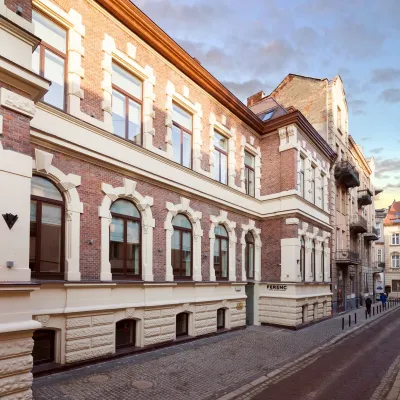 HotelHotel-Restaurant "Ferenc" Lvivunder 1 km from Ruins of the Golden Rose Synagogue ("Space of Synagogues"), LvivSaunaKitchenWi‑FiNearby: Turkuliv-Comello Palace 1.3 kmSt. Andrew's Church 500 m
Nearby attractions
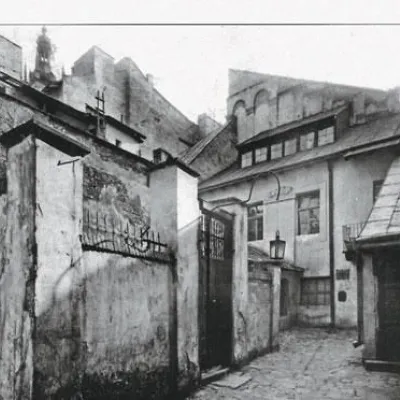 Historic siteJewish Quarter, Lvivunder 1 km from Ruins of the Golden Rose Synagogue ("Space of Synagogues"), LvivTheJewish Quarter is a medieval Jewish ghetto in Lviv that existed during the Polish period of the city's history.
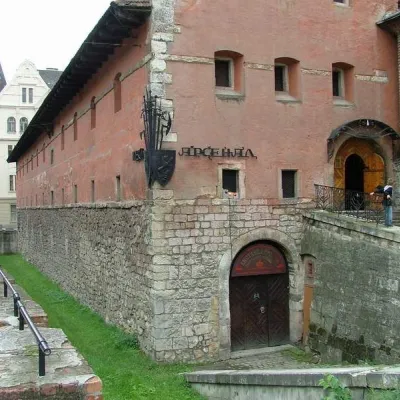 MuseumArsenal Arms Museum, Lvivunder 1 km from Ruins of the Golden Rose Synagogue ("Space of Synagogues"), LvivThe Arsenal Historical Arms Museum is located on one of Lviv's central streets. It first opened its doors to visitors on May 18, 1981.
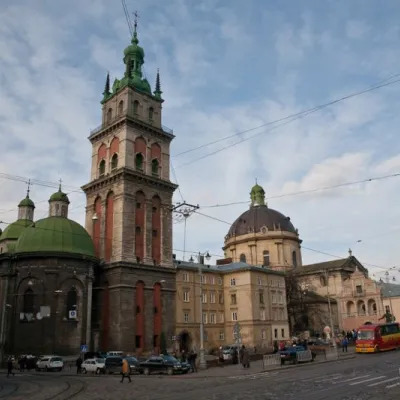 ChurchChurch of the Assumption of the Blessed Virgin Mary, Lvivunder 1 km from Ruins of the Golden Rose Synagogue ("Space of Synagogues"), LvivThe Assumption(Walnut) Church in Lviv, also known as the Stavropegial Church of the Assumption of the Blessed Virgin Mary, is a functioning stone church in Lviv, built...