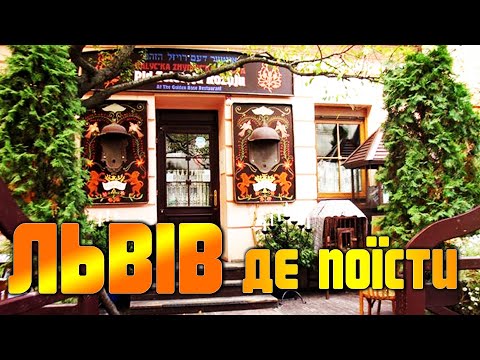
Jewish Quarter, Lviv
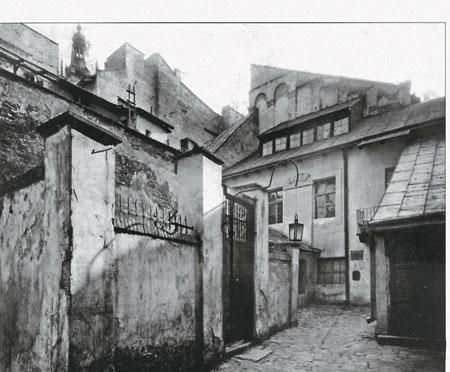
TheJewish Quarter is a medieval Jewish ghetto in Lviv that existed during the Polish period of the city's history. Jews have been known in Lviv since 1352, when they settled at the foot of the Vysokyi Zamok mountain and formed a suburb (which later grew to become known as the Krakivske suburb). In the second half of the fourteenth century, a separate community was formed in the city itself, within the city walls. The first mention of the Lviv city community dates back to 1387.
Urban Jews had the right to live only within their own neighborhood. The ghetto had two main streets: a part of modern Ivan Fedorov and Staroyevreyska streets. The eastern border was the wall of the city arsenal, and the southern border was the city wall. The western border was formed by a wall protecting the quarter from Shkotska (now Serbska) Street. To the north, Jewish houses were adjacent to the backs of houses on Ruska Street. At night the Jewish Gate was closed from the city and from the inside.
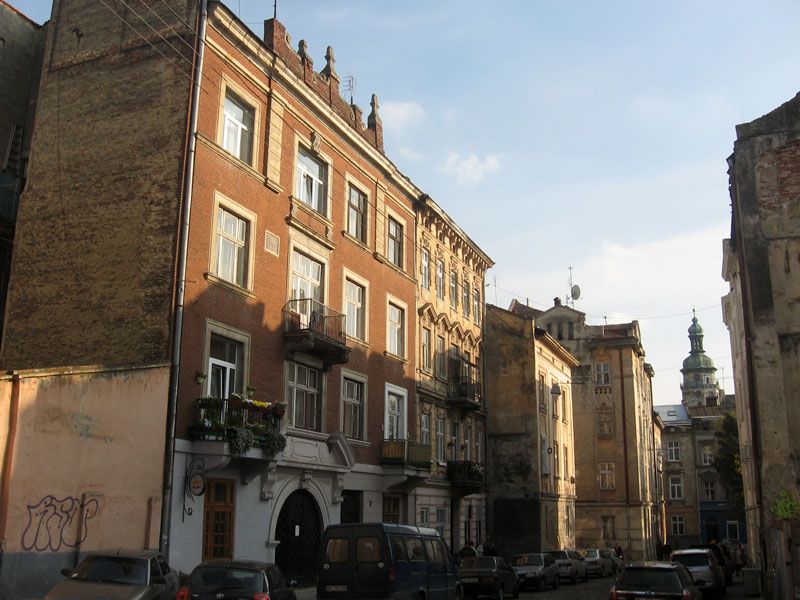
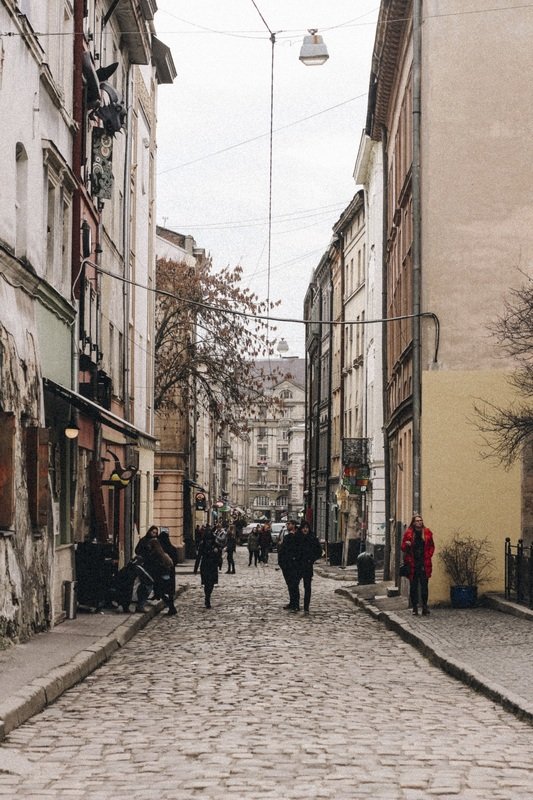
Staroyevreyska Street is one of the longeststreets in the historic part of the city, 400 meters long. The street was laid in the XIII century in parallel between the southern side of Rynok Square and the city walls.
The odd side of the former Vekslyarska street (from Halytska street to Serbska street) until the end of the eighteenth century was made up mainly of the backs of stone houses on the southern side of Rynok Square. At the same time, the rear sides of the even-numbered side of the street faced the High Wall (city fortification). After the High Wall was dismantled, the street Nowa (now Rohatynski Brothers Street) was formed. Until the middle of the nineteenth century this part of the street was inhabited mainly by Christians, in 1870-1940 Jews predominated among the residents; in the early twentieth century there were many furniture and leather goods shops. In the early twentieth century, Roman Catholics predominated among the inhabitants of the former Kapitulna Street, and Jews dominated Vekslyarska and Yevreyska streets .
The medieval Jewish quarter began on what is now Serbska Street. Jews were allowed to settle in the southeastern corner of the city center, and in the legal sense they were subordinated to the magistrate, unlike the Jewish community of the Krakow suburbs, which was subordinated to the royal starostas. The quarter was walled, and a wall also blocked the present-day Staroevreiska Street at the corner of Serbska Street.
After the second conquest of Lviv by Polish King Casimir III the Great in 1350, when the city was moved from the princely hail (present-day Staryi Rynok Square) to its present location, territories in the "new" Lviv were allocated for the three main ethnic groups of Lviv (Rusyns, Armenians, and Jews) to settle. Over time, the respective religious and ethnic centers with their main streets were formed on those territories: the Armenian one in the area of Virmenska Street, the Russian Orthodox one on Ruska Street, and the Jewish city district with its own special status and order in the area of the modern Staroyevreyska Street, part of Fedorova, Arsenalna, and Rohatynska streets.
In 1550, 352 people lived in the Jewish quarter, which had a separate synagogue and other religious and public institutions. The cemetery, first mentioned in 1441, was common to both the city and suburban communities.
In the Jewish quarter there were the Golden Rose synagogue, the Great City Synagogue, and the Beit Hamidrash Talmudic school. Unfortunately, all of these buildings were destroyed during World War II, and only the wall of the Golden Rose Synagogue remained.
The Golden Rose Synagogue was built in 1592-1596 by the Italian architect Pavlo Schastlivyi with the participation of Ambrose Prykhylnyi and Adam Pokora. The construction was paid for by Itzhak Nakhmanovych, a wealthy Lviv merchant, banker, and financier, and at the same time the head of the city's Jewish community. According to legend, the name "Golden Rose" is associated with the daughter of Itzhak Nakhmanovych, who agreed to become the king's wife in order to obtain permission to build the temple. And after the permission was granted, she jumped out of the window. According to another version, the Golden Rose (or Turei Zahav) was a dedication to one of the works of David ben Shmuel HaLevi, one of the most famous rabbis in Lviv. He often prayed in this synagogue. "The Golden Rose was considered one of the most beautiful synagogues in Europe.
The first stone structure of the Great City Synagogue was built in 1555 on the site of a wooden building known since 1320, which was destroyed by a fire in Lviv in 1527. In 1797 the building was dismantled and in 1801 it was replaced by a more spacious and luxuriously decorated one.
TheBeit Hamidrash (Hebrew for house of wisdom) was a Jewish religious school building that consisted of a library of Talmudic literature and a study hall, as well as a prayer hall. The first Beit Hamidrash in medieval Lviv was built in the seventeenth century of wood. It stood between the city synagogue and the Golden Rose. But by order of the Austrian government, the school was dismantled and a new one was built nearby. In 1870, Beit Hamidrash was rebuilt: A large classroom was added, and another tier was added over the prayer hall.
Now this historic square has become the Space of Synagogues. In almost two years, we managed to preserve the surviving remains of the Golden Rose synagogue and arrange a drainage system on its territory. The authentic foundation of the Beit Hamidrash was cleared of concrete and covered with white stone. A memorial installation called "Perpetuation" was also installed, featuring quotes from Lviv residents and Jews who were connected to the city.
Since the Middle Ages, numerous Jewish communities have found their homeland in Galicia, which was part of the amazing "Galician Babylon." On the eve of the Second World War, Jews made up 40 percent of the city's population in Lviv. The Nazi policy of the "final solution to the Jewish question," which meant the genocide of the Jews, led to the complete loss of the prewar Jewish community in Lviv. People and architectural monuments were destroyed. During the Soviet era, Jewish cultural heritage was silenced. All this led to the fact that only a few monuments of the Jewish past remain in the city. However, even this situation is too ambitious to attempt to showcase all of Lviv's Jewish sites in this guide. The proposed tour is rather a continuation of the words of Lviv historian Jakób Schall: "While other cities have mostly one Jewish center, Lviv has two: one in the old Old Rus' Lviv and the other in the new, so-called 'Kazimierz Lviv.
Thebuilding at 36 Staroyevreiska Street today houses a section of the Museum of the History of Religion dedicated to the tragedy of Jewry during World War II. The first part of the exhibition is divided into 4 blocks with conventional titles: "History," "Religion," "Family," and "Forerunners." The first three reveal the history of the city's Jewish community and various aspects of Jewish life in prewar Lviv, while the last one is devoted to the activities of those European politicians and intellectuals who contributed to the emergence of the anti-Semitic component of Nazi ideology and to the growth of anti-Semitic sentiment in European societies.
In the middle of Koliyivshchyna Square, there are the remains of an old well. Water was a strategic product for the city's residents, and so the authorities did not miss an opportunity to blackmail the community by closing the well and demanding additional taxes from the residents of the area. At the beginning of the nineteenth century the square was called "Jewish Square" (pl. Żydowski), and later - "Wekslarski" (pl. Wekslarski).
Turning left on Staroevrejska Street, you will come to the square near the arsenal. The Great City Synagogue used to stand on its site. The stone synagogue has been functioning since 1555 at 54 Staroyevreiska Street near the southeastern part of the city fortifications. At the request of the Austrian authorities, the synagogue was dismantled in 1797, and in 1799-1800 the Great City Synagogue was built on the same site.
Nearby, at the corner of Staroyevreiska and Serbska streets, there was a Beit Hamidrash ("house of wisdom "), a place for independent study of religious literature and prayer. The building was constructed of wood in the seventeenth century and rebuilt in stone in 1798. Thus, a Jewish spiritual complex was formed in the Jewish quarter of central Lviv in the early nineteenth century. Both synagogues were destroyed during the Nazi occupation, and now only archival documents, photographs, and attempts to reconstruct the foundations can help us to get an idea of what these buildings looked like.
If you walk further down Arsenalska Street, under the wall of the city arsenal, you will find yourself in front of house number 3, where the Tarbut Cultural and Educational Society operated before the war, and where house number 7 was at various times a ritual bathhouse-mikvah, a Jewish prison, and the Abraham Kohn School for Girls.
From here, you should return to Staroyevreyska Street to see house number 34. Here are the remains of a special sign, an emphyteusis, which meant the right to own a land plot for life. The owner of this building in the seventeenth century was Shlomo Frydman. On the right side of the doorposts of buildings 11-15 and 17, you can find recesses where an integral element of a Jewish home used to be located: a mezuzah, a case containing parchment with a part of a prayer.
Leaving the center of Lviv and heading north toward Teatralna Street until it intersects with Horodotska Street, we pass the Latin Cathedral (XIV-XV centuries), the main church of the Roman Catholic Church in Lviv.
It is worth taking a few steps to the small Shevska Street, which leads to Rynok Square. House 12 was home to the famous restaurant Naftuly Tepfera, a place that was popular among artists and ordinary Lviv residents. Ivan Franko and the artist Ivan Trush recalled the good liquor and atmosphere at Naftula's. Among the talented, but mostly unrecognized creative youth, Naftula's tavern was known as "Pekelko."
Returning to Teatralna Street, we cross Horodotska Street and end up in one of the oldest districts of Lviv, founded in the time of King Danylo. The center of the suburb was Staryi Rynok Square, which was a major trading area at the time. After the center was moved to a new location in the fourteenth century, the Jewish population became the main community in this space. In the nineteenth and first half of the twentieth centuries, Jews owned most of the shops and workshops in the buildings around the present-day Staryi Rynok and St. Theodor's squares. In the first half of the twentieth century, a significant part of the inhabitants of this district received the nickname "Krakidaly" from the name of the nearby Krakow market.
It was here, on the territory of the old suburban district, that the main shrines of two new religious movements found their place: Hasidism and Progressive Judaism (Haskalah). The influence of Haskalah, the Jewish enlightenment, grew in Lviv after Galicia became part of the Habsburg monarchy in 1772. This movement also affected Jewish religious life, leading to the spread of progressive Judaism. In the synagogues of this movement, organ music and choral singing were used, and women sometimes prayed together with men. Haskalah's supporters were called Maskilim. In 1843-1846, the Tempel synagogue of progressives (architects Ivan Levytskyi and Johann Salzman) was built on the Old Market Square. It was a gathering place for maskilim, where prominent intellectuals and enlighteners such as Jakub Bodek and Abraham Kohn discussed the future of Jews in Galicia. The synagogue was burned to the ground in August 1941, at the beginning of the German occupation of Lviv. A memorial plaque is installed in the square.
Next to the square, Sianska Street begins and leads to the site of the Predmiska Synagogue. Its first building on the corner of Syanska and Stara Streets was wooden (now part of the Dobrobut market). It burned down in 1623, but in 1632 it was rebuilt as a stone synagogue. The synagogue of the Krakow suburb, the only stone building in the neighborhood, repeatedly had to become a defensive stronghold. The synagogue was blown up in the fall of 1941. Just across the street, on the wall of house #4 on Syianska Street, there is a memorial plaque that states that from 1791 to 1941 another synagogue, Hasidim Shul, was located there, the first Hasidic shul that was independent of the local Jewish community, the kahal.
Hasidism as a new trend in Judaism emerged in the mid-eighteenth century and did not immediately become popular, and it met with strong resistance from the rabbis of the time. During the years 1772-1784, rabbis repeatedly imposed cherem (ban, excommunication) on the followers of Hasidism, so the Hasidim began to build their own synagogues, which, depending on the direction of the Hasidic movement and their size, were called either "kloitz" or "shul." The first such kloitz in Lviv was the Hasidim Shul synagogue. The synagogue building was severely damaged after the pogrom of 1918 and was finally destroyed by the Nazis during World War II.
Starting in the mid-nineteenth century, positive changes in attitudes toward the Hasidim took place in Lviv. A new movement called "hiddushim" (innovators) was organized among the Hasidim of Galicia. As early as 1840, Hasidic innovators opened a Talmud Torah (religious school for boys) at the intersection of Uhilna Street and St. Theodore's Square. Nearby, in 1842-1844, a synagogue called the Jakub Glänzer Shul was built at the expense of a Lviv merchant and philanthropist, Jakub Glänzer. During the war, the Nazis closed the shul and used it as a warehouse. In the postwar period, the activities of the Jewish community were regulated by the Soviet authorities, and there was one official synagogue in the city, in the premises of the prewar Jakub Glänzer Shul. In 1962, after the death of the last rabbi, the synagogue was closed under false pretenses. After Ukraine gained its independence in 1991, the Sholem Aleichem Jewish Society began operating here.