Lviv City Hall
Looking at the city hall (from the German word Rathaus, meaning council house), one would never think that Lviv residents once called it an "ugly quadrangle with a chimney." The current Lviv City Hall is the fourth in the history of the Lion City.
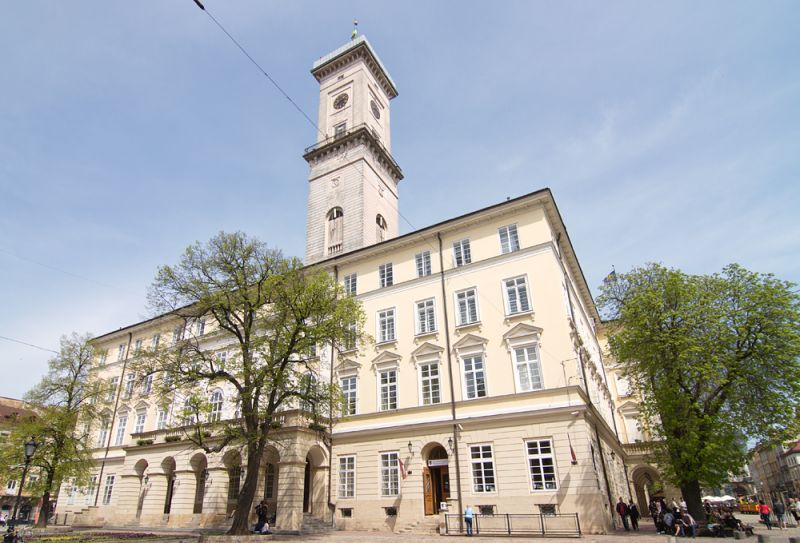
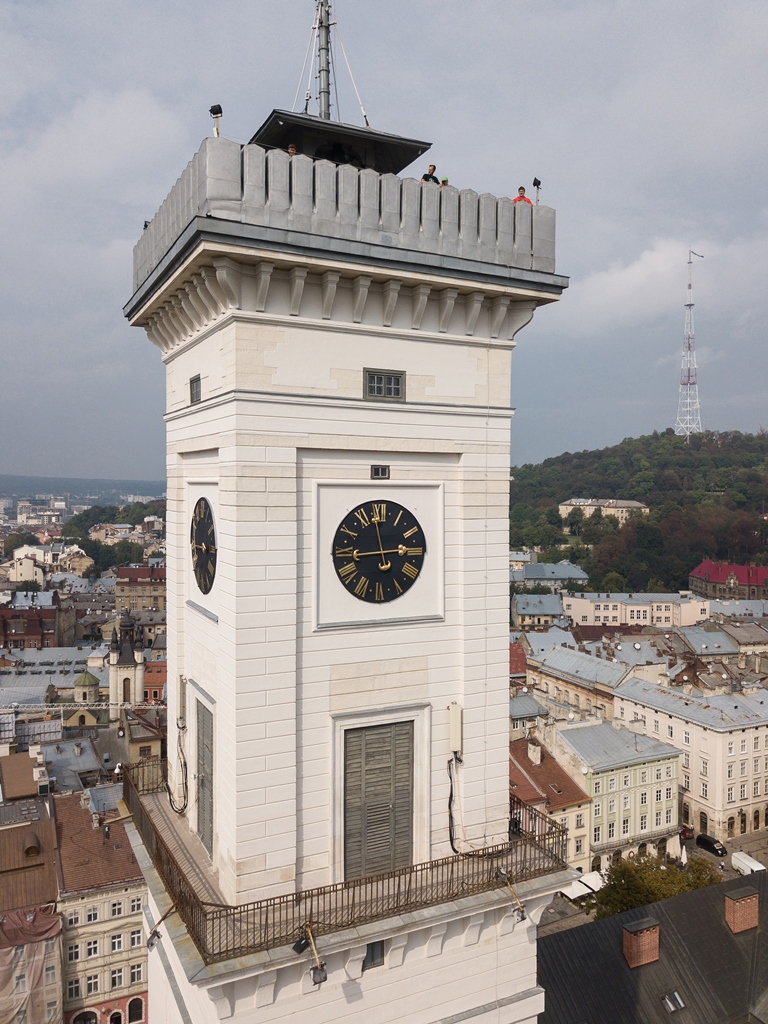
Lviv City Hall is an administrative building in the central part of Lviv, at 1 Rynok Square. Throughout its existence, the Town Hall has been the seat of Lviv's central city government. Today it is the seat of the Lviv City Council. It is an architectural monument of national importance and a UNESCO World Heritage Site. The modern tower of Lviv City Hall is 65 meters high and is the tallest in Ukraine.
An early 20th-century historian Franciszek Jaworski claims that Lviv did not have a city hall in princely times, although Magdeburg law was introduced to some extent even then. The cornerstone, in his opinion, should have been laid by Casimir III after the confirmation of the granting of Magdeburg law (1356), along with the relocation of the city center and the foundation of the future Latin cathedral. However, Jaworski himself pointed out that there are no documentary references to this. The version also does not correspond to the latest ideas about the origins of the city center and the cathedral. According to them, the city center was planned in the second half of the thirteenth century. In turn, the cathedral was probably founded after the death of Casimir III, in the 1380s.
According to the historiographical tradition, the construction of the first, probably wooden, town hall was completed by Prince Władysław Opolski, who ruled Galicia in 1372-1378 as a vassal of the Hungarian king with the title of ruler of Rus. The first mention of the town hall was made by Bartłomiej Zymorowicz in his description of a fire in 1381, when it burned to the ground. But in 1382 the town hall was mentioned again as already existing. Early references to it are very scarce. It seems that the town hall was a typical one, close to those built in German cities based on Magdeburg law. It consisted of a trading hall and a meeting room. In 1387, the magistrate forbade the sale of wine anywhere except in the town hall's beerhouses, which makes it clear that there were beerhouses that were rented out. The town hall tower must have been made of wood, as there are records of repeated expenditures for material and carpentry work on it. The first mention of a clock dates back to 1404. In 1414, a pond was created nearby for the needs of fish traders, and a stone bridge was built over it. In 1425, expenses were recorded for the installation of a pranger (shameful pillar) nearby.
Over the centuries, all parts of the town hall were changed and expanded. At the end of the XV century it was decided to expand the town hall. The western part of the building with the tower was dismantled, and on August 10, 1489, the cornerstone was laid with the participation of King Jan Olbracht. The nature of the expenditures suggests that the new building was quite monumental. The tower was built by the builder Hans Stecher, who led a team of 17 laborers. The carpenter Kapinos was also involved. Most of the work was completed by 1491, but the building was not finished until 1504, when a new clock was installed.
In 1527, during the great fire of Lviv, the town hall did not burn to the ground, but was severely damaged. In 1532, seven bricklayers under the direction of master Oprelich began restoration work. At the same time, a new tiled roof was made. In 1539-1540, the master builder Luka, led by a team of 7 comrades, 2 apprentices, and 16 workers, repaired the town hall tower. In 1557, the clock face was installed and painted by Lviv painter Augustyn. In 1571 the town hall survived another fire.
In 1617, Martin Campian convinced the city council to build a new tower. He paid for the materials and labor of the builders at his own expense. He also used funds from the royal treasury, which were fundamentally intended to ensure the city's defense. In 1619, the construction of the new 8-cornered tower was completed and decorated with sculptures by Andreas Bemer and Bernard Dyckembosch. The tower was used to praise Campian. Fragments of the sculptures that survived the fall in 1826, including coats of arms, probably by Bemer, were kept in the Lubomirski Museum in Lviv.
At the beginning of the nineteenth century, the old town hall consisted of several buildings facing the front toward noon. The middle building was the oldest, with its foundations reaching back to the beginnings of the city; to the right and left were later additions. The main entrance was in the left wing. A wide staircase and a semicircular gate supported by steel pillars led to it; behind it was a hallway and a hayloft with stone stairs to the floors. The most magnificent room in the house was the room of the "gentlemen" or "consular". The city council met here. The council consisted of the richest citizens, the city's "patricians," Catholics, Germans, and Poles. They ruled the city without regard to the resistance of the poorer population. The Stavropegian Brotherhood, on behalf of the Ukrainian community, spent many years negotiating with the city to get Ukrainians admitted to the council. At the end of 1745, the process ended happily, and the first Ukrainian, Heorhii Kotsii, was elected to the city council.
The council chamber was famous for its wealth. There was an expensive collection of oriental carpets, precious candlesticks, clocks, images, maps of parts of the world, a large coat of arms of Lviv, and more. The Rada received guests and embassies here. Bohdan Khmelnytsky's ambassadors also visited the building: In 1648, Zakhariy Khmelnytsky, the hetman's brother-in-law, and in 1655, Pavlo Teteria and Lesnytsky. On the side of the council chamber was a treasury where the city's privileges and various jewelry, both city and private, were kept. On the floor above the council chamber was the hall of the Lavnyk's court, where an ancient image of the "terrible court" hung. Further on, there were rooms for various city offices. Separately, there was a room for the 40-man board, which was established in 1577. It included representatives of craftsmen, the poorer bourgeoisie, and delegates of the "Russian nation" (Ukrainians). The Ukrainian representatives repeatedly criticized the city council in bitter terms for its self-righteousness and injustice against the poor.
Behind the town hall stood an old tower 58 meters high. It was four-walled up to the fourth floor, and eight-walled above; its top was covered by a tin-covered bathhouse with a steep tower. On the top of the tower was the Polish coat of arms and a lion, which has been preserved to this day. In 1672, during a severe storm, the lion fell from the tower, which was considered an omen for the city, as the city was under Turkish siege that year.
The town hall has witnessed many historical events. In 1564, the Moldovan ruler Stefan VII Tomșa was executed here, and in 1578, the leader of the Cossack-peasant uprising Ivan Pidkova was executed here.
The walls of the town hall were dilapidated in the late 1780s. In 1790, the city purchased one of the 12 buildings on the north side of the town hall to replace its old premises with new, more spacious ones. At the beginning of the nineteenth century, a project was developed according to which all parts of the town hall, except for the tower, were to be demolished. Weakening of the town hall tower foundations led to its destruction on July 14, 1826: the longitudinal 4-sided part "started to shake" (i.e., "began to crack" or sway) in the afternoon, and at a quarter past 7 it collapsed, falling apart on two sides. A trumpeter, 2 soldiers, and several workers were killed.
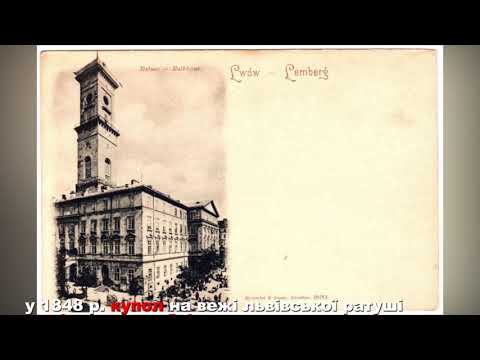
The cornerstone was laid on October 21, 1827. The celebration was opened by Bishop Jan Antoni de Potocki of Przemyśl with a service in the Latin Cathedral. Afterward, in front of a specially arranged altar at the site of the future construction, Archbishop Andrzej Ankwicz of Lviv, in the presence of Governor August von Lobkowitz, Mayor Jan Gomme, and a large number of Lviv residents, held a service and blessed the stone, which contained a capsule with a commemorative act and coins of the time. The foundation stone was laid on the western side of the future building. The historian Franciszek Jaworski claims that the construction lasted from 1827 to 1835 according to a joint project by Franz Trescher and Josef Markl, approved in Vienna. There is, however, a version by Franz Ciszyszek that Markl built the town hall together with Josef Wondrashka under the supervision of Jerzy Hłogowski in 1828-1835. This version is also favored by Tadeusz Mankowski. For a long time, it was impossible to lay the foundations of the northern wing because the issues with the owners of some middle-market houses, the last of which was demolished only in 1832, had not been resolved. The town hall is made of brick, four-story, square in plan, with a courtyard. A clock tower rises above the town hall. The cost of construction was 800,000 gold market marks.
The architecture of the new town hall was criticized by contemporaries. Later, in the early twentieth century, Franciszek Jaworski called it ugly and compared the tower to a chimney. The Ukrainian art historian Dmytro Stepovyk had a much better opinion of the town hall. He considers the restrained decor to be optimal, as it does not offset the beauty of the valuable surrounding monuments, and the massive block of the building, in his opinion, "organizes the entire square." Another art critic, Volodymyr Ovsiichuk, generally supports these views, but describes the character of the building as "cold state property."
In 1837, the offices of both senates of the magistrate and all its departments were moved to the building. In the same year, the first art exhibition in Lviv was held on the first floor of the northern wing. On the morning of November 2, 1848, during the revolutionary events in Lviv, the city center was shelled by Austrian artillery and the town hall was severely damaged by fire. The dome of the tower collapsed, destroying the clock and bells. The 25 arabesque bas-reliefs by Johann Schimzer, which had been temporarily stored in the attic since 1847 and were intended for the southern façade, were lost. In 1851, the building was renovated according to a project by Johann Salzmann (Alfred Bojarski Czarnota was also among the specialists who worked on the reconstruction). The dome top was replaced with a dentil top. The construction was carried out by Wilhelm Schmid, Vincent Ravsky Sr. and Josef Franz. In 1852, a new clock was installed on the tower.
In the late nineteenth and early twentieth centuries, a number of projects for the reconstruction of the town hall were created. But none of them were realized. In 1928-1929, the architects Witold Rawski and Rudolf Martulia reconstructed the interiors in the style of constructivism. The ceiling of the main hall was replaced with a new reinforced concrete one. Ravsky designed new rocaille paintings for the hall to replace the old Secessionist ones. He created sketches of new lions at the entrance, which were not realized.
During the November Rally, centurion Dmytro Vitovskyi handed rifleman Stepan Pankivskyi (with him were also riflemen Mykola Konyk, Lev Getz, Zenon Rusyn, and Mykola Pachovskyi) the Ukrainian national flag, which had been sewn by the wife of the director of Narodna Torhivka, Maria Lazarko, and brought to the headquarters of the Military Committee, and ordered it to be fixed on the spire of the city hall, which was done.
Since 1939, the building has housed the Lviv City Council. The entrance to the town hall is free, and there is a paid observation deck on its tower that offers a view of the city.
In the summer of 1944, the UPA and the Home Army tried to take control of the city; in particular, the Polish flag was hanging on the town hall before the arrival of the Soviets. O. Marchenko became an honorary citizen of Lviv. In his honor, a memorial plaque was erected on the City Council building with the inscription: "On this building on July 23, 1944, tanker Sergeant Oleksandr Marchenko planted a red flag, marking the liberation of Lviv from the Nazi invaders." In 1970 (according to other sources, 1977) a memorial plaque was installed on the façade in honor of the first May Day in Lviv in 1890. Sculptor Mykola Posikira. Cast in bronze at the Lviv Experimental Ceramic and Sculpture Factory.
On the 27th anniversary of Ukraine's Independence in August 2018, the architectural lighting of the Town Hall was carried out by the World of Safety and Comfort and LichtForum.
The earliest information about the Town Hall clock (the first city clock in Lviv) dates back to 1404. During the reconstruction of the town hall and tower in 1491, a 1.1-ton clock bell made by the foundryman Valentyn Felten was placed on the tower. This bell was used to strike the hours manually until the monk Gregory (Gregorius monachus) made a new automatic clock that struck the hours and was installed on the tower in 1504. The clock was decorated by the painter Jan, for which he received 4 red gold pieces. Zymorovych mentions this clock in his works. In the fire of 1527, when the whole city burned, the clock survived, but, like the tower, it needed repair. These works were performed by the craftsman Lukasz. After 20 years, the clock was repaired again, during which the ropes were renewed, new stone weights were hung, etc. In 1557, stonemason Pavlo made four dials for the clock on the town hall and decorated them with carvings of angelic heads, and the artist Augustyn represented the movement of the sun and moon on the silvered dial. At the same time, the clock was equipped with an additional bell for chiming quarters.
In 1571, the town hall and clockwork were again damaged by fire. A clockmaker from Przemyśl, Balthazar Śląwick, found that the old clock was not suitable for use at all, so it was dismantled and the clock from the Galician Gate was temporarily installed in its place. To make a new clock, the master craftsman Melchior Tyl was invited from Slesko. Work on the new clock lasted two years and in 1574 it was installed on the tower. The restoration cost 220 Austrian forints and was financed from the city treasury. Subsequently, a bell was hung that chimed every 15 minutes, a large iron cross for the hands, new weights, two ropes 36 fathoms long, which were regularly lubricated with linseed oil and grease, and new gilded dials were installed. Sebastian Klenovych dedicated several lines to this clock in his Roksolania:
- "There, the clock on the tower counts the silent hours,
- In its constant knocks, its changes in time sound.
- The lever of the clock turns all the cog wheels
- And it accurately measures the time that runs away somewhere.
- The clock caresses our ears with its double chime,
- Each time it reminds us that a part of time has passed,
- As if to say that time lost cannot be returned,
- And always teaches us that it is a precious thing for everyone.
-
In 1619, the mayor of Lviv, M. Campian, rebuilt the Gothic town hall in accordance with the Renaissance fashion. At that time, two medieval bells were added to the tower. In 1721, a new clock mechanism was purchased, which was replaced in 1788 with a clock purchased from the disbanded Jesuit Fathers' Church. The clock and bells were broken on July 14, 1826, when the old town hall collapsed.
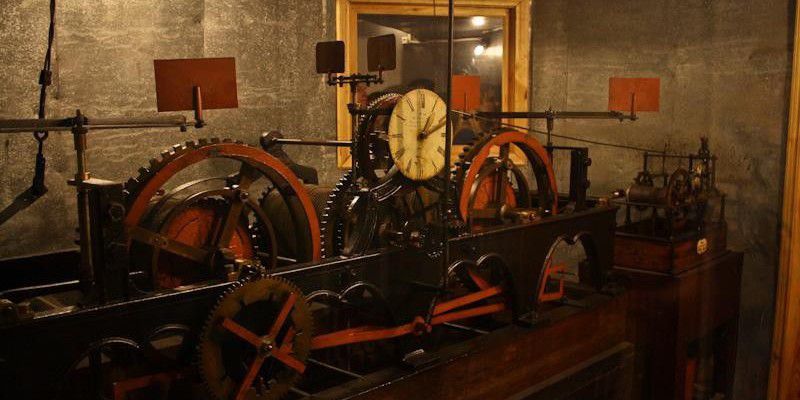
In 1836, a clock made at the Vienna Polytechnic Institute was installed on the newly built tower. Professor Stempfer was in charge of the clock. However, the new clock functioned only for 11 years, until 1848, when during an artillery attack on Lviv by Austrian troops, the clock, along with the town hall tower, burned down. After the tower was rebuilt in 1851, a new clock was installed, also made in Vienna, by the famous Austrian company Wilgelm Stiehl, and it still works today. This is one of the last mechanical tower clocks in Europe. The clock's mechanism is located at a height of 75 meters, with 255 steps from the fourth floor of the town hall to the cabin where it is housed, and a total of 364 steps to the observation deck on top of the town hall, under the bells. The clock weighs 2.5 tons, the diameter of the dial is 2.7 meters, the length of the big hand is about 2.15 meters (weighing 15 kilograms), and the small hand is 1.7 meters.
The smaller bell of the clock was cast in the workshop of Jan Belman in Lviv in 1835. It was his voice that told Lviv residents to turn off the lights at exactly 11 p.m. The larger clock bell was cast in 1849 by the Viennese master Hiltzer. It is inscribed in Latin: "Good people, do not sleep through the kingdom of God." It weighs 700 kilograms and is unique in its components. It contains 280 kilograms of silver and copper and 140 kilograms of cast iron alloy. It is credited with the magical ability to grant wishes, so everyone who knows about it is sure to scramble a couple more meters to touch its magic metal.
One of the most famous legends associated with Lviv's Big Ben is the story of the monk Hryhorii. In 1348, Lviv City Hall was on fire. The fire caused considerable damage to the clock. By some miracle, the second mechanism, the heart of the clock mechanism, survived (it has not seen any repairs or restoration since then). But the bells were silent. After all, the gears that set them in motion were shattered. The restoration lasted two years. At that time, a monk named Heorhii lived in the town hall and rang the bells every 15 minutes. Neither the townspeople nor even the administration of the town council knew about the existence of the mysterious monk. When the gears were restored, the monk was no longer needed. When he went to say goodbye to the mechanism, his heart gave out and he died. Since then, a legend has emerged about a coffin with a black monk that allegedly flies around the town hall at twelve o'clock in the morning.
There are some other interesting stories associated with the life of Lviv watchmakers. Until the sixteenth century, clocks were usually taken care of by monks. One of the reasons was to prevent "evil spirits" from settling in the complex clockwork. It was believed that a watch tended by a "man of God" would never mislead.
Until recently, until 2000, ordinary citizens were not allowed to see the clock, as the town hall tower was considered a strategic object. Now the entrance to the town hall is free.
-
In the XV-XX centuries, the town hall bellman served on the town hall tower. He was supposed to monitor the safety of the city around the clock, announce the exact time with a signal, play solemn music on holidays, and sound the alarm in case of an enemy attack or fire. The tradition of playing the trumpet at Lviv City Hall was revived in 2011. Nowadays, various events take place in the courtyard of Lviv City Hall to the sound of the bugle, such as antiques sales.
Today, Lviv City Hall is a UNESCO World Heritage Site, and its 65-meter tower is the tallest in Ukraine.
Lviv City Hall is located at 1 Rynok Square. Tram #1 goes here. Anyone can come here. However, the entrance to the tower itself is paid.
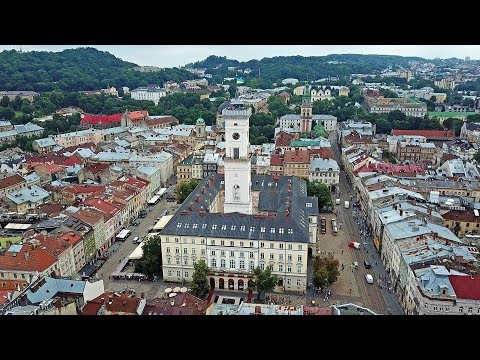
Be warned: it is difficult to get to the observation deck via a narrow spiral staircase. But it's worth it, because the town hall offers a wonderful view of the historic part of Lviv.
Town Hall opening hours: daily from 9:00 to 21:00 (in summer) and from 9:00 to 18:00 (in winter).