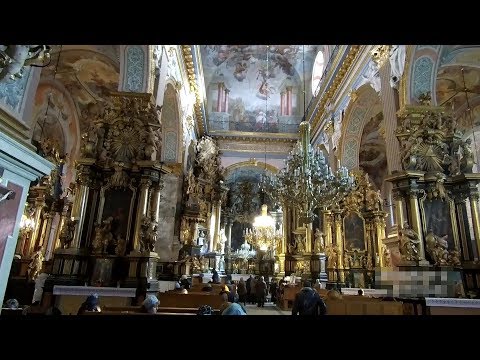
St. Andrew's Church, Lviv
St. Andrew's Church, formerly the Bernardine Church and Monastery, is a Greek Catholic religious building, a historical and architectural monument located in Lviv at 3a Soborna Square. St. Andrew's Church in Lviv has a complicated but quite interesting history of creation. It was the first stone church of its kind, built in the early 17th century. Its architects are representatives of different styles of construction. P. Romans preferred the Renaissance style, A. Bemer - Baroque. However, these two styles were so harmoniously combined that St. Andrew's Church is still considered a masterpiece of Lviv architecture.
The premises of the monastery now belong to the Central State Historical Archives in Lviv, and the Church of St. Andrew the First-Called of the Ukrainian Greek Catholic Church is served by priests of the Basilian Order.
As a result of the Polish-Hungarian conquest of Galicia, Roman Catholic orders began to expand and build their monastic network. A wooden monastery was built on the site of the present building in the fifteenth century. The first mention of the first wooden Bernardine church is found in 1460. Lviv starosta Andrii Odrovonzh from Sprava donated money for the beginning of construction (a land plot was allocated near the Halytska gate, and a small wooden monastery with a chapel of St. Andrew was built). In 1464, after the plague (one of 5 monks survived), the townspeople burned the wooden monastery with a chapel; in 1465, the founder A. Odrovonzh allocated funds for the construction of a much larger wooden church and monastery. In 1470-1484 Jan of Dukla lived in the monastery.
In 1511, the wooden monastery burned down during the siege of Lviv by the Moldovan ruler Bohdan III the Blind. It was rebuilt in 1514 with a Prussian wall (i.e., half-timbered construction) made of wood and brick.
In 1601, the land plot was expanded and the construction of a new monastery began without royal permission. The city authorities opposed this because the monastery was located outside the city fortifications. King Sigismund III Vasa set up a special commission to consider this issue (including Stanisław Żółkiewski, Lviv Latin Archbishop Jan Dymytr Solikowski, and Lviv starosta Yurii Mniszek) - based on its conclusions, in 1603 the king allowed the construction on the condition that the monastery would have its own fortifications, which would be part of the city's defense system. The case was also reviewed by the royal engineer Friedrich Getkant. Sigismund III and Yuri Mnieszczek provided the main funds. Later, Stanisław Żółkiewski and Jan Zamoyski also financed the construction.
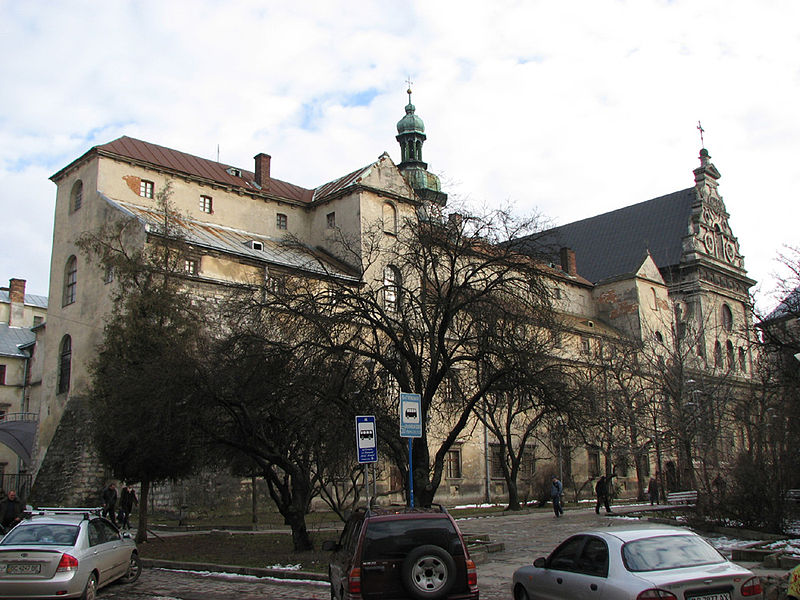
In the 1600s and 1630s, the monastery cells were built along with the structure of St. Andrew's Church: they were erected to the north of the church, while the old wooden church remained in the south. The monastery was surrounded by stone walls with loopholes and a tower; outbuildings such as a smithy, stables, and others were attached to them. Around the monastery there was once a cemetery (in particular, in 1484 St. John of Dukla was buried there). The brick cell building was built close to the northern wall of the church; it has a complex plan with a square cloister and a corridor system of layout. The premises are covered with vaults; the building is 3-storey in total, with separate 4-storey parts. In 1600, Dymytro Solikowski donated funds for the construction of the monastery and consecrated its cornerstone.
The Bernardine monastery has long been an outer outpost of the Lviv fortification system. Its own system of fortifications allowed it to perform this defensive function and, if necessary, it protected the eastern borders of the city with flanking fire. The Galician Gate and the Royal Bastion were located in this system of city fortifications, which it was a part of. Today, only the eastern wall of the fortifications and the Clay Tower on the side of Mytna Square have survived. In 1618, a gate was broken through in the tower, but due to the city's security, it was closed in 1620. The passage was restored only in the XX century.
In the 2000s, the so-called Bernardengarden, or Bernardine garden, appeared under the walls of the monastery on the side of Valova Street. The Museum of Ideas and other organizations hold artistic events there and on the street. The most famous events are the summer "Kinolev" and the winter-spring-autumn "Lviv - the Capital of Crafts". The Museum of Ideas itself settled in part of the monastery's basement, where it now holds various exhibitions and presentations.
On December 27, 2007, frescoes dating from the late seventeenth and early eighteenth centuries were found in one of the cells. According to experts, the frescoes have iconographic and historical value. The cell itself is the only cell known in western Ukraine with a fresco. In January 2008, preparatory work began to restore the fresco. Several stages of work are planned: cleaning, restoration, conservation, and then the exposition of the mural.
In 2012, an international competition was held to design the reconstruction of the monastery courtyard. The jury received 160 projects. The project by Hungarian architects Peter Szabo, Eva Deri-Papp, Andras Hazdag, and Tamás Karacsonyi won. The projects were exhibited for 3 weeks at 10 Rynok Square.
In 1784, the Austrian authorities established the "Archive of Lviv City Council and Zemstvo Acts" in the monastery cells. The archive contains documents of the period of the Galicia-Volhynia principality, fonds of central institutions and organizations of the Old Polish period (XIV-XVII centuries), Austro-Hungarian (1772-1918) and Russian (1914-1915) rule in Galicia, the Ukrainian People's Republic and the Western Ukrainian People's Republic (1917-1918), Poland of the interwar period (1918-1939), as well as small groups of documents of the Soviet period (1939-1941) and German occupation (1941-1944).
The oldest documents in the archive are represented by a collection of parchment charters dating from 1176-1800. Among these parchment documents are interstate agreements (in particular, the Union of Brest in 1596), papal bulls, privileges of kings, princes, voivodes, and starostas granted to cities, villages, churches, churches, monasteries, synagogues, and workshops, as well as estate deeds. The collection also includes charters from France, Italy, Moldova, Wallachia, Germany, Hungary, and other countries-in thirteen languages in total.
The modern Central State Historical Archives in Lviv is one of the largest archives in Central and Eastern Europe and the largest in Ukraine.
The church-basilica was built from 1600 (on September 16, 1600, without waiting for the king's permission, the cornerstone was laid and consecrated) to the 1630s on the site of its wooden and brick-and-wood predecessors from the 15th century in the traditional way in Rus' at that time: the old half-timbered church was not dismantled, and new brick walls were built outside. After the new church was covered with vaults, the old one was dismantled and the remains were taken away in 1614). The author of the construction plan was the monk Bernard Avelides (Avelid). The architect was the Italian Paul the Roman, and the façade of the church clearly shows his creative handwriting, the Renaissance style that was familiar to him.
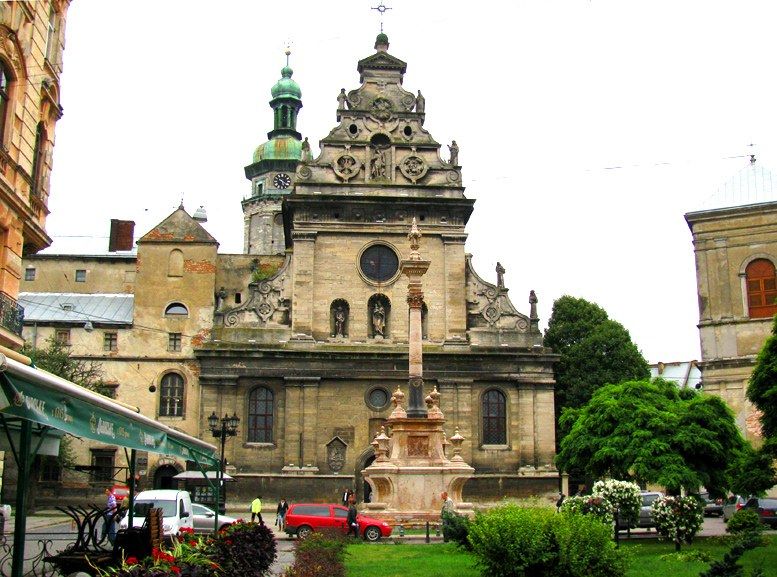
The church was built of hewn stone (King Sigismund III issued a special permit for the extraction of this stone in 1602) in the form of a three-nave basilica with elongated choirs and a faceted apse. The church is 57.5 meters long and 22 meters high. The main façade has two tiers, designed by different architects in a slightly different style. The lower tier is in the traditions of the Italian Renaissance, characteristic of the creative style of Paul the Roman. The division of the lower tier of the façade by paired pilasters clearly reveals the three-nave composition of the church; the side facades are designed in strict and clear forms.
This is contrasted by the complicated outlines and plasticity of the pediment, the upper tier of the main façade, designed by Andreas Böhmer in the style of the Northern German-Flemish Renaissance (Mannerism).
Paul the Roman failed to complete the construction and died in 1618. It is said that King Sigismund III of Poland, who inspected the construction, found Paul the Roman's plan too modest. Therefore, the Swiss (or Italian, who managed the building in 1613-1617) architect Ambrose Prykhylny, a student and successor of the prominent architect, designed the building differently. He is credited with the shield-fronton of a complicated and intricate shape. Ambrosii Prykhylnyi built the building itself in the style of German-Dutch Mannerism.
The third tier was added by Andreas Bemer, a sculptor and architect from Wrocław; under his supervision, the church was completed in 1630. Most likely, the 38-meter-high church tower also belongs to him. In 1753, a clock with a chime was installed on it, for which the master Andriy Frank cast a special bell. The silhouette of the tower is cut, complex, characteristically baroque, elegant and very harmonious.
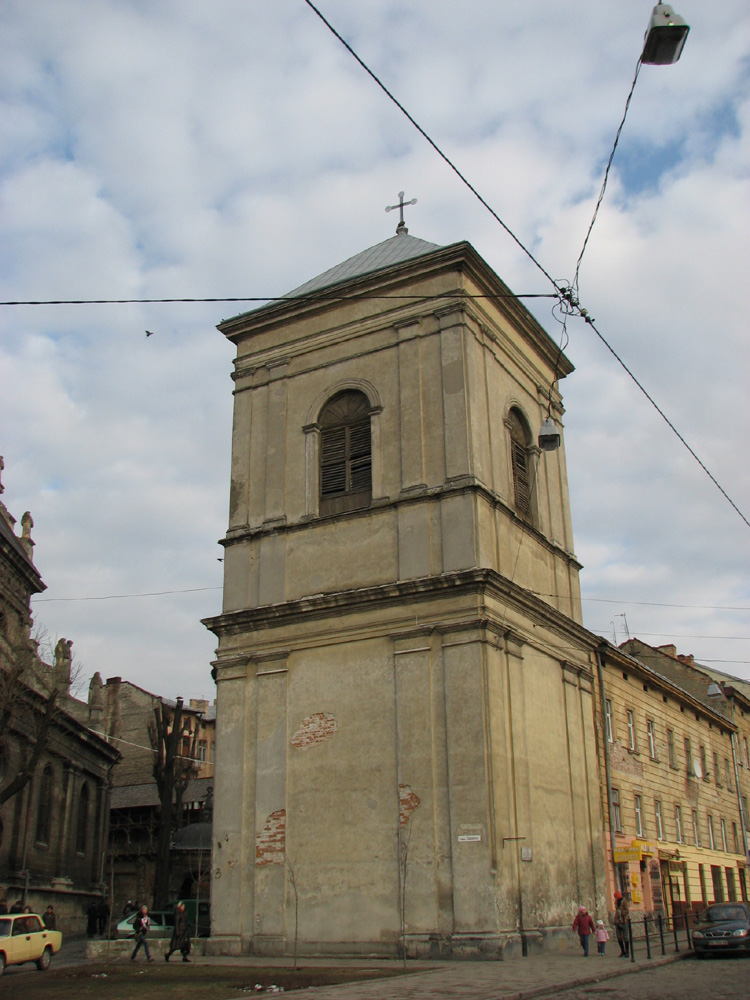
Thebell tower,which is located on both sides of the church, was built in 1734, but the modesty and simplicity of this two-story, square structure with a tent roof make it similar to Renaissance architecture. For a long time, the bell, cast in Lviv in 1588, hung on the bell tower. In 1917, it was moved to the John III Museum, saving it from being melted down for the military needs of Austria-Hungary in World War I. It was used to observe the area (once a sentry from the tower was the first to see an enemy army and gave a signal. In memory, the clock was set so that the next hour was struck 5 minutes faster than other city clocks).
The first Divine Liturgy was held in 1611, on December 13 (or November 30 (the date of 1609)), the day of St. Andrew. This is how the church got its name.
On the façade you can see statues of the Bernardine saints, and in the niches of the second tier there are sculptural images of the Mother of God and the Apostles Peter and Andrew.
The interior of the church was painted in 1738-1740 by Venedikt Mazurkiewicz, a Bernardine monk who studied in Bologna with the Italian artist Giuseppe Carlo Pedretti. Seventeen wooden altars, made in the 1730s and 1740s by craftsmen from Jarosław, Thomas Gutter and Konrad Kutschenreiter, have survived. The carved benches in the presbytery, restored in the early twentieth century, were made in 1640-1644 by the craftsman Paul of Bydgoszcz.
The floor of the church was originally made of hewn stone, and in 1738 it was changed to marble. The metal doors were made in the best traditions of the seventeenth century by Ukrainian blacksmiths. The church has an organ with 1700 pipes and 32 registers, which was created in the eighteenth century by the master Casparini from the Luzhytske Germans.
St. Andrew's Church was highly respected by the nobility. Military campaigns always began with a service in the church with the blessing of weapons. This was the case, for example, in 1604, when False Dmitriy I began his campaign against Moscow from Lviv. Before this campaign, False Dmitriy I married Maryna Mniszek in the church (in the old half-timbered church).
During the restoration work of 1976-1977, the wall of the monastery was restored and completely opened, along with the Clay Tower and the gate from Mytna Square. "Cultural layers" raised the city higher, and during the restoration the wall had to be dug up because the lower layer of large gray stones was in the ground. A canal was made along the wall to imitate a fortress moat, which sometimes fills with water in summer. At the same time, they opened the gates on the Hlynianska Tower, which was built in the middle of the seventeenth century. Nowadays, one of the branches of the underground passage under Mytna Square leads to it.
In the 1960s, under the defensive wall of the former monastery, near the Hlynianska Gate, there was a clock made of flowers that showed the time quite accurately, as for its specific structure. In the early 2010s, a new "flower" clock was installed on the outside of the monastery's defensive walls, and it is still in operation today.
In September-November 2008, the square in front of the church was repaired with new, wide slabs. The square was also fenced off with bollards, which made it impossible to park vehicles directly in front of the church.
Thewell was built in 1620 and is located to the right of the main entrance to the church, or to the south of the building in general, in the depths of the courtyard. There are several legends and stories associated with this well.
The rotunda over the well, built in 1761, is an open arched gazebo topped with a dome with a sculpture. The dome has a painting depicting the miracles of St. John of Dukla. The monument itself was restored in the 1970s.
At the end of the seventeenth century, a wooden column was erected in honor of John of Dukla and in memory of the siege by Khmelnytsky's troops.
In 1736, a stone column was built from the foundation of the Crown Prince Michał Józef Żewuski, which has survived to this day. The column was made by Thomas Gutter or Fabian Fesinger. Some researchers also claimed that it was designed by Mykhailo Severin Zhevusky.
Previously, the column had a sculpture of a saint - St. John kneeling with his hands folded in prayer. Since the sculpture disappeared after 1944, the column is now crowned with a decorative vase.
The church itself now contains a chapel with a tombstone (carved in 1608) of St. John of Dukla, and in the side altar is his icon, which appeared here "from the high religious feeling of Countess Sofia Fredro," the mother of Metropolitan Andrey Sheptytsky.
At the end of 2010, the restoration of the column began, which was suspended due to the onset of frost. The contractor was the Bud-Art company, with funding coming from the city budget.
In early January 2008, between Christmas and New Year's Eve, elements of the church's facade and the side wall began to be illuminated with a multicolored light - red, blue, white, yellow, and green, which changed in turn. A few days later, the entire facade was illuminated, albeit static, including sculptures of saints on the first level, the Mother of God and the Apostles Peter and Andrew on the second, and the central stained glass window. After some time, the well and rotunda were illuminated, on January 17 the bell tower was illuminated, and on January 18 the tower was illuminated.
On the wall of the church is a carved relief of a soldier kneeling and praying. Below the image is an inscription in Latin: "Here lies the noble Stanislav of Vyzhytsia, Kyiv's chorunzhy, Vonvelnyk, Tymbarkiv's starosta, colonel of the holy royal majesty, once a brave warrior, now a stinker and a worm. He lived for 66 years. He died in the year of our Lord 1680, on the 5th day of the month of June."
In the interior (on the walls of the presbytery) of the church , there are several images with stories of miraculous healings due to prayerful appeal to St. John of Dukla. Each of them is commented on in Latin:
- "The daughter of the bright Mrs. Balabanova, the headman of Terebovel, having drowned in the river and stopped breathing, came up and by the power of prayer came to life. 1551";
- "Agnes, the wife of a citizen of Lviv, the famous Matej Stemberk, is cured of epilepsy."
- "The son of a citizen of Belz, Matthias Spunoff Georgi, who was numb due to fever, regains his health and the gift of speech."
- "Gabriel, son of the noble Wolfgang Bernard Wolbornett, a Lviv rayon resident, after being ill for two years, recovered. 1505";
- "The widow Anna, a Lviv resident, who had an overbuilt jaw and a cloudy eye due to illness, is healed. 1506".
Quotes from theologians (held by angels):
- "Those who have atoned for their sins through repentance will receive an eternal share of angelic happiness. St. Augustine in his Monologues;
- "But since the Lord is patient, let us repent of these things and tearfully ask for his forgiveness. Jude 8:14";
- "Produce fruits worthy of repentance. The Gospel of Luke 3:8";
- "Do not be deterred from repentance by the severity of retribution, for the more sins you have committed, the more mercy St. Bernard will have."
- "Repent therefore and be converted, that he may have mercy on your sins. Acts 3:19";
- "Praise and praise again, for the gate is shut with fine bars and indestructible locks. No enemy enters, no friend goes out. St. Bernard".
There are memorial plaques to Stanisław Pilate and the Polish poet Cornel Ujski. They were buried: Stanislav Vyzhytskyi, son of Stanisław, grandfather of Mykola, Kyivan khorunzhyi, there was a magnificent tombstone of him, and Jan Fryderyk Sapieha.
Legends and curiosities
- Between 1650 and 1945, the complex was located, in different names, on Bernardine Square.
- A year later, a healing spring gushed from the place where St. John of Dukla was buried in 1484. This was regarded as a miracle, St. John was reburied, and a well was dug at the site of the spring.
- On September 8, 1604, a private Ukrainian-Polish army, which captured Moscow on June 20, 1605, dedicated their swords to the spring water at the burial site of St. John of Dukla (the patron saint of Lviv and patron of the military gentry).
- During construction in the early seventeenth century, the old church was not demolished, and a new one was built over it, erected like a tent. The old church was dismantled only after the construction was completed.
- In 1641, an unusual event took place in Lviv: a criminal court accused the monk Albert of Wirozem of blasphemy, who, having made a deal with the devil, gave him his soul along with his body. The court case materials stated that this was "the most shameful human act in the history of the city." It all started when Virozemsky, intending to become a monk, stole the monastery's seal and forged a document claiming that he was a priest of the order and could marry, confess, receive communion, and baptize children. The fake clergyman began traveling to villages around Lviv, conducting services and, of course, making money for himself. When the fraudster was exposed, he immediately fled the monastery, but the Bernardine monks managed to capture him and put him in the monastery dungeon. The monastery court was to sentence him to death. Albert's desire to live was so strong that he decided to sign a cirograph, or contract with the devil to sell his soul. The contract was written on the wall of the prison cell in blood: "I sign with my blood and submit to the power of Prince Lucifer. In exchange for this, I ask for twenty years of life, after which he has the right to take me with body and soul. In accordance with this contract, I renounce God and the Mother of God and give myself to the power of all devils, undertake to serve them and glorify them, and they must give me everything I need. I ask to be released from prison this very night. I sign this contract with Weglik, who will get me out of prison." Subsequently, at one of the court hearings, Virozemsky described in detail this mysterious Veglik, a mediator of the evil one, who looked like a young, attractive guy and came to him right through the cell wall. Virozemsky was examined and a wound was found on his finger, from which he drew blood for writing. After a long study of the case, the court found Albert Virozemsky guilty of forgery and blasphemy. The verdict was unequivocal: burning, so the sinner's hopes for the devil were in vain.
- According to one of the legends of 1648, during the siege of Lviv by Bohdan Khmelnytsky's troops, a group of Ukrainians conspired to open the city's gates to the hetman. The monks found out about it. The conspirators were invited to the monastery for lunch. During the feast, they were taken one by one to the courtyard. There they were led to a well and offered to look into it. When a person bent down, they were hit on the head with an axe and thrown into the well (later it was said that it was filled with corpses to the very top). Those still sitting at the table became suspicious. They went out into the yard and witnessed the horrific massacre. There was no way out, and they had to flee - through the city walls to the Cossack camp. In general, the legend is rather dubious, especially given that the well was considered sacred.
- During the siege of the city by Bohdan Khmelnytsky's troops in 1648, St. John of Dukla saved the city from being captured by the Cossacks by his appearance in the sky.
- The archive's exposition presents the so-called "Dracula's Letter" written in blood.
- The clock on the tower was always five minutes late. This was done in memory of a monk who saw from the tower the Turks sneaking up on the city and were almost under the walls. Having no time to run and warn anyone, the monk set the clock forward to the time when the city gates were closing. Thus, the city was saved.
- During the Second World War, a large group of Jews hid in the sewer tunnels under the church in 1943-1944. The remains of their household items were found in the early 2000s during renovations.
On the facade of the church are sculptures of the Bernardine saints. On the second floor, there are statues depicting Jesus Christ, the Mother of God, and the Apostles Peter and Andrew. The finishing part of the façade ends with an elegant Baroque tower. The interior of the church is presented in the same style. It is decorated with sculptures of sixteen wooden altars, shining with gilding. The rich paintings of the artist Mazurkevich are immortalized on the high ceilings of the temple. Unusual marble floor and metal doors of the monastery - the work of the 17th century.
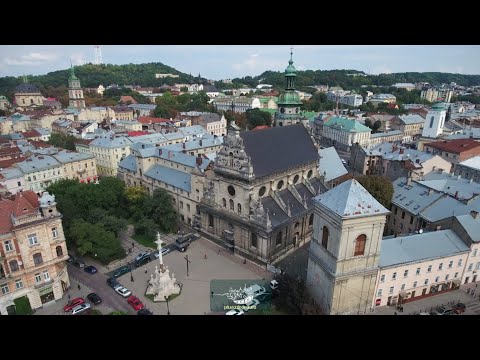
The Church of St. Andrew is located in the city center on Soborna Square, complementing the city fortifications of the Galician Gate. It faces east with an altar, and a clock tower rises above it on the north side. On the south side of the church is the well of the patron saint of the Bernardines, St. John of Dukla. A bell tower was built on the southeast side.
An architectural masterpiece, a unique combination of different styles, the embodiment of historical and cultural values is definitely worth seeing with your own eyes. Lviv is rich in all kinds of monuments. Here you can see some of the most unique and unforgettable churches in Ukraine. Also here is a huge number of interesting museums and architectural monuments that are definitely worth a visit.