Church of St. John Chrysostom, Lviv
TheChurch of St. John Chrysostom (formerly the Church of the Sacred Heart of Jesus and the Franciscan Monastery) is an active church of the OCU in Lviv at 43 Lysenko Street.
In 1873, the Prussian authorities closed the Franciscan Order of the Most Holy Sacrament Monastery in Gniezno. It was the only monastery of this branch of the Franciscan order on Polish lands. The nuns immediately decided to relocate their activities to the east. On October 26 of the same year, the nuns left Gniezno and arrived in Lviv on November 18. Their first home in Lviv was a temporary monastery set up by priest Vitalis Maryansky on Kokhanovskoho (now Levytskoho) Street. The house suffered greatly from moisture, and on June 1, 1874, the sisters moved to Pekarska Street, to the premises of the former Julia Haller orphanage. In 1875, the house was somewhat completed, and a chapel was built nearby. However, the building did not have a fenced courtyard, which was important for the Fratiscans (it did not comply with the internal rules of the congregation). After the construction of one of the wings of the monastery on Kurkova (now Lysenko) Street in 1880, the premises on Pekarska Street were sold to the Fathers of the Early Rebels.
The abbess ofthe congregation, Maria Morawska, worked hard on the idea of building a church and monastery in Lviv. On August 2, 1876, the Ministry of Religious Affairs of the Austro-Hungarian Empire granted permission to establish a congregation of the Franciscans of the Most Holy Sacrament in Galicia. On August 9 of the same year, the sisters announced their plans to Archbishop Franciszek Weschlejski and received his consent. On December 3 of the same year, Pope Pius IX blessed the future construction.
A plot of land on Kurkowa (now Lysenko) Street was purchased from Maurik Rothman. The first project, designed by architect Carl Gregor, was not approved by the city authorities as "too modest." After that, Julian Zakharevych volunteered to make a new design for free. This act of Zakharevych's was surprising given his Protestant beliefs. Representatives of the aristocracy of Lviv, Galicia, and Vienna took part in financing the construction. On September 13, 1877, Archbishop Lodovico Jacobini, the apostolic nuncio in Vienna, consecrated the cornerstone of the future monastery. Julian Zakharevych personally supervised the construction for many years. A special "artistic commission" was also created for this purpose, which included the abbess Maria Morawska, construction manager Józef Kaetan Janowski, writer and ambassador to the Vienna Parliament Otto Hausner, politician Valerian Podlewski, and painter Henryk Rodakowski. The excavation and construction of the walls was carried out by the company of Karl Gregor. The stone details were designed by Leonard Marconi. The carpentry was done by the workshops of the Wczeliak brothers and Franciszek Tenerowicz, the tinsmiths were by the Kruk firm, and the painters were by the Boguchwalski establishment.
The western wing of the monastery was completed in 1880, and the eastern wing in 1883. The date of completion of the northern wing is not known, but it was not earlier than 1889. On June 24, 1883, the first celebrations took place in the church: Magdalena Tesmer took her monastic vows and Olga Kolachkovska was confirmed. On October 29, 1889, the church was consecrated by the papal nuncio from Vienna, Alessio Galimberti, in the presence of Lviv archbishops of all three rites: Severin Morawski, Sylvester Sembratovych, and Isaac Mykolai Isakovych. In 1890, the bell named "Michał-Józef-Franciszek" was installed. In 1901, water supply and sewerage were installed in the monastery. On January 26, 1906, the first abbess of the monastery, Maria Morawska, died. She was buried in a crypt under the choir. During the Ukrainian-Polish war, the church suffered several minor damages. Two bullets hit the stained glass window and a shell damaged one of the monastery walls. By 1919, two one-story houses were built on the edge of the site for church services and for rent. In 1927, two floors (one attic) were added to one of the houses for guests and the chaplain's residence.
In December 1939, the Soviet authorities requisitioned a part of the monastery for the archives. The nuns stayed in the remaining premises until May 13, 1946. When they moved to Poland, they were forbidden to take any of the church's equipment with them. However, the nuns managed to take one sculpture from the church and almost all of the monastery's property. Later, the Franciscan convent was completely given over to the seventh department of the First Infectious Diseases Hospital.
Upon their arrival in Poland, the Franciscans established monasteries in Klodzko and Ząbkowice Śląskie, where they housed the utensils taken from Lviv and the monastery archive. Part of the equipment was transferred to the monastery of their order in Bydgoszcz, which had been looted by the Nazis before.
In 1991, the church and the left wing were transferred to the Ukrainian Autocephalous Orthodox Church. The premises of the monastery housed the Theological Seminary (now the Lviv Orthodox Theological Academy), founded in 1990. In 1993, the seminary became part of the Ukrainian Orthodox Church of the Kyiv Patriarchate. In 1994, the stained glass windows were restored by the Lviv Institute Ukrzakhidproektrestavratsiya. In 1999, the last premises belonging to the hospital (the right wing) were transferred to the educational institution. The church has a Sunday catechetical school for children and a youth organization named after St. Peter Mohyla.
On January 29, 2006, a mass was held in the crypt of the church, led by Bishop Marian Buczek, on the occasion of the 100th anniversary of the death of Maria Morawska.
The monastery complex is located on the odd side of Lysenko Street, on the slope of the so-called Snake Mountain, on a plot leveled and paved from the street. When viewed from Lychakivska Street through Zankovetska Street, it visually closes the latter's perspective. Behind the buildings is a brick-walled garden. On the central axis with the church, there is a metal gate in the wall, from which two wings of stairs lead up. On the western edge of the wall is an entrance covered by a semicircular arch with a stepped roof.
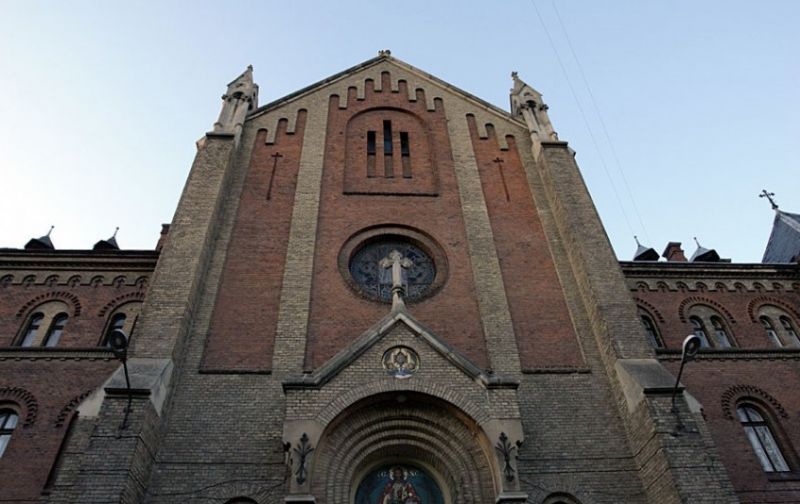
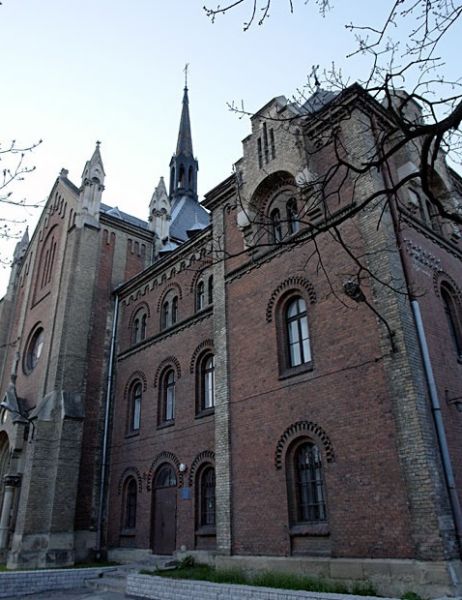
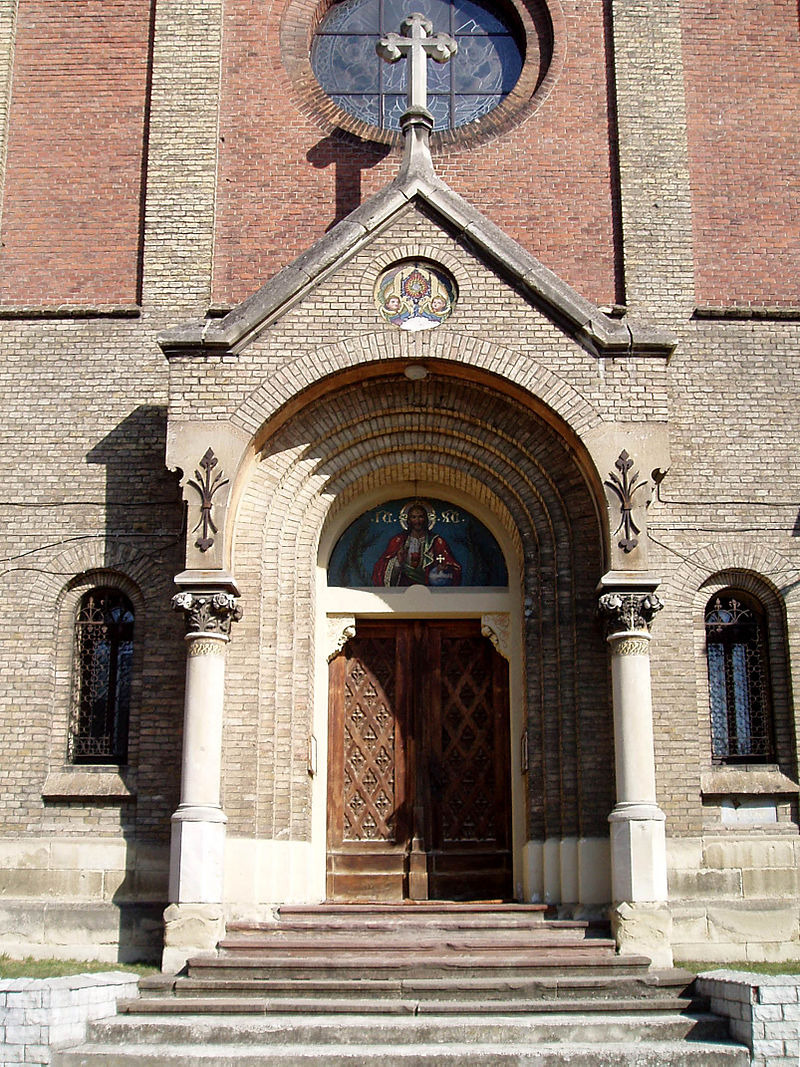
The church was built of red and yellow bricks with stone elements, and is unplastered on the outside. It is oriented on the north-south axis. The monastery buildings are adjacent on both sides. The layout of the basilica is a one-nave basilica. The nave is square in plan, covered by a single cross vault. The edges of the vaults are supported by tall semi-columns with cubic Romanesque capitals. The side walls of the nave have one window with a semicircular ending. On both sides of the nave are entrances to the chapels adjacent to the church. The first is St. Francis (east side), the second is St. Josaphat (west side). The narthex is single-straight, shorter than the nave, and raised one step above it. It has an emporium, under which there is a small antechamber and two side passages leading to the eastern and western wings of the monastery. To the north of the nave is the presbytery, somewhat narrower than the nave, elevated one step above it, and covered by a single cross vault. After the presbytery there is a two-story abyss overlooking the courtyard. The façade of the church is two-tiered with a triangular pediment protruding outward in the form of the monastery's risalit. The pediment is crowned with a stone cross (the cross is lost), and the edges are decorated with stone towers. The second tier is divided into three fields by yellow brick lisenes, with the central field being much wider than the side ones. On the second tier there is a round window, and above it, in a semicircular shallow niche, there is a group of three narrow windows, the middle one being higher than the side ones. The church's portal has its own triangular pediment crowned with a cross, supported by two columns with floral ornamentation capitals. In the middle of the pediment is a semicircular arch with a stepped profile. Above the arch in a round niche is a monstrance with angels. The entrance is rectangular, with a tympanum above it with a mosaic image of the Savior and the inscription IS XC. The roof over the narthex, presbytery, and abyss is gable, while the roof over the nave is tent-like and covered with slate. The roof over the nave is crowned with an octagonal tin-covered tower with an elongated, sharp end with a cross. A similar, somewhat smaller tower crowns the roof of the nave.
All 3 stained-glass windows, made in Munich by F. Mayer in 1887-1889, have been preserved in the narthex. The central stained glass window depicts the Sacred Heart of Jesus, while the side stained glass windows are dedicated to St. Melania and the Archangel Michael. The stained glass window in the round window on the church's facade depicts the Immaculate Conception.
Theinterior of the church was painted with floral and geometric ornaments by Julian Krupsky in 1930-1931. The frescoes were whitewashed after an infectious disease hospital was established in the monastery. The wooden Neo-Gothic pulpit, made before 1889, is located on the left at the transition from the nave to the presbytery. The wooden parapet of the Empire period by the workshop of Franciszek Tenerowicz. The sculptures of the Mother of God and St. George, made by Julian Markowski, are known to exist. During the Soviet era, the pulpit, wooden confessionals, church pews, and marble sprinklers at the entrance designed by Leonard Marconi were destroyed.
In total, the church had five altars. All of them were destroyed in Soviet times. Remnants of the stone high altar slabs fortify the earthen bank at the entrance to the monastery courtyard.
Themain altar in the Neo-Romanesque style with a monumental canopy and a high partition was installed in the presbytery, almost in the middle of the church. It was made of marble and alabaster in the Lviv stone factory of Leopold Szymzer. The design belonged to Julian Zacharewicz and was modified by Leonard Marconi when he made plaster models for Schimzer's workshop. The work was funded by the Liechtenstein family of princes from Vienna. The multicolored light passing through the stained-glass windows hit the altar from behind and partially passed through the alabaster, giving the altar an unusual appearance. The altar contains a wooden crucifix from the second quarter of the 18th century.
The altar of St. Joseph at the east wall of the main nave was made by the Mayer'sche K. Hof Kunstanstalt company in Munich at the expense of the Podhurski family. It is a wooden neo-Gothic with polychrome sculpture. In the central field is St. Joseph and the Child, flanked by angels.
The Neo-Gothic Altar of the Immaculate Conception of the Virgin Mary is also at the east wall, made of wood in the workshop of Francis Tenerowicz, at the expense of Oleksandra Hausner. The white marble sculptures were made by Amelia Jadwiga Lubińska and Julia Lubińska. The statue of the Immaculate Conception is still preserved today and is housed in the Lviv Museum of the History of Religion.
The stone altar of St. Josaphat in the western chapel was made in the factory of Leopold Schimzer at the expense of the Zewuski family. The white marble sculpture of St. Josaphat was made by Oskar Sosnowski in Rome.
The wooden altar of St. Francis of Assisi in the east chapel was made by Tadeusz Sokółski at the expense of the Kielanowski family from Kozłów. The white marble sculpture "St. Francis Receives Stigmata" was made by Amelia Jadwiga Lubińska.
The monastery is three-story, close to a square in plan, with a courtyard. The façade is unplastered, on a stone plinth, and is divided between the second and third floors by a dentil wing; the top floor is crowned with a wing with a Neo-Romanesque arcade frieze. The windows of the first and second floors have semicircular architraves formed by recesses in the brickwork; the windows of the third floor are narrow and placed in pairs under common semicircular architraves. Two smaller risalits in the form of low towers flank the large central risalit from the south, which is also the facade of the church. The façade of the courtyard is reinforced with stepped brick piers. The roofs of the monastery's wings are covered with slate, gable, sometimes three-pitched, and tent-like over the risalits. The roof planes are enlivened by lucarnes with multifaceted roofs and spires. The chimneys are tall and crowned with arcaded gimmes. On one of the axes of the courtyard façade of the eastern wing is a sculpture of the Mother of God with the Child. It has been preserved to this day without a head. The interior layout is corridor-sectional, with semicircular brick vaults on the ground floor corridors. A wooden staircase is located in the middle of the eastern wing. The premises were largely redesigned in Soviet times. Many entrances were walled up, and new partitions were built.