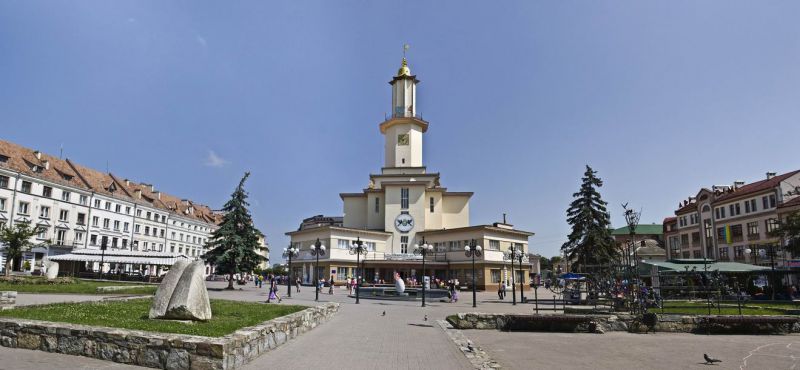
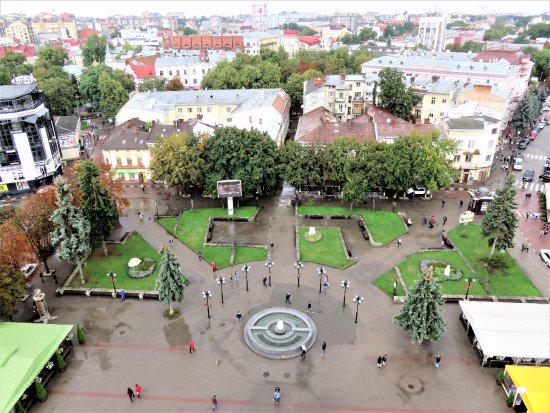
Rynok Square, Ivano-Frankivsk
In the Middle Ages, the main square of the city was commonly called Rynok. Ivano-Frankivsk was no exception. Here, in a strange symbiosis, architectural monuments merge with original stalls. And it looks quite organic, by the way.
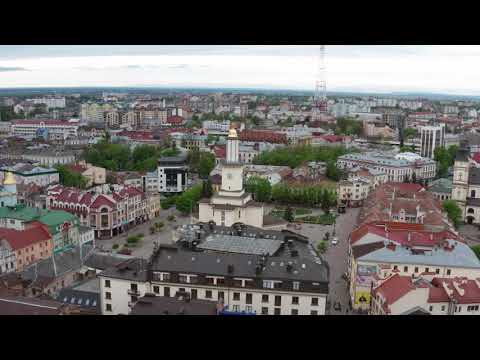
Cities that received Magdeburg rights had to have a square square in the center, usually called the Rynok. On all sides, the square was densely built up with two- and three-story buildings with three windows wide. The numbering of the houses began at one corner and continued along the entire perimeter. It was from Rynok Square that the development of the city called Stanislaviv began.
Rynok Square in Stanislaviv met all European requirements. Until recently. Currently, several modern buildings are brutally squeezed into the space around Rynok Square, which neither in terms of architectural style nor number of storeys fit into the old European tradition and violate the harmony of Rynok Square itself, which now looks distorted.
Not many old houses have survived around Rynok Square, because, for example, almost all the houses along Halytska Street 9-29 are recreations of old, demolished buildings. The work on it lasted 15-17 years. This is also due to the fact that the buildings had been empty for two years, which, of course, led to partial or even complete destruction. Therefore, over time, the process of restoration turned into a process of reconstruction. However, this is the only large complex project that has been completed properly in Ivano-Frankivsk.
Fortunately, two blocks of old houses have been preserved on Rynok Square, which are separated by the shortest street in Ivano-Frankivsk, Trush Street, and which stretch from the cathedral to Vitovskoho Street.
The house at 6 Rynok Square is interesting because the so-called "Russian Reading Room" was opened here in 1884. We read in the Prosvita calendar of that year: "Ruska Chyttalnia" was the name of a society opened by the Rusyns of Stanyslaviv on November 9, 1884, and its purpose was the same as that of the Ruska Bessida. The main founder H. Okunensky recalls: "On the advice of professors E. Zhelekhivskyi and L. Zaklynskyi, I set about creating the 'Besida'. I (...) rented a room in the Rynok, as it was the magistrate's office in the district court, in a stone building on the second floor."
Reading rooms began to open en masse in Galicia in 1876, based on a law of the Austrian state (most often under the name "Ruthenian Reading Room"). The first reading room was founded in the city of Kolomyia in 1848 during the revolution of 1848-49 in the Austrian Empire.
The network of reading rooms developed especially in the 1890s, when the most massive Galician cultural and educational societies Prosvita and Kachkovsky Society, according to their charters approved by the authorities, turned into three-stage organizations (central - branch - reading room).
According to annual reports, in 1910 Prosvita had 2,355 reading rooms, and the Kachkovsky Society had 1,225.
But let's return to 6 Rynok Square in Ivano-Frankivsk. A plaque that once hung on the facade of the building somewhat inaccurately informed that it was the building of the Ruska Besida, and it might seem that it was the society's former own house. In fact, it was a private house owned by Jakub Reischer, who rented the premises to the society. However, this does not deny the fact that it was in this house that the Stanisławów "Conversation" was launched, that the founding congress of the "Society of Russian Women" organized by N. Kobrynska took place two months later, and that it was here, at the congress, that Ivan Franko addressed the women, who in his article "The First General Meeting of the Russian Women's Society in Stanisławów" (Dilo newspaper, December 11, 1884) presented a detailed report on the work of the first women's society in Galicia.
The very next year (1885), the reading room of the "Conversation" moved to a house at 5 Belvederska Street. Unfortunately, this building has not survived to this day, unlike the one at 6 Rynok Square.
House No. 6 on Rynok Square, a small two-story building in the northern part of the square built in 1871, is a local monument. The facade faces Rynok Square, and one wing faces the already mentioned Trusha Street. There are six windows on the façade (including the balcony), and eight windows face Trusha Street. There is also an end balcony on the second floor.
The house is made of brick, the foundation and plinth are made of brick strip, and the roof has two slopes covered with tin. The house has two wings that form a small courtyard. In the courtyard, there used to be a balcony along the entire perimeter of the second floor. Unfortunately, at present, the part of the balcony that connected the two wings has collapsed, so only extreme sports enthusiasts can take a walk around the perimeter.
Despite the well-maintained facade (not without the help of the pizzeria, which is located on the ground floor), the hidden part of the building is not very pleasing to the eyes of those who have the opportunity to enter the courtyard of the building. Plaster crumbling to bricks, cracks in the walls, and skewed dilapidated balconies. In short, all the signs of Ivano-Frankivsk's old buildings are inherent in this two-story house in the very center of the city.
Unfortunately, old (and even historical) buildings in Ivano-Frankivsk are gradually being destroyed and no one seems to care. Although the legislative framework is quite well developed. However, no one seems to care about the legislation. Various utilities are busy signing service contracts with residents, but it is unlikely that at least one of Ivano-Frankivsk's historic buildings has signed a security contract, as required by law.
Every year, fairs were held on the central square. They lasted about 4 weeks and began on May 7, September 8, and November 28. To ensure fair trade, authorized people checked the scales of the vendors several times a week. If everything was in order, they would put a special stamp. If there was no such stamp, the trade was stopped.
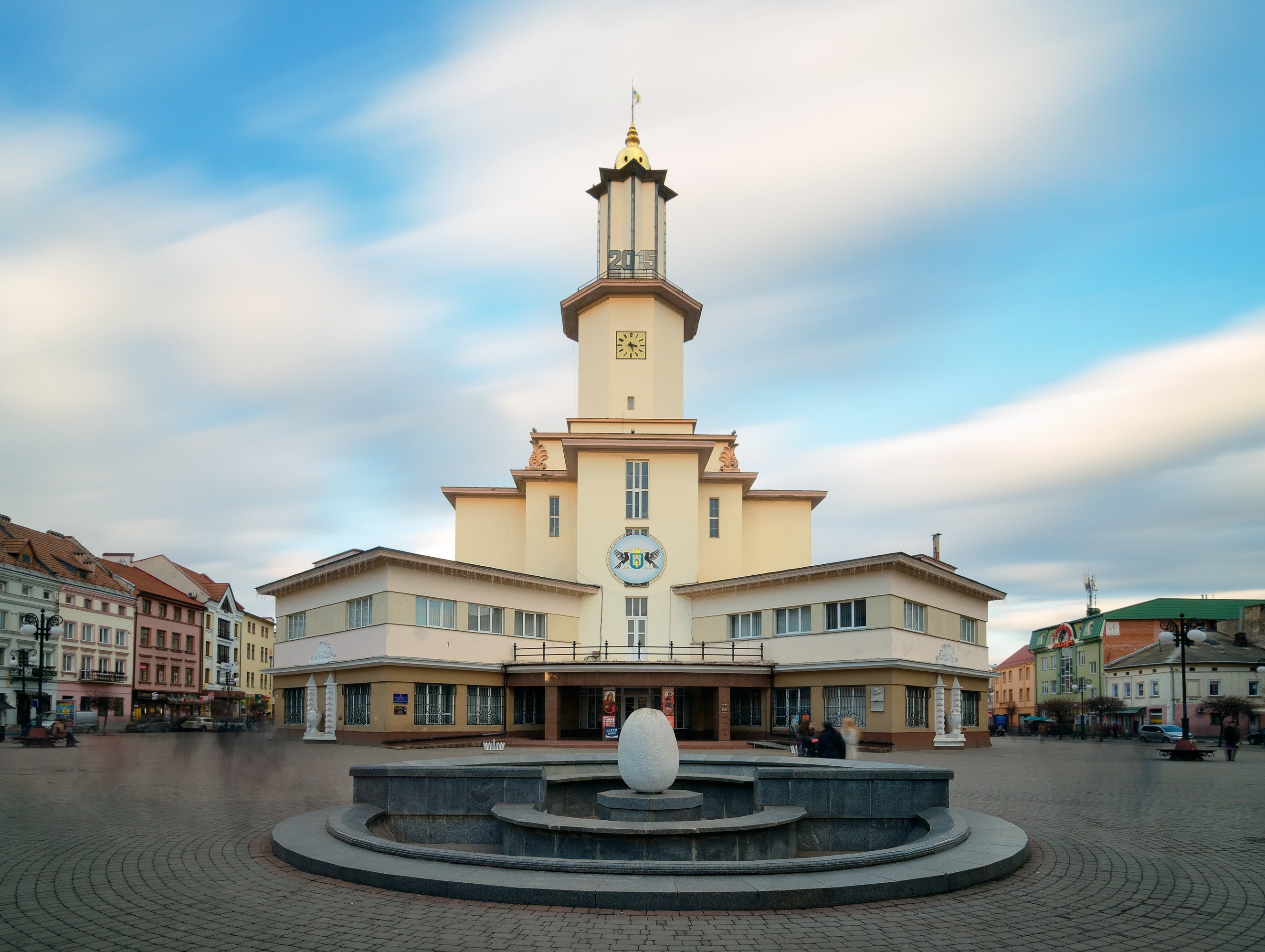
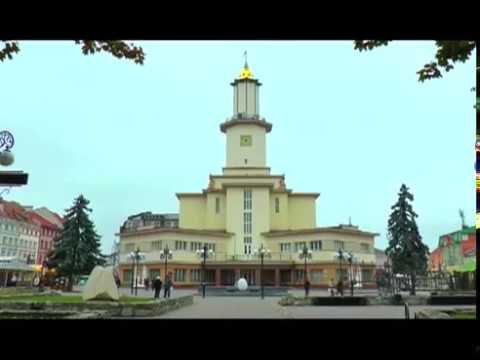
The town hall was an integral attribute of the square.
Some facts about the town hall on Rynok Square in Ivano-Frankivsk:
- In 1675, the first town hall was built on the square. It was made of wood and served as a military and fire observation post. At the same time, underground passages and emergency exits were running under the square in all directions. Unfortunately, by now they have turned into ruins.
- After the siege of the city by Turkish troops, the wooden town hall was dismantled and a new one was built in its place, which is still located in the center of Ivano-Frankivsk. The project of the new town hall was designed by architect Karol Benoît.
- The fate of the city and its people was decided in the town hall, lawsuits were considered, and people were even executed on the square. It was here that the court handed down the death sentence to the opryshky. The last such bloody public execution took place in April 1754. It was carried out by a fellow activist and successor of Oleksa Dovbush, Vasyl Bayurak.
A tin sculpture of a Jew holding a loaf of bread with the inscription used to stand near the southern wall of the town hall: "One penny". The authors wanted to show how cheap bread used to be.
Rynok Square used to be a center of cultural, economic, and political life. Now it is just a cultural center of Ivano-Frankivsk, hosting various festivals, concerts, and exhibitions.
Rynok Square is located in the very center, so you can get to it from any corner of the city. From the train station, you can take a bus #22 and then walk for a few minutes.
Accommodation around Rynok Square, Ivano-Frankivsk:


Which trails pass by Rynok Square, Ivano-Frankivsk?
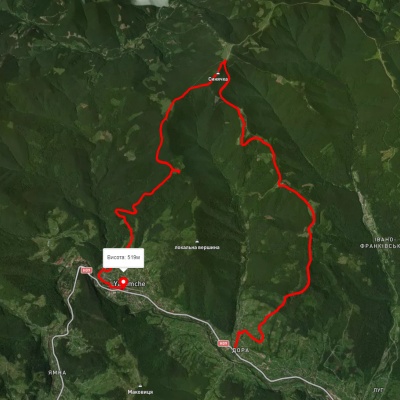
We suggest these hiking trails through or near Rynok Square, Ivano-Frankivsk: Pasichna village, via Maniava village, Maniava Waterfall and Mount Velyka Syvulia to Bystrytsia village, Maniava village - Monastyretska polonyna, Dora village, via Mount Syniachka, Pereslip Pass, Turshuhuvata polonyna and the Yavirnyk ridge to Yaremche, Dora village, via Mount Syniachka and Pereslip Pass to Yaremche, Dora village, via Mount Syniachka and Chornohorytsia polonyna to Yaremche, Dora village, via Mount Syniachka and the Chornohorytsia ridge to Yaremche

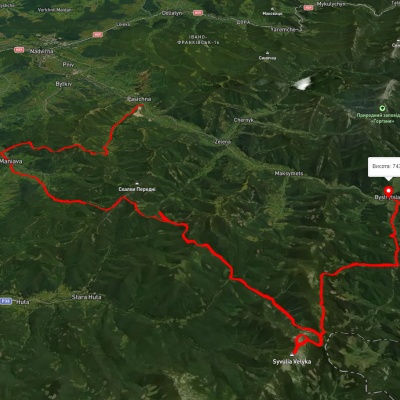
Pasichna village, via Maniava village, Maniava Waterfall and Mount Velyka Syvulia to Bystrytsia village
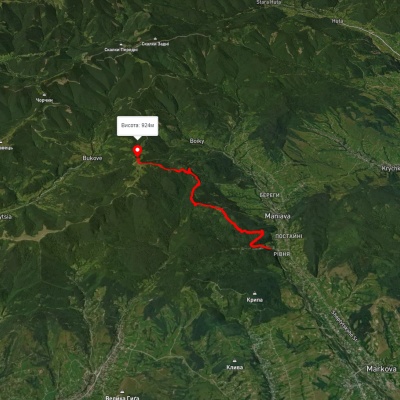
Maniava village - Monastyretska polonyna
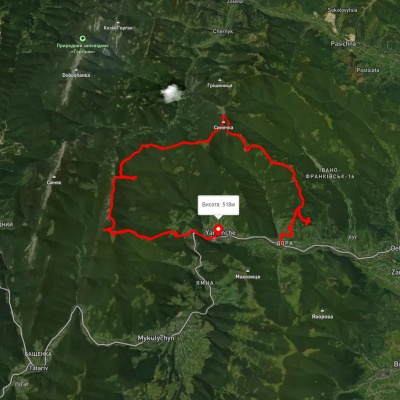
Dora village, via Mount Syniachka, Pereslip Pass, Turshuhuvata polonyna and the Yavirnyk ridge to Yaremche
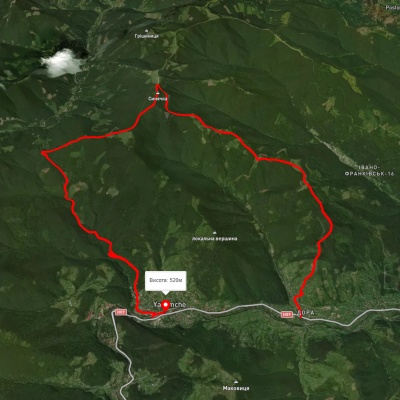
Dora village, via Mount Syniachka and Pereslip Pass to Yaremche