Potocki Castle, Ivano-Frankivsk
ThePotocki Palace is an architectural and urban planning monument of historical significance in the city of Ivano-Frankivsk. The palace complex was built in 1672-1682 and was completed in the 1980s. The Potocki Palace in Ivano-Frankivsk is a cultural heritage site and is protected by the state - by the order of the Executive Committee of the Ivano-Frankivsk Regional Council of People's Deputies of May 26, 1981, No. 238, it was recognized as a local monument.
It was built by Polish Crown Hetman Andriy Potocki for himself and his family. It was first used as a residence for the owners of Stanislaviv, and later, for decades, as a military hospital. In Soviet times, a military hospital operated here.
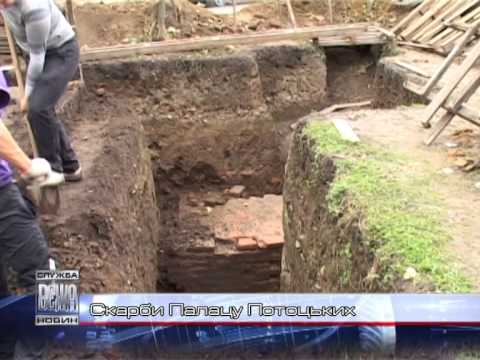
Currently, researchers do not have even a rough "portrait" of the residence. The history of the palace is most likely stored in Polish or Austrian archives. Currently, local authorities continue to restore it.
Initially, there was a wooden castle. It was located on the site of the modern Greek Catholic Cathedral and it was there that Andriy Potocki's son Stanisław was born. This palace was built simultaneously with the foundation of the city and was most likely intended as a temporary residence.
The intention to build a new, more respectable palace arose in the early 1670s. The traveler Ulrich von Werdum, who visited our city in 1672, describes what he saw: "The castle in which he himself now lives is also only wooden, but beams, bricks, and stone slabs have already been brought in for another castle, a heavy building to be erected at the southeastern end of the city. The voivode wants to provide it with towers and other fortifications, like a citadel."
At that time, François Corassini was the court architect, and perhaps it was he who developed the drawings for the palace. But the Polish-Turkish wars prevented the construction. Prykarpattia turned into an arena of fierce battles, and in 1676 it even withstood a long siege by the Turkish army. It is clear that there was no time for palaces then. At the end of the war, the Potocki family began construction.
Between 1679 and 1682, a castle was built on the northeastern outskirts of the city, which organically fit into the system of Stanislaviv fortifications. Two powerful bastions and a raveline covered it from the north. However, the building was designed by a new architect, Carole Benoit, who replaced his predecessor after the latter's contract expired.
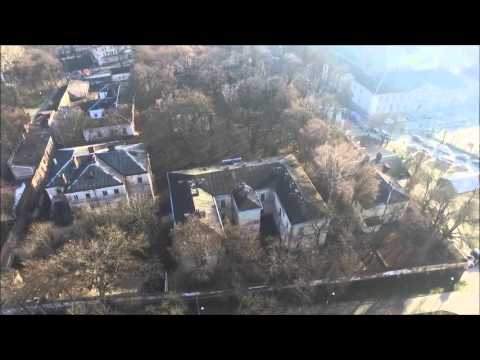
The next traveler who visited Stanyslaviv in 1687 wrote that "the palace was built of stone and beautifully decorated." It was a three-story building that was hidden in the depths of the park and was supposed to consist of a center, left and right wings. However, in the eighteenth century, only the center and left wing were completed. In the center of the park was the old kitchen, and on the sides, like stone sentinels, were the new kitchen and the offices. These two-story buildings with rough walls, which have survived to this day, also played a defensive role.
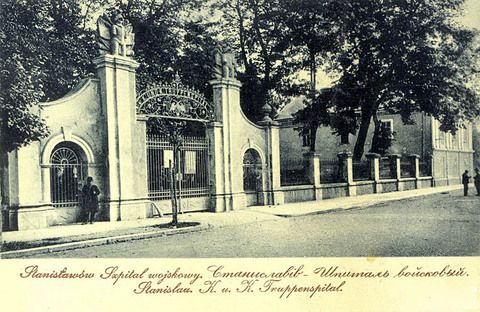
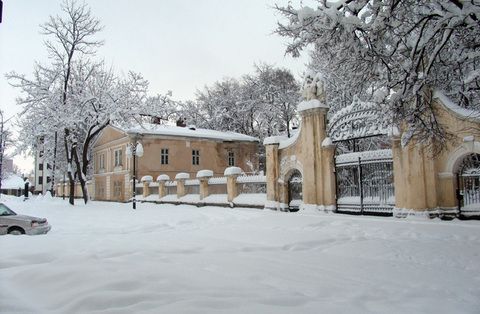
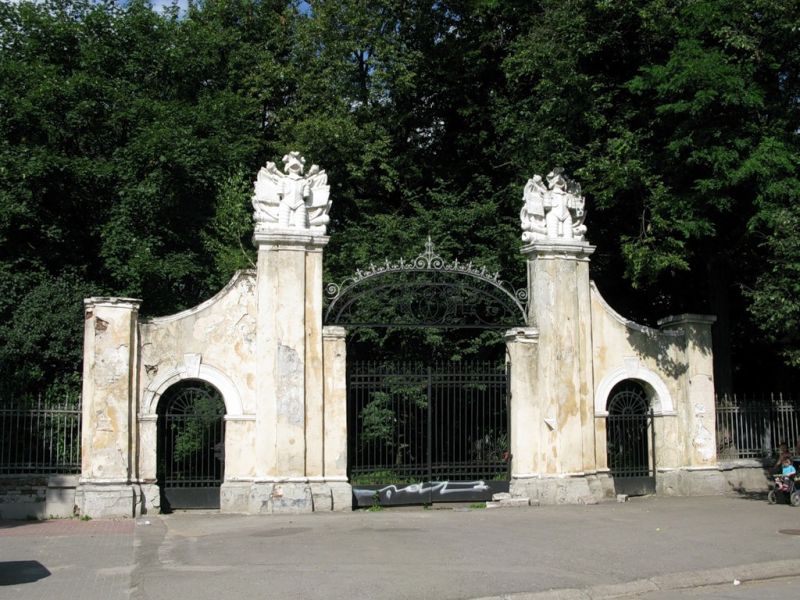
The palace complex was enclosed from the city by a wooden fence with stone pillars, the real decoration of which was the main entrance gate decorated with military armor. The area in front of the fence was called the "esplanade" and was free of any buildings. This served two purposes at once: in the event of a fire, the fire would stop on this wasteland, and in the defense of the palace, it allowed artillery fire from the park to be directed at the square. At the end of the eighteenth century, security requirements were slightly relaxed, and this made it possible to build a stable and carriage house on the esplanade, where the lord's carriages were kept.
Unfortunately, neither plans nor graphic images of the palace have survived. However, we have a description of its decoration in the 18th century. The lower part of the castle consisted of six small vaulted rooms, a kitchen, and a stable.
A spiral staircase led up to the second floor, "to a large hall with a parquet floor, a white-painted ceiling, and two windows. There are two large glazed doors leading to the rampart (which surrounds the palace with all the castle buildings on three sides). Behind them is a bridge that leads to the rampart. In the hall, all the walls are upholstered with a cloth with colorful stripes. From this hall, through double doors painted white with gilded leaves, one entered the company's room, which had an oak floor, a ceiling made of canvas painted white, a cabinet-like brick fireplace, and two double windows." Next to it was a bedroom and a "dressing room," then a "women's room," a "coffee shop," a second "dressing room," an entrance hall and a room with an oak floor, a ceiling upholstered with white-painted canvas, four windows, walls painted with not very wide dark gray stripes, wooden panels, darkly painted."
The third floor consisted of eight rooms, quite modestly furnished.
It is clear that during its long history, the old palace has seen many distinguished guests within its walls. In addition to the large Potocki family, the Polish king Jan III Sobieski and the ruler of Transylvania, Ferenc II Rákóczi, took refuge here, the wife and daughters of the Ukrainian hetman Pylyp Orlyk, and there is even a legend that the Austrian emperor Joseph II himself visited the palace.
Like every magnate family, the Potocki's were simply forced to live large. That's why they often organized balls, dinner parties, weddings, and other entertainments. When a French prince was born, who was related to the wife of the owner of Stanislaviv, a fireworks display was organized in the palace in honor of the crowned baby. In addition to cheerful holidays, sad events were also celebrated. For example, the plague epidemic of 1729-1730 claimed the lives of many family members, and the funeral of Joseph Potocki in 1751 became a national event.
But the Potocki's knew how to have fun, too. Here is what a Polish historian writes about the secret side of the city's rulers' activities: "New political movements, ideas, adventurous plans, and designs were born in the Hetman's palace. It was from here that rumors of political intrigue intensified. These rumors confused the rulers in the palaces of Dresden, Warsaw, and St. Petersburg. Cunning plans were drawn up here, which entangled Constantinople, Paris, and Stockholm with their secret networks. The Stanislaviv Hetman's Palace turned into a nest of anti-Saxon opposition. It was here that the idea of putting the hetman's son Stanisław on the Polish throne was born."
To complete the picture, it should be added that there was also a small out-of-town palace. It was located at the end of the modern Belvedere Street, in a picturesque area with a magnificent view of the city. A magnificent view sounds like a "belvedere" in French, and this is the name of our street. However, it was popularly nicknamed "The Flea" because of its proximity to the Bystrytsia River, where people used to wash clothes. This palace was built in the early 1730s. It was there that Josef Potocki's wife, Victoria of Lishchynski, died. In the nineteenth century, the palace passed into the hands of a small landowner who dismantled the building for construction materials.
However, when Galicia came under the rule of the Austrian Empire, the Potocki's influence on the city decreased dramatically, and after the bankruptcy of the last owner of Stanisławów, Prot Potocki, in 1801, the city became state property. The Austrians set up a military hospital there, which has not changed its purpose for more than 200 years. It is clear that the new owners redesigned the palace according to its new purpose, destroying the interior. In the first third of the nineteenth century, the central wing of the building burned down in a fire. The military did not restore it, but simply dismantled it. In the 1990s, they built a two-story surgical building on the left side of the palace park.
In the turbulent twentieth century, the military hospital served Austrian troops, the Russian Tsarist army, soldiers of the Ukrainian Galician Army, Polish soldiers, Red Army soldiers, Germans, soldiers of the Soviet army and the Armed Forces of Ukraine.
The palace greeted the second millennium as one of the oldest military medical institutions in Ukraine. But the attractive site in the city center was already an eyesore for many officials. In 2004, the Ministry of Defense of Ukraine (Minister Yevhen Marchuk) and Oleg Bakhmatyuk's Prykarpattya Financial Company signed an agreement under which such tidbits of military real estate as the Potocki Palace, the Officers' House, and the General's Mansion on Shevchenko Street were exchanged for several apartments for the military in a district center. All of this was done with the tacit consent of Governor Mykhailo Vyshyvanyuk, who had previously been pounding his chest and shouting loudly that historical monuments would not fall into private hands.
When the public learned that the seventeenth-century historical and architectural monument was actually given away for nothing, a terrible uproar ensued. It is said that even on the sidelines of the Verkhovna Rada, where Oleh Bakhmatyuk, a member of the Lytvyn Bloc, worked, he was jokingly called "Count Potocki." In order not to provoke the public and to avoid legal proceedings, the young "count" declared that he was transferring the palace to the community. The Ivano-Frankivsk regional and city councils immediately began to consider themselves representatives of this community. A small paper war broke out over the long-suffering palace, between the left and right wings of the White House. While the squabble between the political elite of the city and the region was going on, a clever businessman resold the palace several times to his subsidiaries, and now no court will return the monument to state ownership.
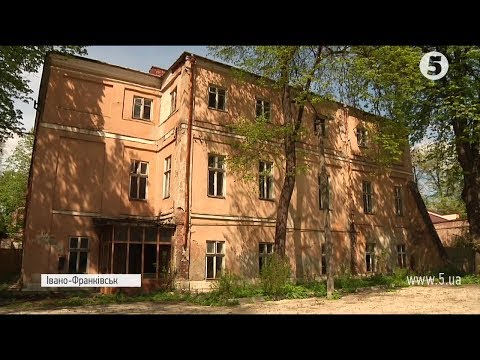
As a result, the palace remains in the ownership of Oleg Bakhmatyuk and is now empty. The windows are broken, the ceiling is leaking, the walls are cracking and the garden is overgrown. No work is being done to restore the historical monument. The front gate, which is considered one of the symbols of Ivano-Frankivsk, is about to fall on tourists' heads. It seems that the building is being deliberately brought to a state of disrepair when nothing can be done.
In the fall of 2016, the old Potocki residence came to life. The grounds were thoroughly cleaned and the "Operation on the Heart of the City" was held there, an artistic event that combined theater performances, choral singing, literary readings, plein airs for artists and photographers, and master classes for children. Later, scholars from Ukraine and abroad also came to visit. And an initiative group of citizens created a charitable foundation that could attract grants for the restoration of the historical monument. But now the land is under lock and key again, as the courts decide who the real owner of the palace is.
But while the land, buildings, and property rights are being divided, the palace is slowly collapsing, taking away the Potocki's secrets, the military attacks repelled by the Stanislaviv Fortress, and the unique spirit of the past that could have attracted thousands of tourists to Ivano-Frankivsk to experience history.
Accommodation around Potocki Castle, Ivano-Frankivsk:


Which trails pass by Potocki Castle, Ivano-Frankivsk?
We suggest these hiking trails through or near Potocki Castle, Ivano-Frankivsk: Pasichna village, via Maniava village, Maniava Waterfall and Mount Velyka Syvulia to Bystrytsia village, Maniava village - Monastyretska polonyna, Dora village, via Mount Syniachka, Pereslip Pass, Turshuhuvata polonyna and the Yavirnyk ridge to Yaremche, Dora village, via Mount Syniachka and Pereslip Pass to Yaremche, Dora village, via Mount Syniachka and Chornohorytsia polonyna to Yaremche, Dora village, via Mount Syniachka and the Chornohorytsia ridge to Yaremche

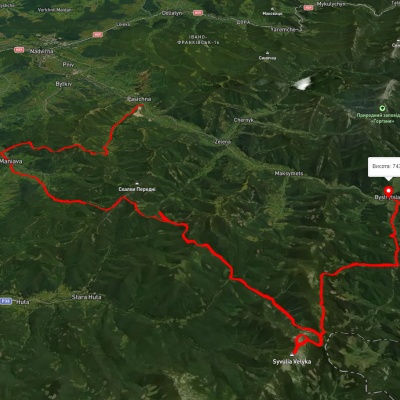
Pasichna village, via Maniava village, Maniava Waterfall and Mount Velyka Syvulia to Bystrytsia village
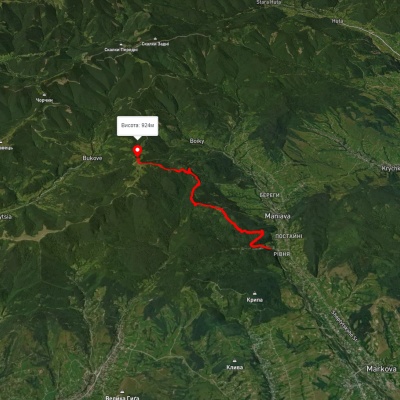
Maniava village - Monastyretska polonyna
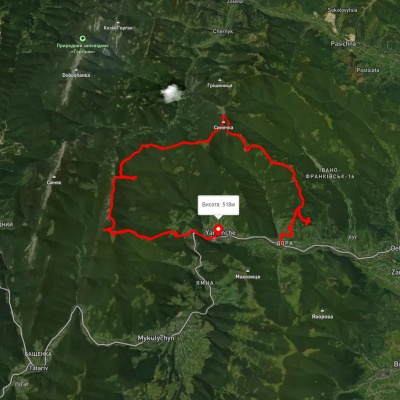
Dora village, via Mount Syniachka, Pereslip Pass, Turshuhuvata polonyna and the Yavirnyk ridge to Yaremche
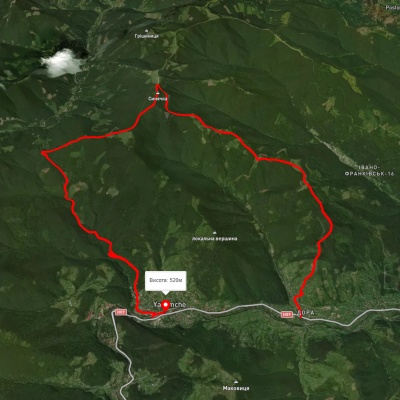
Dora village, via Mount Syniachka and Pereslip Pass to Yaremche