St. Elias Church, Yaremche
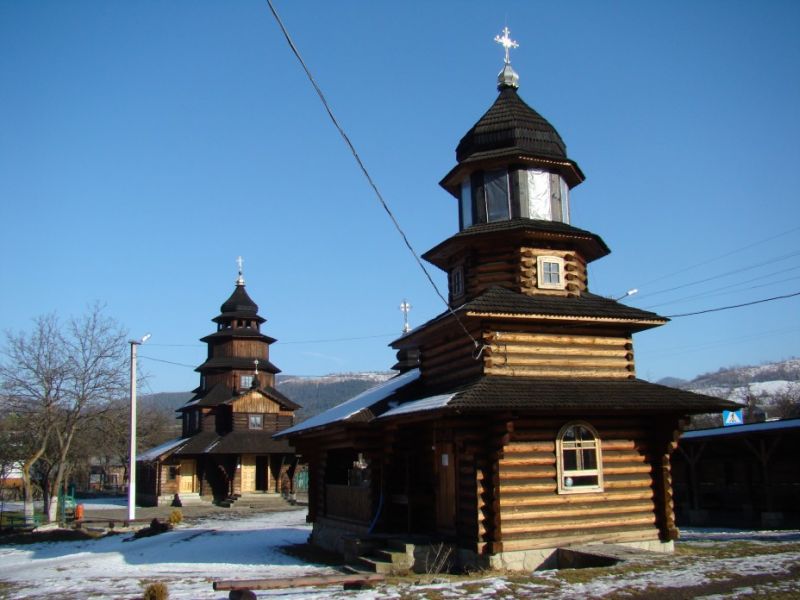
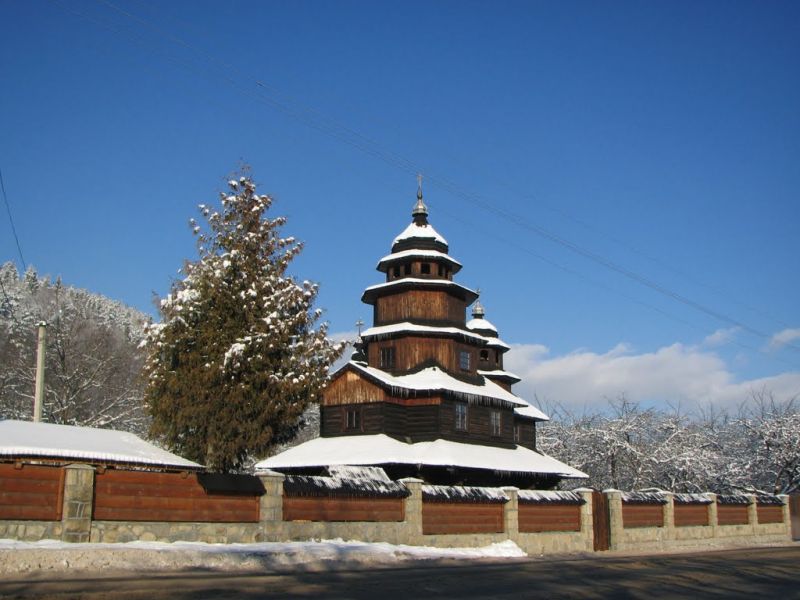
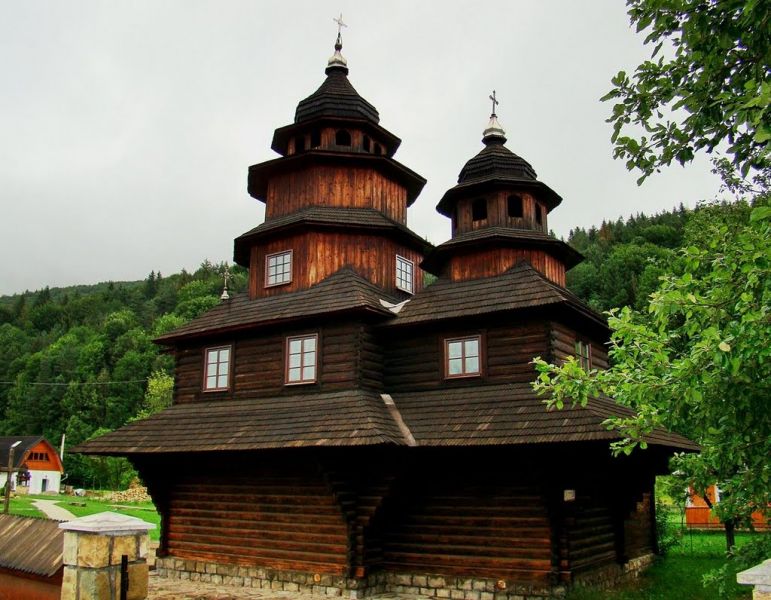
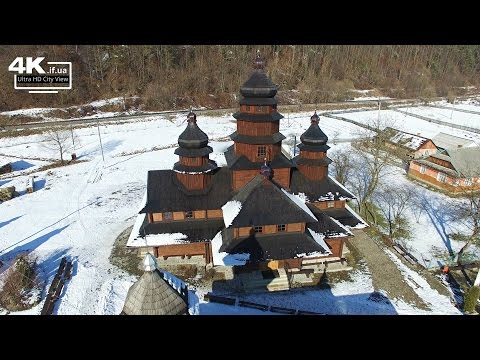
TheChurch of the Holy Prophet E lijah is a unique architectural monument built in the Hutsul style in the shape of a cross in Yaremche.
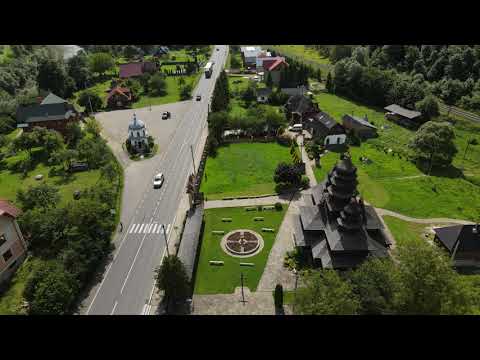
The wooden church is located on the territory of the Studite Fathers' monastery in the village of Dora, which is part of the Yaremche City Council. The Church of the Holy Prophet Elijah is covered with wooden shingles. The church is crowned with 2 domes: a central three-tiered dome and a rear two-tiered dome. The interior is decorated with special ornaments and images burned into the wood. The church was built near the central road leading from Ivano-Frankivsk to Rakhiv. The beginning of the route to Mount Makovytsia is not far away. It is also convenient to get to the center of Yaremche and to any corner of Dora. From the monastery, it is easy to get to the banks of the Prut River, where there are good places for swimming.
The Monastery of the Holy Prophet Elijah was founded in late August 1935. With the blessing of Metropolitan Andrey Sheptytsky and Abbot Klymentiy Sheptytsky, as well as the consent of Bishop Hryhoriy Khomyshyn, three Studite monks came to the village of Dora from the Holy Dormition Univ Lavra. A couple of educators from Lviv, Ilya and Ivanna Kokorudza, donated two houses and the land adjacent to them for the needs of the monastery. A chapel was arranged in one of the buildings. In 1936, the Studite Monastery already had 7 monks.
Construction of the monastery church began in 1937 and was completed in 1938. However, since there was a lack of funds, after consulting with the secretary, the village elder of Dora, Andrii Boiko, announced at a meeting that the community would provide the wood for the construction free of charge. Construction work was carried out under the supervision of craftsmen Ivan Yavorsky from the village of Zarichchia and Petro Hryhorchuk from the village of Zhabie.
From the beginning of its foundation, the monastery conducted active cultural and educational activities. The monks organized a craft school where local residents could learn shoemaking and carpentry. During the Soviet period, a warehouse was organized here, and later a museum of atheism (1963-1990). In 1990, the church was returned to the students, who restored the monastery and rebuilt it. Soon after, a convent of the Congregation of the Sisters of Charity of St. Vincent was founded near the church. Nowadays, the church is still functioning, and services are held here on a regular basis. Especially many pilgrims come here every year on the feast of the Holy Prophet Elijah.
Studite monasteries appeared somewhere in the fifth century. At that time, a Studite built the Church of St. John the Baptist in Constantinople and settled monks near it. Over time, a powerful monastery grew here, numbering up to a thousand monks. In the ninth century, it was headed by Theodore Studius, who became famous for his asceticism and holiness. He finally regulated monastic life and made it more ascetic.
After the baptism of Ukraine-Rus by Volodymyr in 988, the Studite Statute came here as well. Theodosius of the Caves adapted it to the conditions of the Kyiv Cave Monastery.
Over time, under the influence of various circumstances, the Eastern spirit of Ukrainian monasticism was lost. It was restored by Metropolitan Andrey Sheptytsky of the Greek Catholic Church. In 1901, he founded the order of St. Theodore Studite. Later, their monasteries spread throughout Galicia. The center of the Studite order was the Holy Dormition Univ Lavra, headed by Abbot Klymentiy Sheptytsky.
There were no monasteries in the Hutsul region, with the exception of the Orthodox Maniavsky Skete (1611-1785). Therefore, in 1935, with the blessing of Metropolitan Andrey Sheptytsky and Fr. They chose the village of Dora near the city of Yaremche (now the village is part of the city).
The family of the famous Galician teacher and educator Ilya Kokorudz (1857-1933) gave a plot of land and two houses to the monastery of St. Elijah in Dora. In a short time, the monks won the love and affection of the people of Dora and the residents of the surrounding villages. The Hutsuls came here not only to attend the Divine Liturgy, but also for advice. The task of the Studite fathers was to provide the highlanders not only with spiritual services but also to conduct cultural and educational work among them. The following year, a craft school was opened at the monastery, where the monks taught tailoring, shoemaking, and carpentry to village boys for free. In the summer, the monastery also hosted visitors from the cities of Galicia for vacation.
In 2001, the Andrei Sheptytsky Museum was opened in the St. Andrew's Missionary and Catechetical Center, located in the Tovshyi Dil tract near the monastery, for which Fr. Yaroslav Svyshchuk donated many of the exhibits he had collected, as well as a large collection of works of fine and applied art. Among them are icons, portraits, narrative paintings, sculpture, and mosaics by famous artists of the Ukrainian diaspora. The works of Fr. Yaroslav himself are also exhibited here, for he is known not only as an ascetic and pastor, but also as an iconographer and sculptor. Unfortunately, on June 10, 2005, Fr. Yaroslav Svyshchuk found eternal rest in the monastery he founded.
Today, the monastery of St. Elijah of the Studite Fathers is once again living a full religious life. People come here to pray, receive the blessing of the holy fathers, and find peace of mind.
At first, the monks prayed in the village church of St. Michael, and then decided to build their own church.
Building a church is not an ordinary event in the life of any community. They always chose the best places for the House of the Lord, which were considered holy. It is said that the place for the church was suggested to the Studite fathers by a sign from God. One evening, three monastic brothers (Michael, Patrick, and Dionysius) saw a strange phenomenon. A glow in the form of a tablecloth tied at the four corners slowly descended from the sky. It descended to the ground, and then slowly rose and disappeared into the sky. The monks took it as a sign from God and decided to build a church on that very spot.
In the spring of 1937, a talented craftsman from the neighboring village of Zarichchia, Ivan Yavorsky (born in 1939), began construction. But probably because of his health, he did not complete it. The church was completed the following year by Petro Hryhorchuk from the village of Rychky, according to other sources from Zhabie (now Verkhovyna). In 1980, the Church of St. Elijah was listed in the State Register of Monuments as an architectural monument of local significance.
In every Christian church, the dominant feature is the iconostasis, a kind of curtain that separates the Holy of Holies from the rest of the sanctuary. If the Altar belongs to the invisible world, the iconostasis, which a person perceives with the eyes of the body and the eyes of the soul, is a window to another unearthly world. It is an open Holy Book that our illiterate ancestors "read" during every visit to the temple.
With the development of carving in the Hutsul region, church interiors, especially iconostases, were decorated with openwork and relief carvings, and some were made entirely carved.
As for the iconostasis of St. Elias Church, it is somewhat atypical, oval in shape. The icons were made by burning and flat-relief carving. They say that it is easy to pray in front of them. Its design was made by the headmaster of a local school, Ivan Svyshchuk, who was a talented painter and carver. His fate was tragic. At the end of the Second World War, he and his family went to the West and were killed in Germany during a bombing. His children moved to the United States. His son, Yaroslav, became a missionary priest and worked in many countries around the world. After Ukraine declared its independence, Fr. Yaroslav returned to his homeland. He settled in Dora and in the picturesque Tovstyi Dil tract built the Missionary and Catechetical Center and the monastery of the Congregation of St. Andrew with a small church of the Holy Apostles Peter and Paul.
Unfortunately, the original church burned down on March 15, 2014. During 2015, the church was rebuilt in its old form.
Accommodation around St. Elias Church, Yaremche:


Which trails pass by St. Elias Church, Yaremche?
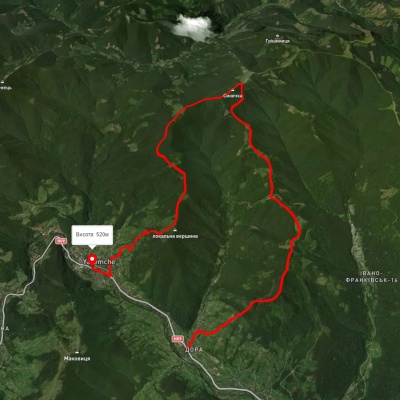
We suggest these hiking trails through or near St. Elias Church, Yaremche: Dora village, via Mount Bilyi Kamin and Mount Syniachka to Dora village, Dora hamlet – Bilyi Kamin rock – Mount Syniachka – Shchivka polonyna – Dora hamlet, Dora village, via Mount Syniachka and Chornohorytsia polonyna to Yaremche, Dora village, via Mount Syniachka and Pereslip Pass to Yaremche, Dora village, via Mount Syniachka and the Chornohorytsia ridge to Yaremche, Dora village, via Mount Syniachka, Pereslip Pass, Turshuhuvata polonyna and the Yavirnyk ridge to Yaremche

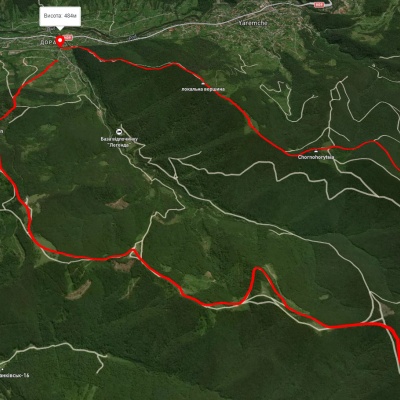
Dora village, via Mount Bilyi Kamin and Mount Syniachka to Dora village
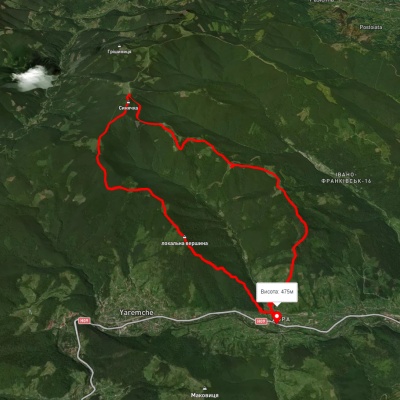
Dora hamlet – Bilyi Kamin rock – Mount Syniachka – Shchivka polonyna – Dora hamlet
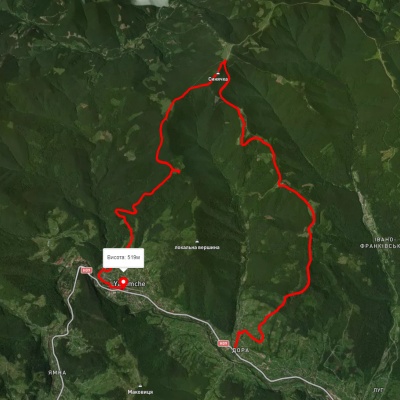
Dora village, via Mount Syniachka and Chornohorytsia polonyna to Yaremche
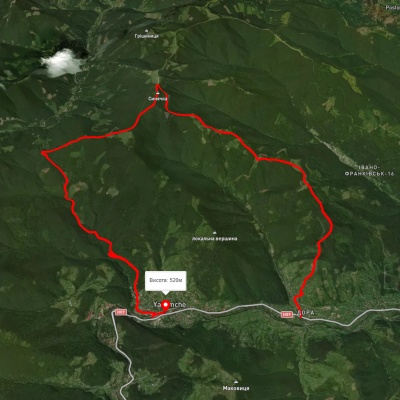
Dora village, via Mount Syniachka and Pereslip Pass to Yaremche