Armenian Quarter (Armenian Street), Lviv
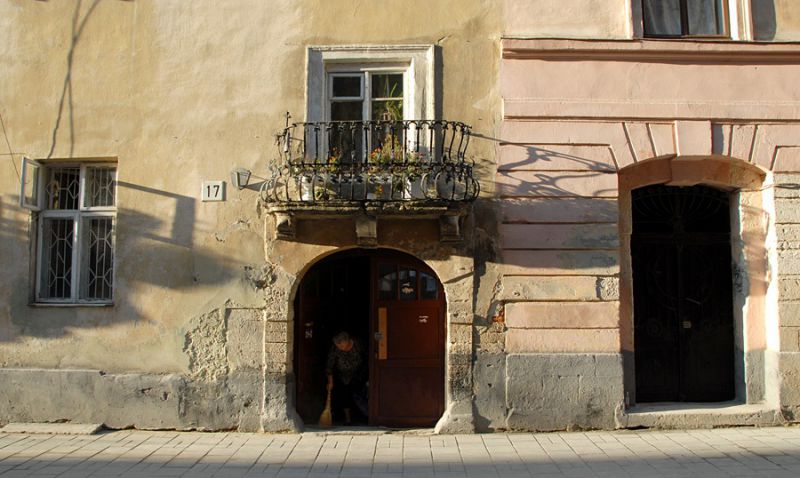
One of the oldest neighborhoods in the ancient city of Lviv is Armenian. For centuries, the community has been creating a center of national culture and architectural heritage in the city with its spiritual Christian content. Virmenska Street is a street in the Halytskyi district of Lviv, in the historic center of the city, near Rynok Square. It starts from Svobody Avenue and ends at the walls of the former Dominican Monastery. In the Middle Ages, it was the central street of the Armenian quarter.
Armenians probably appeared on the territory of Lviv in the middle of the 13th century. The Lviv Armenian colony was one of many that emerged at that time on the territory of present-day Ukraine as a result of the Turkish conquest of Armenia. The first representatives of this nationality were probably Armenians from Kafa (now Feodosia), where an Armenian colony already existed in 1047.
The initial place of their settlement was the beginning of the present-day Khmelnytskoho Street, the former Volynskyi Shlyakh. The old Lviv marketplace, Staryi Rynok Square, is still located nearby. The first Armenian settlers were probably merchants and artisans with equal rights to the local Russian population.
With the granting of Magdeburg rights to Lviv in 1356, the formation of a new city center around the present-day Rynok Square began. The development of the so-called "downtown" was surrounded by a wall and three rows of ramparts. The new Armenian quarter was located in the northeastern part of the walled city center. Its center was a street that is now one of the sections of the present-day Virmenska Street. The cultural center of the quarter was the Armenian Cathedral, which in 1364 became the diocesan center for all Armenians of Rus and Wallachia and was directly subordinate to the Supreme Catholicos in Echmiadzin. At one time, on the section from the first city wall (roughly Svobody Avenue) to the intersection with Krakivska Street, there was an archery moat that belonged to the Brotherhood of Archers.
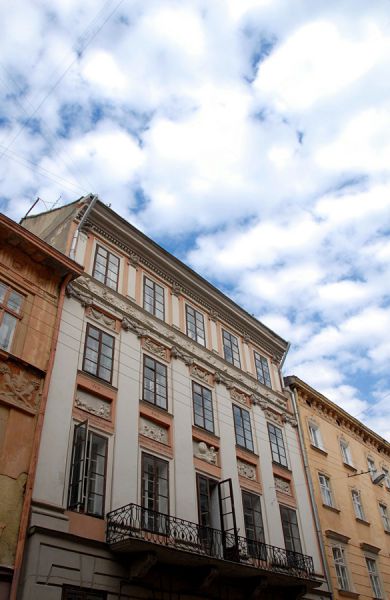
According to foreign travelers, the construction of Virmenska Street was one of the best in the city, along with Rynok Square and Ruska Street. Already in the XV century, there was a stone pavement, water supply, and drainage system. The best Lviv builders were involved in the creation of the architectural ensemble. The wooden Gothic buildings of Virmenska Street (as well as the entire city) were completely destroyed by the great fire of Lviv in 1527. This gave rise to a new, mostly stone Renaissance architecture. Household plots were elongated and faced the street on the smaller side. The buildings were mostly two- and three-story, three windows wide, and often had a roof that sloped down to the center with a gutter. In the seventeenth and eighteenth centuries, they were actively rebuilt, redeveloped, and merged, and additional floors were built. Often the reason was to convert them into apartment buildings. The Renaissance character of many buildings was lost. The facades acquired baroque and empire features, and at the end of the nineteenth century houses in the historicist style appeared. One of the turning points for the development of the street was the sacking of Lviv by Swedish troops in 1704. Tax registers show a number of houses that remained destroyed as late as 1712 and even in 1723.
Armenian Street has been the official name of the street since 1871. The street includes several small streets that did not appear at the same time and had different names. In July 1944, a new 450-meter-long street was formed from 3 separate streets. Its pre-war name, Ormianska Street, was returned to it, and in 1946 the street received its modern name, Virmenska Street. The names of its predecessor streets have been changed many times, mostly due to changes in political regimes.
The section of the street between the present-day Svobody Avenue and Teatralna Street:
- from 1895 - Didushytskikh, in honor of the Ukrainian family of Didushytsky, whose representative Volodymyr Didushytsky founded the Natural History Museum on the neighboring Teatralna Street;
- since November 1941, Welfenstrasse, in honor of one of the oldest European dynasties, the Welfs, whose representatives ruled a number of European states.
The section of the street between the modern Teatralna and Krakivska streets:
- 1444 - Pekarska Street, because bakers settled here in the fifteenth century;
- end of the eighteenth century - 1871 - Universitetska street or, in Austrian style, Universitetgasse;
- 1871 - Nyzhnia Hormianska.
The section of the street between modern Krakowska Street and the Dominican Monastery:
- In the late sixteenth and early eighteenth centuries, it was divided into several parts, each with its own name: Armenian, Old Armenian, Higher Armenian, Upper Armenian, or, in the Austrian style, Ober Armeniegasse.
The buildings on Virmenska Street are dominated by Renaissance, Baroque, and Classicist styles. Most of the buildings are architectural monuments of national and local importance.
№3. The Iłowiczówska House is located on the corner of Krakowska Street. The earliest mention of this building dates back to the beginning of the XIV century and comes from tax registers. Probably, the Gothic beer houses have been preserved from those times. At the end of the sixteenth century, it was renamed Shymonovychivska. Data from 1593 indicate that the building had three floors (the third was an attic). Later, it was given a new name, Ilovychivska, after the surname of the new owner, the goldsmith Matii Ilovych, probably the son of the rymar Ilya, who lived here until 1632. This name lasted until the end of the eighteenth century. Around the turn of the seventeenth and eighteenth centuries, it became the property of the Lviv Latin Cathedral, and in 1776 it became the property of the city. A reconstruction project of 1856 has been preserved, according to which it acquired its modern appearance. In 1866, the building was acquired by the People's House Institute.
№ 7, 9. The Armenian Church ensemble is one of the oldest churches in Lviv, an example of mixed Armenian-Byzantine architecture. The original (eastern) part of the church was built in 1363 at the expense of merchants Jacob from Kafa and Panos from Gaisarats (the builder was Doring, other variants of the name are also found). The construction was fully completed in 1437. There was a cemetery in the eastern part of the courtyard. Now the courtyard is lined with tombstones. The building of the former Armenian bank "Pii Montis" has been preserved in the depths of the eastern courtyard. In 1570, a bell tower was built under the direction of the builder Petro Krasowski, which is located separately from the church and has a through passage to Lesi Ukrainky Street. The first restoration of the church was carried out in 1862. On September 23, 2008, the Golgotha Altar was added to the list of cultural heritage monuments that are not subject to privatization. The building is listed in the Register of Architectural Monuments of National Significance under No. 318.
№ 10. The"House of Death" is a building that was dismantled as a result of a series of accidents that led to the deaths of several people at different times. Due to the sad associations associated with this building, it was completely dismantled, and nothing was built on this site for a long time. In 2015-2020, the building was reconstructed and used as a hotel.
№13. Muratovych's house. Originally, there were two houses of the XIV-XVII centuries on this site: The Muratovych House and the Ubalevych House, or Cefutiv House. Govganes Karmatanyants (Ivan Muratovych), the first Armenian printer in Lviv, lived in the Muratovychi House. Since the beginning of the eighteenth century, both buildings have been in ruins. In 1773, the ruins were sold to Lviv architect Petro Poleiovskyi, who built a new three-tiered Baroque building on the site. The construction was carried out by the shop foreman Yosyp Dubliovskyi according to the project of P. Poleiovskyi himself. The sculptures on the façade were probably made by the architect's brother Matwaj Polejowski around 1775. In 1778, the house, damaged by fire, became the property of the state counselor Count Josef Mir and was rebuilt by the architect Pierre-Denis Gibault in 1781-1783. Today the building has four floors. Since 1857, it has housed the financial prosecutor's office, since 1929 the Religious Library Society, and since 1933 the Archdiocesan Union of Armenians. Today the building is a residential building, owned by the city. Several rooms on the ground floor are occupied by the Cilicia cafe-bar; in 2000-2001, two apartments were reconstructed for this purpose. On the second floor of the building there is a hostel "Bazikalo". The building is listed in the Register of Architectural Monuments of National Importance under #319.
№15. TheDomazhyrivska house was built in the seventeenth century. In the taxpayers' lists of 1767, the house is mentioned as "Domazhyrivska Kamianytsia". In 1776, it was rebuilt by the Stefanovych family and, thanks to the new owners, was named Stefanovych's House. It also acquired the characteristic features of classicism and rococo. In the nineteenth century, the fourth floor was added and the house acquired the features of the Biedermeier style, and the facade of the house acquired a modern look. Today it is an ordinary residential building and is on the balance sheet of the city council. The premises in the ground floor are rented by the Khlib i Vyno cafe-bar. In the 1880s, the building housed the Pharmaceutical Society. The building is listed in the Register of Architectural Monuments of National Importance under No. 320.
As of today, the house generally retains its original layout, combining two two-story townhouses into one building with two entrance gates at the edges. The building is brick, U-shaped in plan (the main rectangular building and two outbuildings on both sides in the courtyard), three-storey, with a 4-window façade at the level of 2-3 floors containing vertical massive blades (in the middle part) supported by 4 stone consoles, the façade surface is rusticated, and the vaults of the XVIII century have been preserved in the beer-houses and haylofts. The house is listed in the Register of Architectural Monuments of National Importance under No. 1254.
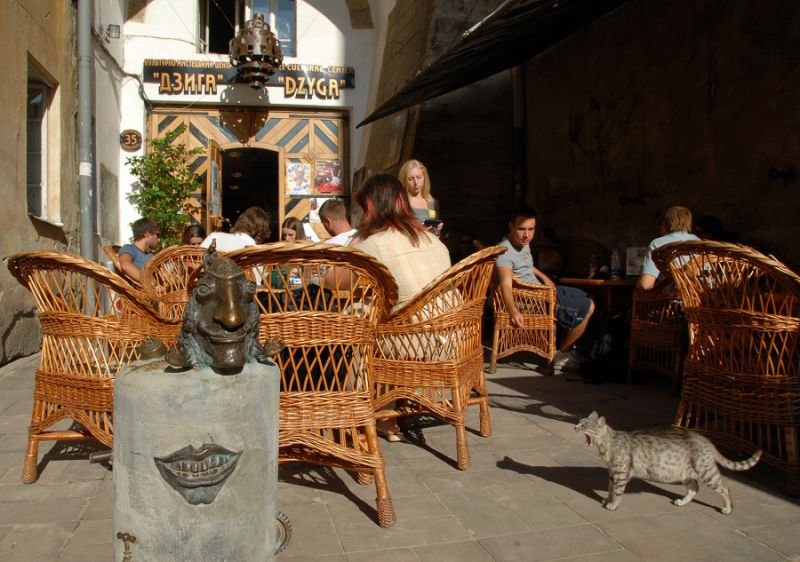
№20. Mykolaivovychiivska Kamianytsia. The windows of the house are located at different levels, which is probably the result of the union of two neighboring houses: one is two windows wide, the other has three windows. A well-preserved Renaissance residential building designed by Italian architect Peter the Italian from Lugano in the 16th century. The original entrance portal is decorated on both sides with columns that unusually combine features of the Doric and Ionic orders. At the bottom of the columns are canelures with inscribed rollers, an ornamental motif typical of the architecture of the Cilician kingdom. A similar ornament is also preserved on the portal of the Armenian Bank. In 1898, the building was reconstructed according to a project by Ivan Levynskyi. Since 2008, the left wing of the building has housed the Gas Lamp Restaurant and Museum with its own collection of kerosene lamps, near which stands a monument to the inventors of the kerosene lamp, Ignatii Lukasevych and Jan Zeg (sculpted by Volodymyr Tsisaryk). The house is listed in the Register of Architectural Monuments of National Importance under No. 322.
№22. Kassian's house. A residential building built in the seventeenth century. For some time, the owner of this house was a professional ophthalmologist, Dr. Alfred Buzhynskyi (d. 1914), who operated in a clinic located in the house at 7 Teatralna Street. In his will, Dr. Bużynski wrote down one million crowns for the purchase of five-acre plots for the needs of scout colonies. The executors of the will were the board of the Polish Sokol Society and Bishop Władysław Bandurski. The house is listed in the Register of Architectural Monuments of National Importance under No. 1256.
№ 30. The house is also known as the Farukhovych House, as well as the Hrachanivsky House and the Bernatovych House. The latter two names come from the name of the owner, Hranjan Bernatowicz, who lived here in the second half of the seventeenth century. It is known that as of 1712 the house was a one-story building. The current building was built in 1792 for Armenian Archbishop Yakov Tumanovych by Lviv architect Clemens Fesinger.
№32. The three-story building was the rear part of the Holubovychivska house at 9 Stavropyhiiiska Street. The vicars of the Armenian cathedral lived here. The house is listed in the Register of Architectural Monuments of National Significance under #1257. On December 3, 2018, the executive committee of the Lviv City Council approved urban planning conditions and restrictions for Krypa LLC, which will build a catering facility and apartments with an attic at 32 Virmenska Street.
№ 34. Gregorovychiivska Street. The house is on the corner of Fedorova Street with an entrance from this street (another address is Fedorova Street, 2). The size and outline of the plot have not changed since the foundation of Virmenska Street in the 14th century. Elements of Gothic brickwork discovered during the reconstruction of the ground floor suggest that the original masonry structure appeared no later than the 16th century. The original name of the building was Bohdanivska. At the turn of the sixteenth and seventeenth centuries, it was purchased by Armenian merchant Petro Gregorovych, which gave rise to the current name. It was thoroughly rebuilt in the late eighteenth century. In 1875, the third floor was added according to the project of the builder Michael Gerl, and the shingle roof was replaced with tiles. Minor reconstructions took place in Soviet times. In 2005, the ground floor was converted into a kneipp.
№ 36. Thehouse is locatedon the corner of Fedorova Street (another address is 1 Ivan Fedorova Street). The original name of the building was the Tarafatska house. After Tarafatskyi's death in 1631, it was passed to his sons-in-law Bernatovych and was renamed Bernatovychivska. In the early 1630s it was rebuilt by architect Jakub Boni. The house changed hands several times, but they were always connected to the Bernatowicz family in one way or another. At the beginning of the nineteenth century, it became the property of other families. In 1808, it was rebuilt according to the design of Friederik Pachmann.
In 1875, the Muller's coffee shop operated on Virmenska street.
The Armenian Bank was a banking institution that existed in Lviv at what is now Lesi Ukrainky Street, 14, from the beginning of the sixteenth century until 1940, and is mentioned under the name "Mons Pius." The practice of establishing pious banks at churches, which began in medieval Italy, was reflected in Lviv.
The main activities of the Armenian bank were lending, mediation in trade transactions, and pawnshop. Armenians lived in medieval Lviv mainly within their ethnic neighborhood and in the surrounding area. In the 16th century, about 200 Armenian families were recorded. To solve their financial issues, Armenians created their own bank on the basis of membership in the church brotherhood. This practice was widespread in the late Middle Ages and the Renaissance. Similar banks were established in Lviv by Poles, Jews, and Germans.
Once a year, the brotherhood elected the bank's management and officers. The brotherhood was managed by two pharmacists (sub-treasurers) and a scribe, whose duties included keeping books and recording decisions made at quarterly meetings. The brotherhood had two boxes. The first one, which was in the chancel, contained the founding documents, money, pledges, and registers. It was locked with a padlock and two pads, the keys to which were kept by two pharmacists and a clerk so that they could not open it in the absence of one of them. Donations for the current needs of the brotherhood were collected in the second box, which was placed near the altar. Other brotherhoods were organized in a similar way.
As a part of the Armenian Cathedral ensemble, the former bank building has the status of an architectural monument of local significance (protection number 1289). It is located to the northeast of the cathedral building. It is one of three buildings (#10, 12, 14) facing Lesi Ukrainky Street and Virmensky Lane. All these buildings belonged to the Armenian Catholic community in the seventeenth and eighteenth centuries. The house is brick, made of white stone masonry, four-story, with basements, and elongated from north to south. In the middle is a miniature courtyard-well. The house is an ordinary residential building. It retains its Renaissance structure and consists of two houses: the main and the rear. The main façade faces Lesi Ukrainky street, almost close to which the northern strand of the High Wall was located. The rear façade faces the courtyard bordering on Virmenskyi Lane. The name "rear" is conditional, since the lanes from Virmenska Street, the main artery of the Armenian Quarter, lead to its southern façade. Nowadays, the halls of the Mons Pius restaurant are located on the parterre of the "rear house".
A wide arched white stone entrance portal leads to the building's premises from Lesi Ukrainky Street. The semi-circular vaulted passage with its fluted vaults has been preserved. Nearby is a two-chambered room covered with a barrel vault. The entrance to the staircase to the upper floors leads from the courtyard from Virmenskyi lane, behind the house No. 12. This staircase was built in the late nineteenth century. The façade from Lesi Ukrainky street is plastered, without any architectural decoration. The windows of the 1st and 2nd floors have stone surrounds, and those of the 3rd and 4th floors have brick surrounds, indicating that the upper levels were added later. In the center of the 2nd floor is a blind niche with an arched end. The façade is crowned with a profiled cornice.
A narrow paved passageway leadsfrom the alley between houses #7 and #9 on Virmenska street to the arch with the inscription "Mons Pius". The arch reveals the entrance to the courtyard in front of the house, which was built on the site of a former cemetery. The courtyard is surrounded by a wall cut by semicircular arches with pylons. It now serves as a summer terrace for a cafe. The second entrance to the courtyard is through an arch from Virmenskyi lane. The southern façade of the house is modest - four-axis, with horizontal division by rods and wide window frames. On the right is the entrance to the cellars decorated with white stone slabs. To the left, on the elevation, is the entrance to the halls of the establishment, united by Renaissance portals and covered with semicircular vaults with flared arches. In the western part of the cafe is the largest hall, which is accessed by a white stone portal. This hall - formerly the main one in the bank - occupies the parterre of the 3rd, western volume of the complex.
The Armenian Cathedral has become one of the landmarks of the Armenian Quarter in Lviv. The Armenian community began its activities in the 14th century. The church complex was built in several stages. The cathedral was built in 1363, but its bell tower was constructed much later, in 1572. The cathedral is located in the back of the quarter, behind a gate with a sculpture.
The Armenian quarter in Lviv is located next to Rynok Square and Svobody Avenue. You can get to the center by most local transport, get off at the avenue near the Lviv Opera and Ballet Theater. Heading from there, walk two streets, turn left on the third and cross the road.