Dombrowski's house, Lviv
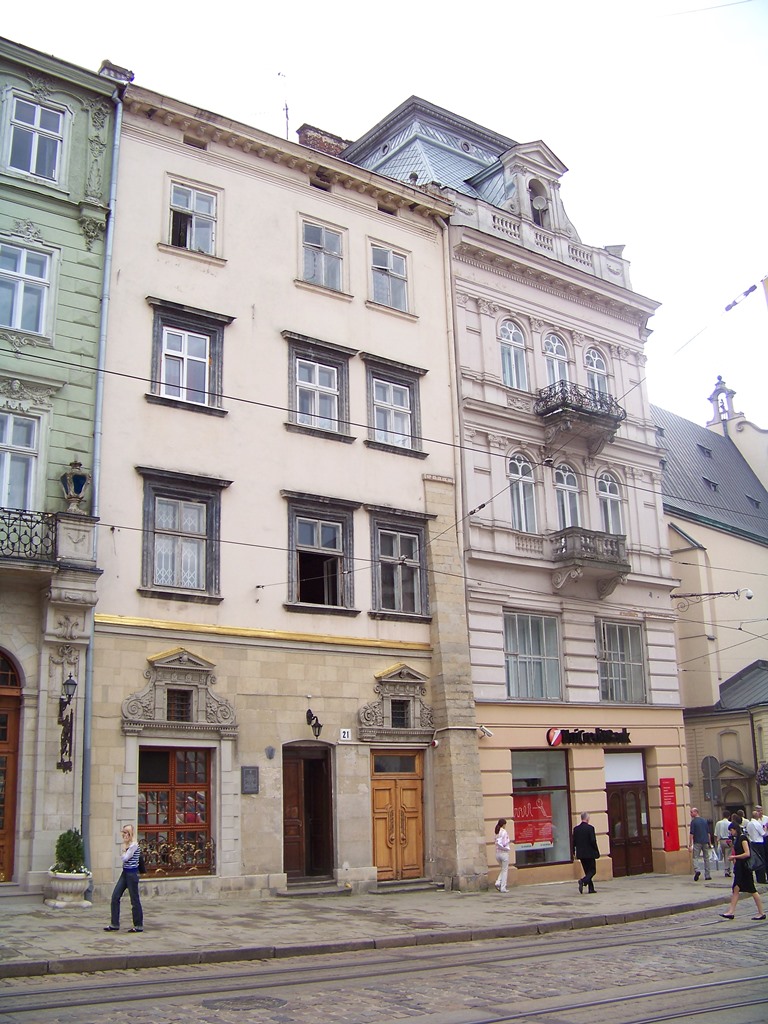
On Rynok Square, next to the Massarivska, Heppnerivska, and Bielska Stonies, there is a small four-story building, the Dombrowski Stonies, a residential building at 21 Rynok Square in Lviv (registered as an architectural monument under the State Historical and Architectural Reserve). The building is located on the territory of the State Historical and Architectural Reserve, in the linear development of the southern side of Rynok Square. This is the former Dombrowski House, built for Andrii Sambir Dombrowski in the first half of the seventeenth century.
Later it was successively owned by the Ubaldini, Zylkiewicz, Kupiński, and Nuszczyński families.
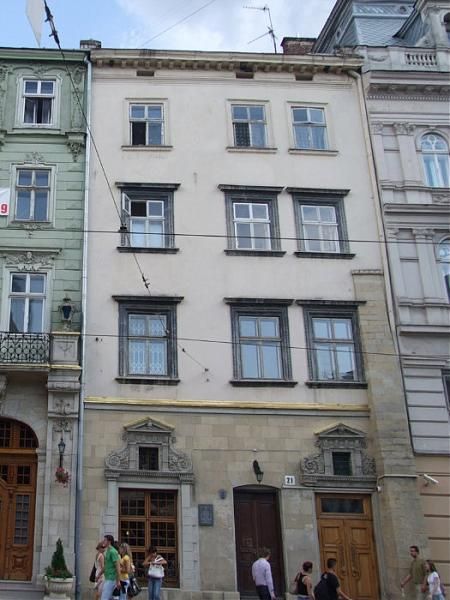
This three-windowed house has preserved two Renaissance portals on the main façade and an old two-division from the seventeenth century. On the ground floor, the house has an ornamented chamber with stone-carved window and doorways. The cartouche above one of the portals shows the outline of an animal, most likely a lion, which is typical of Lviv architectural decoration.
Among all the similar buildings located on Rynok Square, the Dombrowski building stands out. Built in the first half of the 17th century, the building has undergone several major reconstructions, including the completion of the fourth floor in the 19th century. At the same time, despite numerous restorations, the townhouse has retained its original layout and decoration - stucco molding and carvings.
In 1866, architect Antoni Serwacki designed the toilets in the building.
In 1876, the builder Józef Michel designed the extension of the office for the then owner of the building, Julia Krajczyńska.
In 1880, the architect Wincenty Kuźniewicz designed the fourth floor above the rear townhouse.
In the 1890s, the owner of the building was Dr. Władysław Piszek.
In 1900, the architect Artur Schleyen designed the wooden storefront.
In the 1930s, the building was owned by Edward and Stefania Dziedziccy.
In 1934, architect Michał Łużecki reconstructed the store's portals.
Due to its pristine condition, Dombrowski's house, as an exclusive exhibit of Renaissance architecture, attracts city guests and architects thirsting for inspiration with its strict exterior forms.
The building was erected on the south side of Rynok Square, in a linear development. It is built of stone and brick (foundations of stone blocks), plastered, four-story, and has a rectangle with a narrow main façade, characteristic of market houses, stretched into the depths of the plot. It has preserved its original interior layout, vaults on the ground floor with peculiar cantilevered capitals, and a portal with an old wrought-iron door in the hallway. The windows in the second-floor chamber are decorated with carved stone frames. The façade, designed in strict Renaissance forms, is decorated with two original stone portals and window frames.
The main building retains the medieval planning structure in general. It has four bays in depth; an indermah (the front large rooms - rooms and haylofts, an inner corridor, kitchens, and a staircase); a courtyard with a side wing; and a hindermah (the rear house with wings). The house is three-dimensional in width: two large rooms (rooms) from Rynok Square, located on both sides of the entrance (stables). The main staircase is three-flight, square in plan, with a wrought-iron fence. Above the staircase is a high four-pitched glass roof (lantern). There is a second staircase with a baluster fence at the rear of the house. A rectangular stone portal (now closed) has been preserved in the entrance (porch) on the left side. On the ground floor, the rooms and the beer hall are covered with cross and cylindrical vaults.
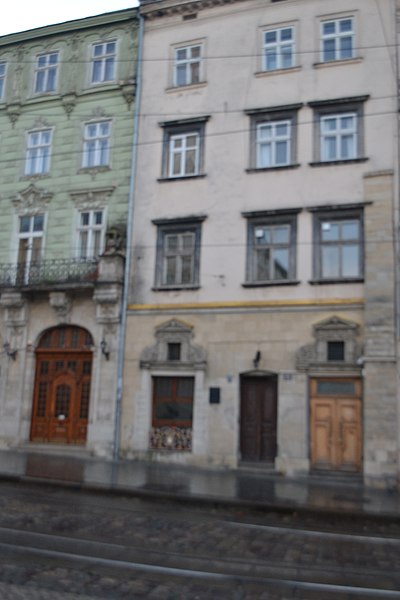
The main façade has three windows and is asymmetrical, with a stone buttress on the right side, which is two stories high. Two Renaissance portals with small barred windows on the main façade, as well as an ancient two-division, have been preserved in this three-windowed building since the seventeenth century. The cartouche above one of the portals shows the outline of an animal, most likely a lion, typical of Lviv architectural decoration.
Since 2010, one of the portals has served as the entrance gate, and the other has been converted into a large window display case. The surface of the ground floor walls is faced with natural stone. A profiled cornice runs between the first and second floors. The windows of the second floor have strict Renaissance profiled stone frames decorated with linear sandriks. The fourth floor, added in the nineteenth century, has similarly shaped windows. The façade ends with a profiled cornice with brackets. On the ground floor, the house has an ornamented chamber with stone-carved window and door openings.