Belsky's house, Lviv
The Bielski, Bielski, Kaiserivska, Kralivska House is a residential building at 20 Rynok Square in Lviv, an architectural monument (under protection No. 326/19) located on the territory of the State Historical and Architectural Reserve, in the linear development of the southern side of the market square.
The house was built in the sixteenth century. The first name of the house, Kraizerivska (Kaiserivska or Kralivska), comes from the surname of the Lviv voit Stanisław Kraizer (1569). This name survived until the seventeenth century. At the beginning of the eighteenth century, the house was three-tiered and had a courtyard wing.
In 1776-1779 the house was thoroughly rebuilt. The reconstruction project was created by architect Petro Polejowski at the request of Constance Bielska (a Galician castellan, the second wife of Józef Bielski), the starosta of Rabshtyn. After P. Polejowski's death, the building was completed by the builder Franciszek Xawierz Kulczycki. The interior and exterior of the building was decorated by carvers Franciszek Olenski, Mykhailo Stebanski, Johann Gertner, and Stepan Unicki. Only the façade on the ground floor level, faced with hewn white stone, has survived to this day, preserving elements of late Baroque decor. After that, the building was renamed Belska or Bilska.
In the 1840s and 1850s, the house was owned by Gabriel Mülling. In the second half of the nineteenth century, the house became the property of Ukrainian burghers. In 1858, it was bought by Mykhailo Dymet, a merchant who owned a shop and a workshop. His shop "Under the Hope," located on the ground floor, provided churches in Galicia with church utensils and books. In 1864, Taras Shevchenko's Kobzar was sold here for the first time in Lviv. Mykhailo Dymet was elected to the City Council for 27 consecutive years and to the Chamber of Commerce several times. In the 1860s, he supported the Ukrainian literary community in Galicia financially.
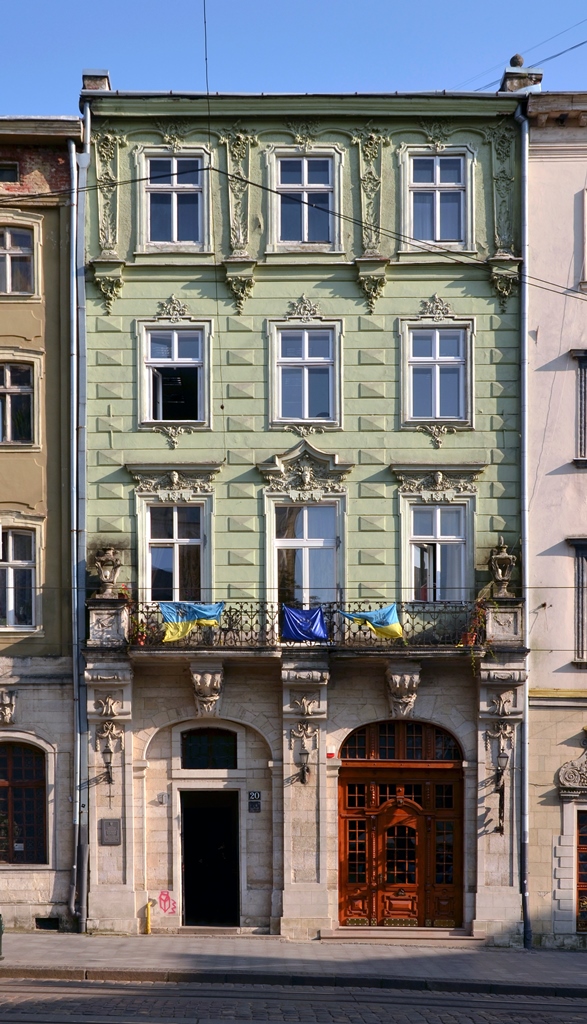
In 1860-1861, the house was extensively rebuilt at Dymet's expense according to a project by the builder Michael Gerl, which was approved by the magistrate on July 13, 1860. The fourth floor was added. The facade of the house, except for the parterre and the second floor balcony, decorated with Rococo lattices and heavy stone vases on pedestals (probably from the time of Francis Kulczycki's reconstruction), has lost its appearance since 1779. In the 1890s the house belonged to Franciska Dymet.
In the 1900s and 1930s, the house belonged to Adolf and Marta Auerbach, who commissioned architect August Bohohvalsky in 1908 to design a project to cover the courtyard with a glass roof, which was implemented. In September 1934, the architect Tadeusz Wrubel designed the entrance portal for Martha Auerbach. Subsequently, the ground floor and basement were used as a popular restaurant in the 1960s and 1970s, the Pid Lievom, whose interior was decorated with a ceramic panel "Danylo Halytskyi" from 1965 by the masters Andrii Bokotey and Liubomyr Medved. In 1986, after the restoration of the ground floor and basement, the Pid Levom cafe was opened here.
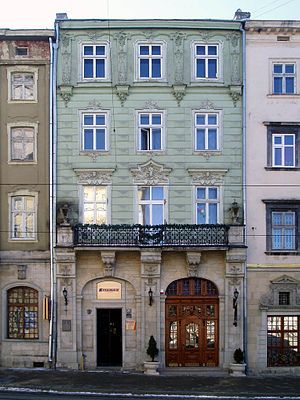
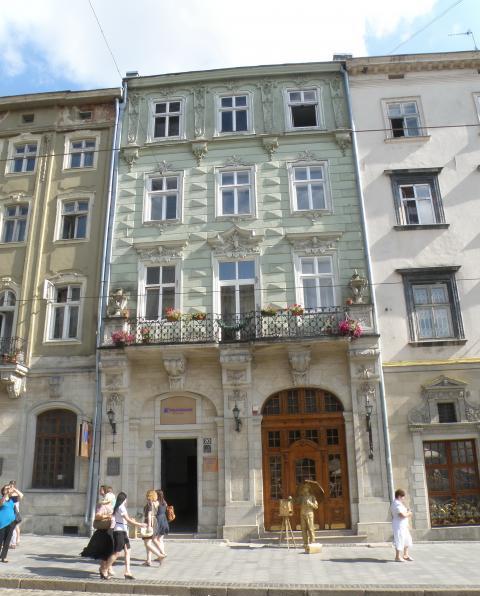
The building was erected on the south side of Rynok Square, in a linear development. It is built of stone and brick (foundations of stone blocks), plastered, four-story, and has a rectangle with a narrow main façade, typical of market houses, which is extended into the depths of the plot. The façade is designed in the Rococo style and is decorated with elegant vases, stucco garlands, and curly consoles of the second floor balcony with an openwork metal lattice.
The sculptural decor was created in 1786 by sculptor Franciszek Olenski.
Today, a cozy cafe is located on Rynok Square, in the house number 20. However, the restaurant is not all that this building is famous for. Going up to the next floor, visitors can see a lot of interesting things, get acquainted with the history of several generations who lived in the Belski house. Small stucco moldings, jewelry carvings and interior decoration even after 4 centuries remind of the former grandeur of this house.
Today, Lviv citizens and visitors are mostly limited to gatherings in the iconic cafe "Under the Lion" since the 1970s and rarely go up to the upper floors of the building. And in vain, there is much to admire and to be surprised at.
The main façade is three-windowed, symmetrical with an entrance portal shifted to the right. At the ground floor level, the façade retains elements of late Baroque decor. The surface of its walls is faced with hewn white stone. Two wide arched portals with stone profiled frames at the top are decorated with keystones that pass into the balcony consoles. The wide pilasters are crowned with capitals at the top, which divide the first floor into two equal parts, support the balcony in the center, and serve as pedestals for white stone vases. At the second floor level, a balcony with a rococo lattice decorated with a lattice extends almost the entire width of the façade. The façade is pierced by windows with profiled white stone frames decorated with sandriks (on the second floor) and lavish Rococo decor.