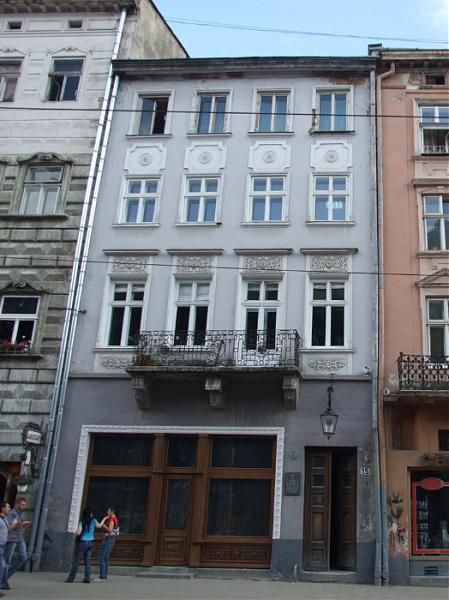

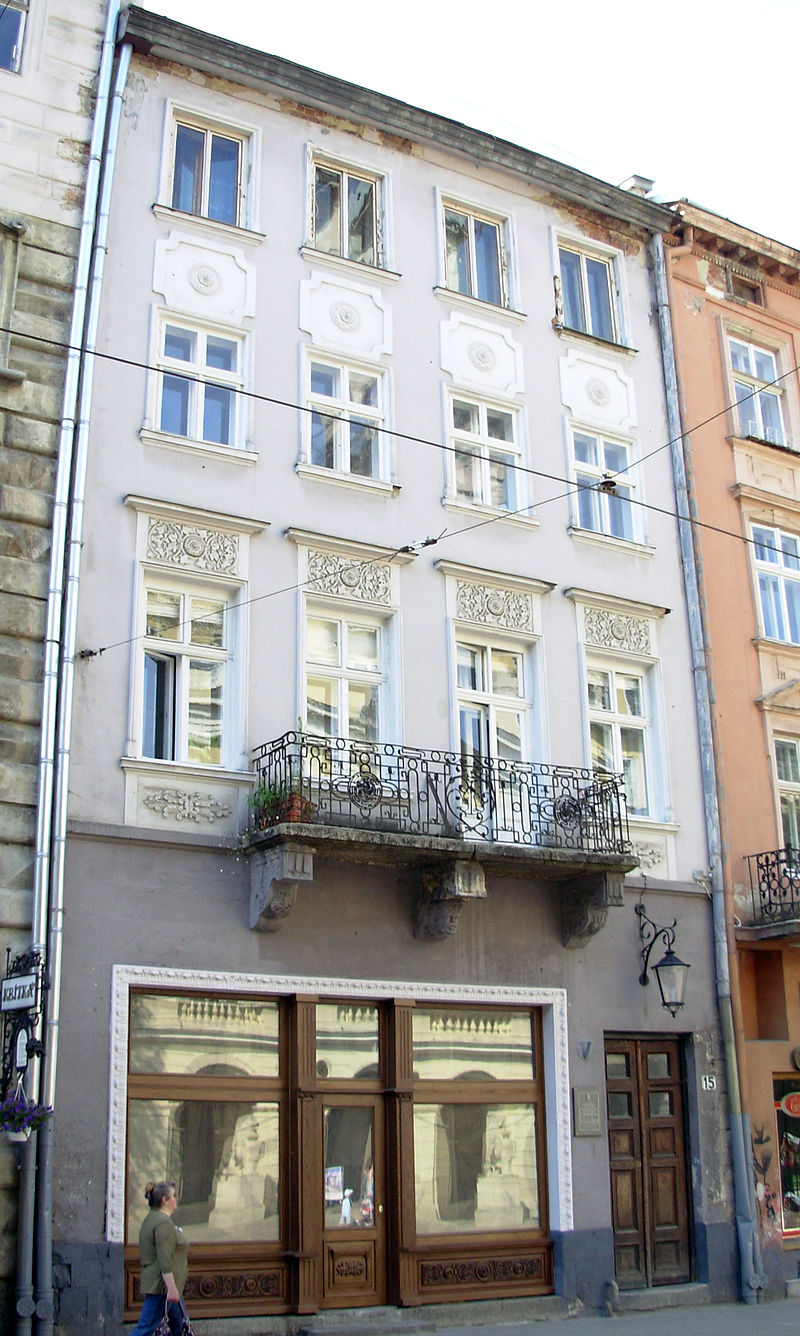
Thehouse at 15 Rynok Square (conscription number 232), formerly the Mistrzszymonowska house. An ancient manor house of Szymon Simonides (Szymon Szymonowicz), a "mister" (i.e., master). In 1609, Szymon Simonides sold it for 5500 zlotys to the clothier Wawrzynec Szmid.
In 1870-1890, the house was owned by Anna Lau, née Lachs (Anna Lau zam. Lachs). At her request, on April 9, 1894, the architect Sołomon Riemer designed a wooden shop window on the ground floor.
In the late nineteenth and early twentieth centuries, Nathan Mensch became the owner of the building. In 1901, at the expense of this owner, the four-story building was reconstructed according to the design of architect Henryk Salwer.
In 1913-1914, the architect Leopold Reiss reconstructed the building by order of Nathan Mensch. At that time, the outhouse was reconstructed, the courtyard was paved, and new toilets were installed in the outhouse.
In the 1920s and 1930s, the house was owned by Abraham and Róza Schütz. In 1929, the magistrate approved the design of the store portal and shop window on the ground floor of the building. It was executed in December 1928 by the builder Israel Markus Sobel at the request of Abraham Schutz.
It is very easy to find the Shymonovych mansion in the historic center of Lviv. A signboard of the hostel, which occupies the second floor of the mansion, can become a distinctive sign. The house is located opposite the main entrance to the City Hall. The building is brick, plastered, extended into the depths of the plot, with a small courtyard, and has four floors. The façade, decorated with stucco inserts and rosettes above the windows, has a balcony on curly consoles fenced with an openwork metal lattice. The plan has a rectangle, characteristic of market houses, extended into the depths of the plot with a small courtyard and a narrow four-window main façade.
The symmetrical composition of the main façade is offset by the entrance gate shifted to the right. The shop window on the ground floor dates from the first half of the twentieth century. At the second floor level, there is a balcony on shaped consoles fenced with openwork metal lattices. The windows of the house have profiled frames, decorated with stucco decorative inserts and rosettes.
This typical Lviv building has always been an architectural complement to the city's main square. Like all the townhouses of the center, the Shymonovych mansion did not exceed the established height limit of three floors. The house was built in the XVI century, but only in 1901 did it grow and take on its modern appearance.
Location on the map
Comments
Places to stay nearby
All stays HotelHotel "Swiss" - Swiss Hotel LvivLvivunder 1 km from Shimonovich's house, LvivSaunaSPABreakfastNearby: St. Andrew's Church 200 mTurkuliv-Comello Palace 900 m
 HotelHotel-Restaurant "Ferenc" LvivLvivunder 1 km from Shimonovich's house, LvivSaunaKitchenWi‑FiNearby: St. Andrew's Church 500 mTurkuliv-Comello Palace 1.3 km
Nearby attractions
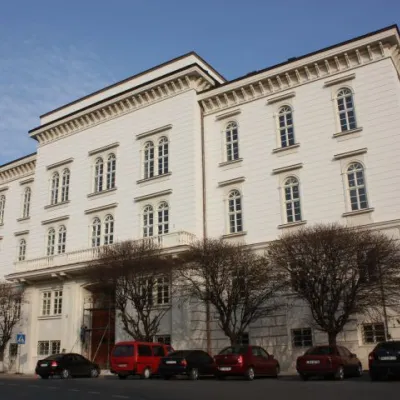 SightPalace of Latin ArchbishopsLvivunder 1 km from Shimonovich's house, LvivThe site for the construction of the archbishops' palace was donated by the ruler of the Kingdom of Rus, Prince Władysław Opolczyk, in 1375 to Latin Bishop Matthew of...
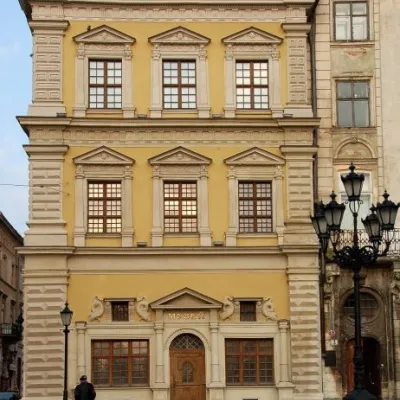 SightBandinelli PalaceLvivunder 1 km from Shimonovich's house, LvivAn Italian merchant Roberto Bandinelli, who received Lviv citizenship, bought the house and started a classic European-style post office.
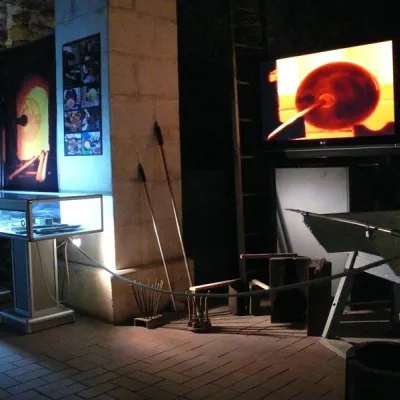 MuseumMuseum of glassLvivunder 1 km from Shimonovich's house, LvivA very interactive and modern museum. Small in size, but quite interesting.