Church of Saints Olga and Elizabeth, Lviv
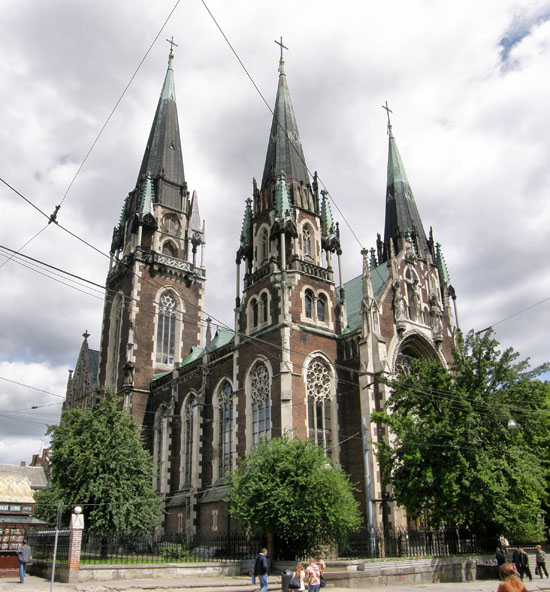
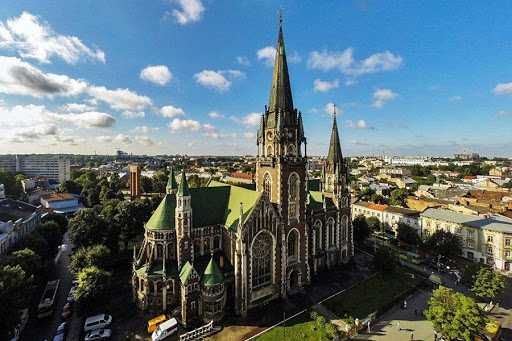
The Church of Saints Olga and Elizabeth (formerly the Church of St. Elizabeth of Hungary) is a functioning neo-Gothic church of the UGCC in Lviv, on Kropyvnytskoho Square (popularly called Pryvokzalna Square), which is distinguished by its tall towers with sharp spires. The church was built in memory of the popular Empress (Tsarina) Elisabeth of Bavaria (Habsburg), known as Sisi, the wife of Emperor Franz Joseph I of Austria-Hungary. Today, this building is the tallest in the city, 88 meters high. This landmark is perhaps the most fascinating to tourists and residents of the city. The church is located on Kropyvnytskyi Square, not far from the train station. Thanks to people's concern for historical and spiritual values, the church is still functioning today. It is an architectural monument (oh. No. 146-M).
In the last half of the nineteenth century, Europe began to develop very intensively the means of communication, especially railroad transport. A railway yard with infrastructure was built in the western part of Lviv, and the surrounding area was built up with houses for railway workers, the so-called "koliivka". The population of this area of the city came from the central regions of Poland and the outskirts of Lviv. The high rate of growth, especially of Polish-speaking residents, required that their religious needs be met. Why mostly Polish-speaking population? At that time, Ukrainians could not receive the education necessary to service railroad transport in western Ukraine, while ethnic Poles had the opportunity to receive it in educational institutions in Germany and Austria-Hungary. In addition, the railroad has always been considered a strategic industry, and for certain reasons, Greek Catholics and Orthodox Christians were not allowed to work there.
According to the Catholic clergy, the Church of St. Elizabeth, in contrast to St. George's, was to emphasize the Polish character of Lviv.
The site of the construction was chosen to be Solarna Square, on both sides of Horodotska Street. The choice was made so that the church building would block the view of St. George's Cathedral, which was Greek Catholic, from the main station and remind all those arriving in Lviv by rail that Poles lived here. The church was built at the expense of the railroad workers for their parish. The church was immediately dedicated to St. Elizabeth of Hungary, the emperor's guardian, and in honor of his wife Elizabeth of Bavaria (Habsburg). On March 5, 1902, an architectural competition was announced, with 19 participants, among whom the best project was recognized as the Trio project, designed by Professor of the Lviv Polytechnic Institute Theodor-Marian Talovsky (1857-1910), a famous architect of his time, a graduate of the Vienna and Lviv Polytechnics, and a student of the Lviv architect Julian Zacharewicz. The total cost of the construction was not to exceed 700 thousand gold roubles (without landscaping and interior design). Funds for the building were raised by charitable contributions from Lviv railroad workers. According to the terms of the competition, the church was to have a capacity of 2,200 people, including 500 seats; it was to be designed in the style of late Romanesque or early Gothic architecture, and to be built of stone and brick with open masonry. During the design process, the church was incorporated into the existing architectural ensemble. The architects and builders made the only right decision to build the future church in the traditions of Gothic architecture.
Theconstruction of the church began on September 25, 1904, under the leadership of engineer Karol Richtman, with the laying of the foundations. The church was built in memory of the popular Empress (Tsarina) Elisabeth of Bavaria (Habsburg), known as Sisi, the wife of the Emperor Franz Joseph I of Austria-Hungary. On September 10, 1898, the sixty-year-old empress was stabbed in the heart with a sharpened knife by a young anarchist Luigi Luceni. The attack took place during a walk along the embankment of Lake Geneva, where the Empress was to board the Genève steamer, which was sailing to the city of Montreux. Not realizing the seriousness of her injury, the Empress boarded the ship and bled to death. The emperor also took part in laying the foundation stone for the shrine. The church was decorated by leading artists, sculptors, and carvers, including Tadeusz Blotnicki, Petro Wijtowicz, and Kazimierz Sihulski.
During his last visit to Lviv on September 13, 1903, 73-year-old Franz Joseph I took part in laying the foundation stone for the church. At the time, the emperor was on his way to maneuvers of the royal cavalry in the vicinity of Komarne. In this way, Franz Joseph was to be involved in this project, using his funds.
Sculptors: P. Wiitowicz, L. Zepikhowski, J. Szostakiewicz, and others, and the artist was K. Sichulski. The neo-Gothic style of the cathedral repeats many elements of Gothic architecture: high pointed spires, lancet windows, a portal with a large rose in the center, and a vertical interior space. Petro Wijtowicz, who was called the "Lviv Fidius," decorated the church with the sculptural composition "Crucifixion with the Sitting Ones."
At the beginning of the First World War, the Austro-Hungarian government confiscated the church bells for military use.
In thefall of 1911 the church was consecrated, and in 1913 the interior was almost completed. During the Ukrainian-Polish war of 1918-1919, the church was damaged by Ukrainian artillery. On the wall is a memorial "Ex obsidione ruthenorum" ("From the Ukrainian siege of March 6 and 9, 1919").
Only in 1923 did the management of the building receive permission to build rooms in which altars for the church were to be made instead of the original ones installed as temporary ones. In 1926, one of the largest organs in Poland at the time, made by the famous firm of brothers Dominik and Wacław Biernacki, was installed in the church. In 1930, the temporary high altar was replaced with a new marble one in the Art Deco style, designed by the architects Ludomyl Durkowicz and Józef Szostakiewicz and the sculptor Janina Reichert-Toth, a graduate of the Lviv School of Art and Industry and the Krakow Academy of Arts. She created the sculptures of St. Elizabeth and Stanisław, as well as angels made of artificial stone. The altar was made at the Czartoryski factory in Zhuravne. In 1926, the sculptor Petro Wiitowicz and L. Repikhovsky made a neo-Baroque pulpit. In 1933, ornamental stained-glass windows were arranged by the Żeleński company according to the design of Wawrzyniec Dajczak (lost). In 1935-1936, a crypt was built, and the roofs of the church were covered with copper tin. At the same time, it was planned to build a parish house and a bursa on the square near the church, but the projects were not implemented.
In 1939, in the first days of World War II, during the bombing of Lviv, an aircraft bomb exploded near the church, damaging the spires and walls. In 1946 the cathedral was closed. The building was transferred to the warehouse of the Svitoch confectionery factory. The communist authorities of the time did not care about religious monuments, so the church fell into decay and was subjected to various destructions by the authorities. It was repeatedly proposed to destroy the building.
With the independence of the Ukrainian state, the church began to acquire the status of a functioning religious shrine. In 1991, the church was transferred to the Greek Catholic community and consecrated as the Church of Saints Olga and Elizabeth. Father Mykhailo Fedoriv became the pastor, and in 1992 intensive repairs to the church began. The roofs were completely covered and the windows were glazed. During the reconstruction, the Latin throne was also dismantled and replaced with a Greek Catholic one. Graduates of the Trush College recreated 10 sculptures of the apostles (2 have survived). On May 19, 1994, a cross made at the Lviv Locomotive Repair Plant was returned to the clock tower (the cross weighed 400 kg). Restoration work on the interior lasted until 1995. In 1996-1998, the stained-glass windows of the altar part were made by Valerii Shalenko. In 2000-2003, the territory of the church was fenced with a forged iron fence made by the workers of the mentioned plant. The church is still undergoing repair and restoration work. During 2005-2011, a heating circuit was installed in the floor (2007); the floor was tiled with ceramic tiles (2008); and the roof was repaired. In addition, a number of repair and restoration works were carried out on the exterior: window sockets were restored, old window frames were replaced with double-glazed windows; decorative stone elements were restored, and lost elements are being recreated. In recent years, the basement and classrooms in the towers have been arranged, and all the stairs, including the metal spiral staircase in the towers and the stone staircase leading to the main entrance to the church, have been repaired.
The church is an active dominant not only in the development of the western part of the city, but also in shaping its landscape. The church was built in the Neo-Gothic style and features tall towers with spire tops, large lancet windows with mullions, pinnacles characteristic of the Gothic style, and rose windows. It is built of brick on a stone foundation, with white stone and roman cement molded details. The overall dimensions are 70.75x32.6 meters. The height of the roof ridge is 24.65 m, the height of the towers of the western façade is 48.4 m, and the height of the main tower is 71.5 m.
In terms of its planning and spatial structure, the church is a three-nave basilica with a transept, altar, and narthex. The altar part is two-dimensional, crowned with a semicircular apse, surrounded by a gallery, and adjoined by semicircular chancels on both sides. The narthex is flanked by rectangular towers. The perimeter walls are reinforced by buttresses crowned with vials with crabs and crucifixes. On the north side of the transept is an 85-meter-high spired three-tiered tower with a clock (lost), with a figure of St. Elizabeth on the northwestern face.
The façades are of open masonry, with the plinth and corners emphasized by white stone blocks; some structural elements in the interior are also made of stone. The main, western façade is three-tiered, with two tall towers crowned with steep spires and topped with crosses. The central part of the façade is accentuated by a rosette window in a perspective window niche and a perspective lancet portal of the main entrance, each ledge of which is decorated with columns with capitals in the form of chestnut leaves and fruits. The porch is decorated with pinnacles with violets and a monumental composition "Crucifixion with the Rising" (sculptor Petro Viytovych).
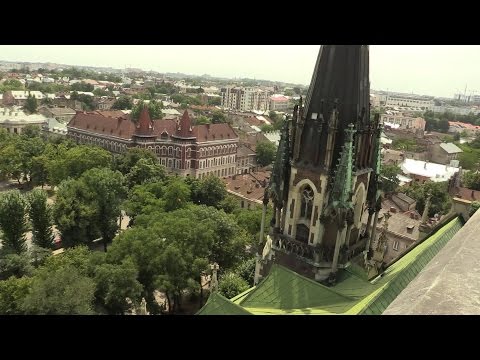
The large lancet windows and rose windows on the main façade and in the transepts are decorated with trifoliate, quadrifoliate, six-leafed, and fish-bubble mouldings. The towers are decorated with pinnacles with crabs and cruciferous flowers, with observation balconies with openwork stone parapets decorated with a fish-bubble masquerade.
The interior of the church is open in depth, the central nave is covered with a star-shaped vault, the side naves with cross vaults, and the altar part with a closed vault. All the vaults are nervous. The naves are separated by pillars in the form of bunches of columns with capitals in the form of chestnut leaves. The arches between the pillars are lancet, with profiled architraves. At the western wall above the narthex are wide choirs (the organ is lost) on four columns, between which are four small columns of red marble. There are white marble sprinklers on the columns. On the cornices of the pillars on the side of the nave there were sculptures of Christ and the Virgin Mary, now there are relief images of angels with trumpets. The parapet of the choirs is made of wood, animated by the rhythm of arches with masquerades. Metal spiral staircases in the towers lead to the choirs. The interior is dominated by a marble high altar.
The church is one of the largest churches in Lviv.
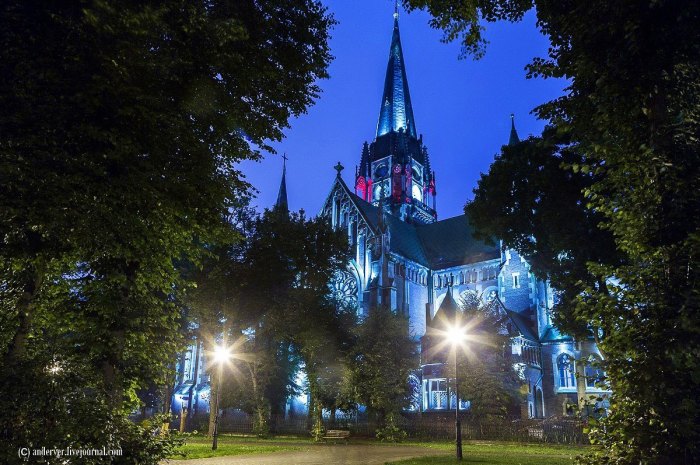
In 2013, the church's exterior lighting was installed. 2016 - a group of stained glass artists (Yurii Pavelchuk, Oleksandr Lychko) installed the first stained glass iconostasis in Ukraine.
TheChurch of Saints Olga and Elizabeth is located in Lviv at 1 Kropyvnytskoho Square. You can walk from the railway station to the monument, which will take about 6-10 minutes, or take buses #16, 31 and get off at the first stop. From other parts of the city there are buses numbered 7, 15, 24, 29, 29A, 36, 41, which stop a few meters from the temple. Trams 1, 6, 9, 10 also go to the church.