St. Volodymyr's Cathedral, Chervonohrad
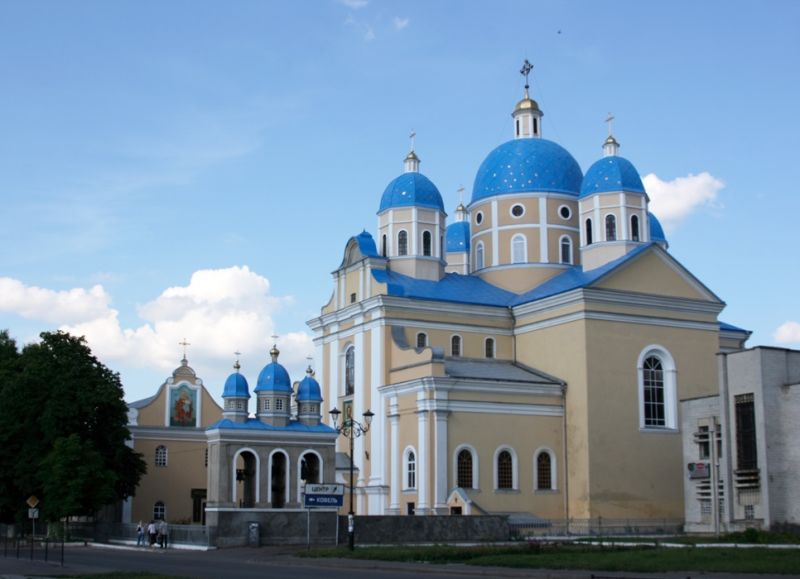
St. Volodymyr's Cathedral (formerly the Church of the Holy Spirit) is a religious building, a church of the OCU in the city of Chervonohrad (Lviv region). It was built in the early eighteenth century in the Baroque style as the Catholic Church of the Descent of the Holy Spirit in the Bernardine monastery complex and is the oldest building in Chervonohrad. After the Second World War, the monastery and the church were closed, and in 1988 the dilapidated church was handed over to the Orthodox community and rebuilt into an Orthodox church. It has the status of an architectural monument of national importance in Ukraine, with protection number 1336.
The church is located in the old part of the city, at 20 Bohdana Khmelnytskoho Street. The rector of the cathedral is Metropolitan Archpriest Mykhailo Hnativ.
The Bernardine monastery in Chervonohrad (then called Krytynopil) was founded in 1695 (according to other sources, in 1692), when the founder of Krytynopil, Felix Kazimierz Potocki, built a wooden church of the Holy Spirit with stone underground crypts in the city, which were to serve as a burial vault for the Potocki family and his descendants. Feliks Casimir also invited monks from the Bernardine order to settle at the church and granted them land for pastures, the right to fish in the Western Bug, and the right to use mills and forests that belonged to the nobility. In 1701, the church burned down in a fire, and Feliks Kazimierz began construction of a new brick church in the Baroque style, but in 1702 he died and was buried in the church's crypt. His son, Józef Felician Potocki, continued the reconstruction of the church, donating 30,900 zlotys for the construction work. In 1710, the Brotherhood of the Immaculate Conception of the Mother of God began to operate at the church.
In 1723, Józef Felician Potocki died and the construction of the Church of the Holy Spirit was continued by his son Franciszek Salesius Potocki. In 1733, he transported the coffin with the relics of St. Clement from Rome to the church in Krytynopol. Another relic, a piece of the Holy Cross, was brought to the church in 1752.
The first buildings of the Bernardine monastery at the Church of the Holy Spirit were wooden, so in 1747 Franciszek Salesius began construction of a stone monastery designed by Franciszek Czajka. However, in 1749 there was a fire that destroyed part of the monastery buildings and damaged the church. The restoration of the monastery and church was completed only in the 1760s. In 1767, a stone fence was added.
In 1755, an organ was installed in the church, and in 1758 a small chapel for the relics of St. Clement was added to the right of the altar area. Franciszek Salesius Potocki invited the Lviv artist Stanisław Stroinski to paint the interior of the church. The cost of the painting, which lasted from 1759 to 1759, amounted to 16,016 zlotys. Stroinski painted the walls and vaults of the church with polychrome frescoes, the most notable of which were the frescoes on the Resurrection of Christ and the life of St. Francis in the main nave. The artist D. Balzani also created several paintings for the church.
In 1772, after the first partition of Poland, which ceded Krystynopil to the Habsburgs, and the death of Franciszek Salesius Potocki, the monastery began to gradually decline. In 1772-1774, some of the premises were used as Austrian army depots, so the monks gradually left the monastery and moved to Polish lands. In 1802, the Austrian authorities tried to close the monastery because of the small number of monks, but thanks to the intercession of Lviv consistory Euclarch Jevkarpii Wegiel, the monastery continued to exist.
In 1840-1843, the monastery was partially repaired, and its abbot was Antony Mikosh. In 1852, a large fire destroyed the church and monastery again, but in two years the buildings were completely restored. The restoration work was supervised by the new abbot of the monastery, Anzelm Pizunsky, who held this position in 1848-1855; numerous benefactors, including the then owner of Krytynopol, Teresa Vyshnevska, gave money for the restoration of the shrine. The frescoes of Stanisław Stroinski were restored after the fire by the artist Stanisław Rodiecki in 1854. In 1889, a new altar by the Polish master Majerski was installed in the church, the cost of the altar was 4000 zlotys. The Baroque altar was decorated with wooden carvings: in the central part - statues of St. Bernard and St. Francis, on the sides - statues of Popes Gregory and Urban. At the end of the nineteenth century, the side chapels were rebuilt.
In 1876, when the crypts of the church were opened, it turned out that the burials in them had been looted and desecrated. In 1898, they were restored by the wife of Count Adam Potocki, who restored two crypts at her own expense and reburied the bodies of the Potocki family in them.
It is known that in the second half of the nineteenth century an elementary school operated at the monastery. As of 1885, the church parish numbered over a thousand people. In 1927, the church was once again restored.
During the Second World War, the church and monastery were almost not damaged, only in 1944 the top of the dome was damaged. Jerzy Biletsky was the rector in those years. The Germans occupied the neighboring Basilian monastery as a hospital, so the Basilians, with the consent of Father Biletsky, held their services in the Bernardine monastery. In 1944-1946 the monastery, abandoned by the monks, housed the Polish police of Krytynopil. A torture chamber was set up in the basement of the monastery, as evidenced by human remains found during the reconstruction of the church in the 1990s.
When Krytynopil was ceded to the USSR in 1951 under a Soviet-Polish intergovernmental agreement, the Soviet authorities closed the church and monastery, and although they were granted the status of "architectural monuments of the Ukrainian SSR under state protection" in 1979, the buildings gradually collapsed.
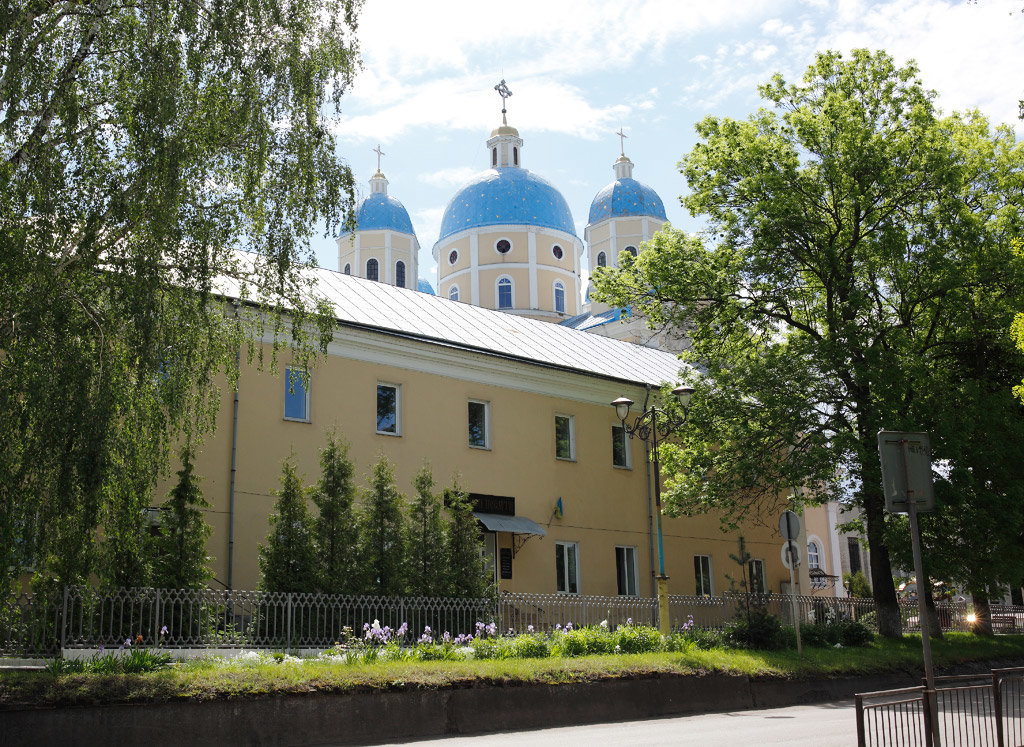
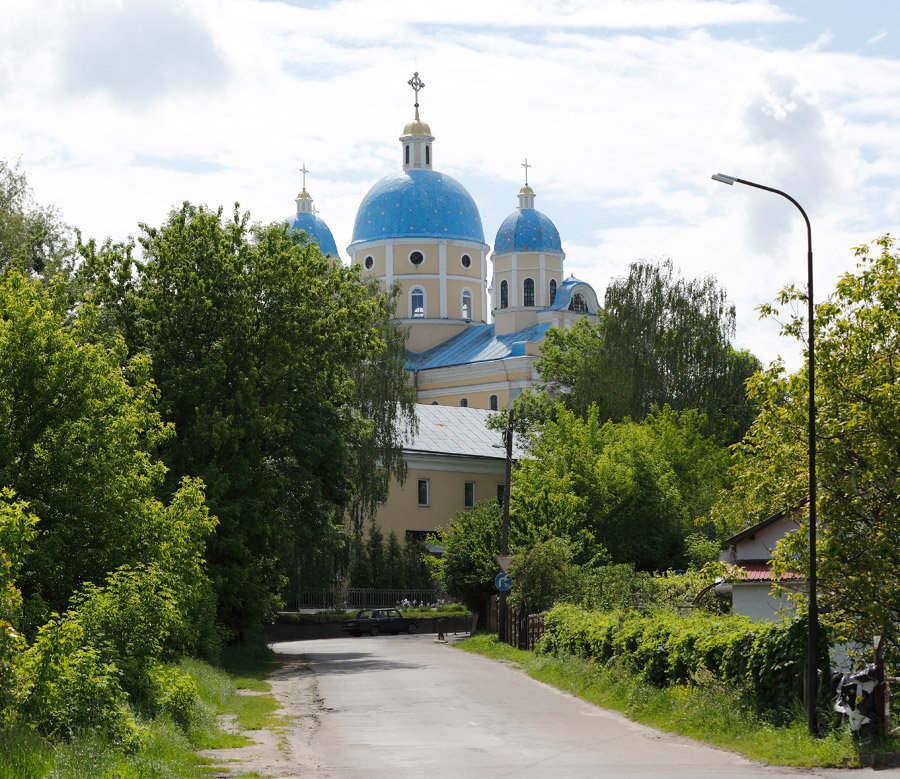
Only in 1988, by a decision of the city council, the Church of the Holy Spirit was transferred to the Orthodox community and became the first functioning church in Chervonohrad. In 1988-1989, repair and restoration work was carried out, as a result of which four smaller domes were added to the main dome, and the former church was rededicated to the Orthodox Church of St. Prince Volodymyr the Equal-to-the-Apostles. The interior of the church was decorated with paintings by artists from the town of Horokhiv under the direction of Oleksandr Koretskyi, the dome was painted by teachers of the Chervonohrad Art School S. Ruzhytskyi and M. Levkun, and the iconostasis was created by Lviv carver Ihor Kozak. Unfortunately, however, the interior paintings of the eighteenth and nineteenth centuries were destroyed during the restoration. In 2006, the church's domes were painted blue and decorated with golden stars.
St. Volodymyr's Church is a historical monument that belongs to the Ukrainian Orthodox Church (OCU). Today, St. Volodymyr's Cathedral is one of the most beautiful churches in the city of Chervonohrad.
The church building is made of brick and has the shape of an equal-armed cross with a three-nave volume at its western end. The central nave, crowned with a chapter, is much higher than the side aisles and transept. The main façade, decorated in the Baroque style, is decorated with pilasters set on high plinths and crowned with a cornice and a curved pediment. A small narthex with a triangular pediment was added to the main entrance in the nineteenth century. The southern façade of the church lacks architectural decoration. To the north and east, the church building is adjoined by two-story monastic cells with a spacious rectangular courtyard.
The church houses the icon of the Mother of God "Vsetsaritsa". The church also houses icons with relics of the following saints: St. Demetrius of Thessalonica, St. Panteleimon, St. Barbara, St. Spyridon, St. Trimython, St. Cyprian, and St. Cyprian the Great Martyr.