Church of All Saints and Benedictine Monastery, Lviv
The prehistory of the Benedictine women's order on Ukrainian soil dates back to the sixth century in Western Europe, when some monasteries adopted its new statute while remaining under the authority of the local bishopric. Although over the next two centuries the future order experienced a rapid growth in the number of its adherents, the first Benedictines appeared in Ukraine, and Lviv in particular, only ten centuries later.
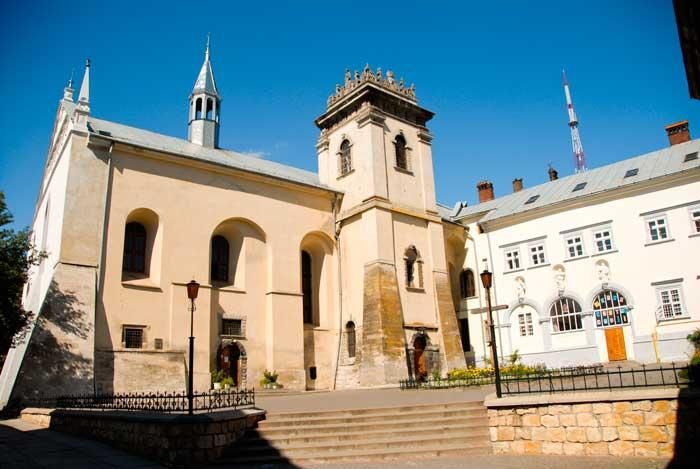
TheChurch of All Saints and the former Benedictine Monastery is located in the center of Lviv (2 Pisha Street), a monument of Renaissance architecture, with security numbers 369/0 and 369/1.
M. Borkowska claimed that the monastery was founded in 1593 by the noblewoman Katarzyna Saporowska, who used her father Adam's inheritance for this purpose. However, Zbigniew Hornung, in his biography of the architect Paul the Roman, claimed that: "Adam Kolo Saporowski recorded the foundation for the church and monastery on January 14, 1595; the cornerstone was consecrated on July 14, 1595 by the Latin Archbishop of Lviv, Jan Dymytr Solikowski, who also consecrated the three-nave church on November 29, 1597.
One of the first acquisitions of the newly created monastery was the village of Rokytne (1599), and during the reign of the founder's sister Anna Saporowska (1638), Rakivets, Volkov, Kuhaiiv, Zahiria, and Dombrowytsia were added to the monastery with the active participation of the eminent Polish families of Seniavsky, Lubomirsky, and Gursky, which allowed Lviv Archbishop Jan Zamoyski (1614) to build a defensive wall around the shrine instead of a wooden fence.
The school at the monastery became the first women's educational institution in Lviv and in Red Rus, and the nuns focused on educating young ladies of the nobility. The monastery became the second women's monastery in Lviv after the Clarissa Monastery. Construction began in 1597 and was completed in 1616 with the participation of Paul the Roman, as he himself testified in his will. In 1598, the church was consecrated by Lviv Latin Archbishop Jan Dymytr Solikowski. The buildings were badly damaged by a fire in 1623. They were rebuilt by 1627 by architect Jan Pokorowicz, whose youngest daughter was a novice in this monastery. It is possible that Pokorowicz is the author of the tower, as it is absent from the project preserved in the Central State Historical Archives, which was probably made by Paul the Roman himself.
The monastery was often visited by Abbess Dorota Danyłowicz's nephew, King Jan III Sobieski and his wife, who in 1672 convinced her to leave the monastery because of the threat of a Turkish attack, and helped the monastery. The next restoration took place after a fire in 1748 (architect Martin Urbanik).
The southeastern part of the monastery is adjacent to the cell building: a stone, complex, two-story building that preserved construction techniques and elements of the Renaissance. It was originally built of wood at the same time as the brick church.
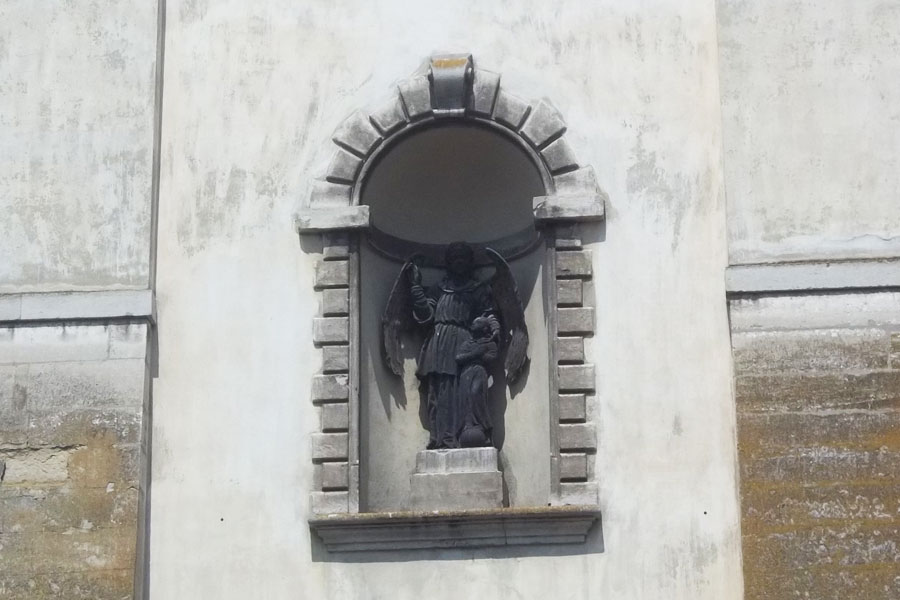
The open loggia of the monastery with three arches, whose keystones serve as consoles for sculptures installed in niches, is interesting. The arches were eventually laid down, and thus the columns were turned into pilasters. This created an additional room, but greatly simplified the complete look of the monastery building. The design of the vault of the stables, which rests on a single massive pillar, is peculiar. Many rooms have preserved carved keystones and consoles.
Being built outside the city walls, the monastery, like other mid-city monasteries, had features of defensive architecture. The courtyard was originally formed by a church, a monastery house, and a wall built in 1608-1610. The monastery complex also included a garden, an example of Renaissance landscape architecture, whose layout was also designed by Pavlo Rymlianyn.
At the beginning of the nineteenth century, the relatively small church had eight altars, a wooden cross with a crucifix, a western emporium, two side balconies (one of which had an organ), a preacher's pulpit, a confessional, and benches. The designs of the altars and carvings in the interior of the church were probably made in the 1770s and 1780s. Their architecture is similar to the works of Bernard Meretin and Johann Georg Pinsel and their immediate followers (for example, the altars in the missionary church in Horodenka, churches in Buchach, Navariya). The carpenter Hornung made new elements for the lower choir of nuns in the church, which were installed in 1889 to replace the ones that had been removed from there, which traditionally dated back to the time of the abbess Anna Saporowska.
In 1906, the new high altar was designed by Jan Tarczalowicz in the style of the modernized Renaissance. It has not been preserved to this day. In 1935, a school (the Benedictine Sisters' Scientific Institution) in the functionalist style designed by Witold Ravsky was added to the outside of the monastery wall from Piszowa Street.
In Soviet times, the church was used as a warehouse, and the monastery's premises housed the Music and Pedagogical School #2. In 1946, secondary school No. 19 was built on the territory of the monastery garden. Today, the monastery complex belongs to the congregation of Studite sisters and is called the Church of All Saints and the Monastery of the Intercession of the Blessed Virgin Mary of the Studite Sisters. The monastery houses the St. Sophia School.
After Ukraine's independence was proclaimed, the activities of the Studite nuns resumed and the monastery returned to the Greek Catholic Church. They are engaged in embroidery, weaving, and Easter egg making. The monastery operates the St. Sophia School, which is popular among children and youth in Lviv. Within its walls there is now the Holy Protection Monastery of the Studite Sisters, which is gradually bringing its shrine to perfection, bit by bit restoring its former greatness and glory.
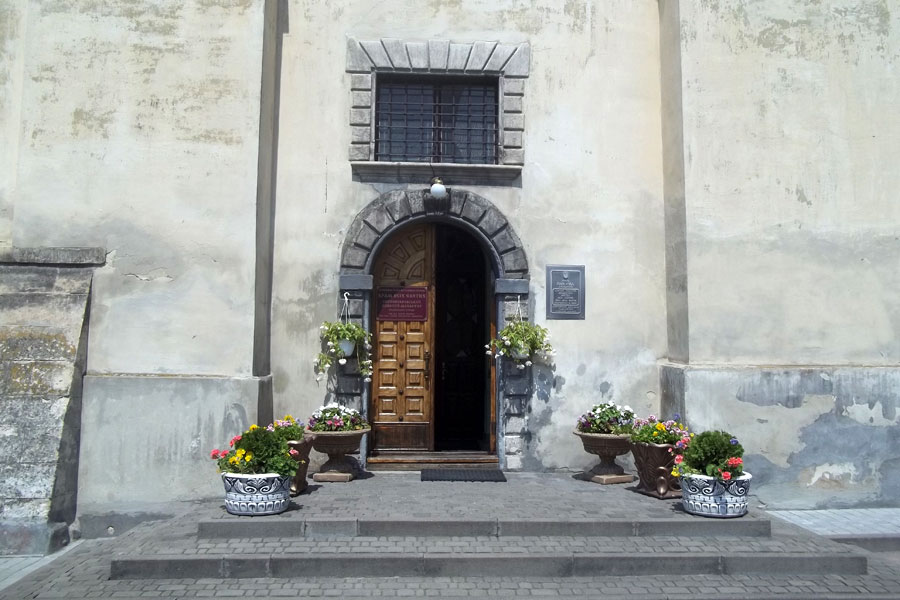
The Benedictine monastery in Lviv is a complex silhouette of buildings of different periods behind a stone wall with a baroque gate of the eighteenth century. Its dominant feature is the All Saints' Church, which is a small rectangular, single-nave building under cross vaults with niches-arcasolies in the side walls and decor in the form of round rosettes in square fields. The exterior of the building is decorated with carved white stone portals, deep niches with arched windows, corner buttresses, and, of course, the southern tower with a unique Renaissance attic above a Doric frieze.
From the southeast, the church is adjoined by a two-story stone cell building with remnants of Renaissance decor, part of which was a now lost open three-bay loggia with keystone consoles decorated with sculptures in niches. Among the features of the preserved interior decoration are carved castle fireplaces in many rooms and a single-pillar vestibule design.
By public transport to Lviv railway stations, and then to the center of the old town to Danylo Halytskyi Square, then one block north to the All Saints' Church.