St. Anthony's Church, Lviv
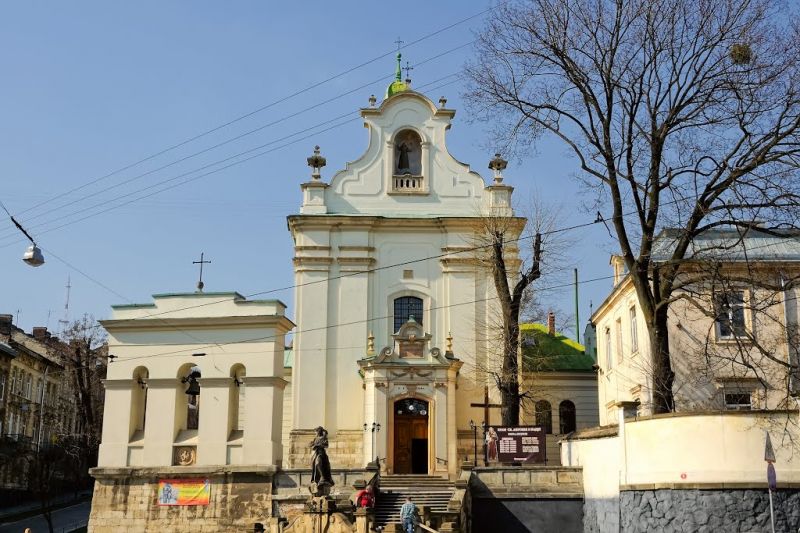
On the longest street of Lviv, Lychakivska Street, 49a, there is a beautiful Roman Catholic church - the Church of St. Anthony of Padua. This is a famous monument of Baroque architecture (security number 372) with an ancient history dating back to the late Middle Ages. Fortunately, over the years, the structure of the temple has not changed its appearance.
Theland for construction in the area called "Dry Will" was granted by the magistrate on June 23, 1617. The permit provided for the construction of a wooden church and monastery only. The document was approved by King Sigismund III Vasa. The construction lasted from 1618 to 1630. In the fall of 1648, the buildings were completely burned down during the siege of Lviv by Bohdan Khmelnytsky's troops. In 1652, a fire broke out again in the church, which was just under construction. In 1669 the construction of the church of hewn stone began at the expense of Konstanty Krzysztof Korybut Vyshnevetskyi. The likely author of the project could have been someone from the Fontana family, who lived in Krakow at the time. The construction took a long time, and its second phase began in 1718 at the expense of the castellan of Krakow, Prince Janusz Antoni of the Wyszniewiecki family.
In 1739, Suffragan Samuel Glowiński consecrated the church. Finishing works continued. In 1765, it was reconstructed by Francis Kulczycki, and a baroque pediment with vases designed by Piotr Polejowski was added. At the time of the capture of Lviv by Austrian troops, the monastery had four priests and two monks. As a result of the Josephine reforms, in 1786 the church became a parish church, instead of the Church of Peter and Paul, which was given to the Greek Catholics. In 1818, the architect Josef Markl built a bell tower for three bells, and in 1830 the church was surrounded by a wall, which included the bell tower.
The mural of thechurch and some of the monastery's premises was painted in 1854. In 1861 the building was covered with a new roof, which was repaired again in 1878. In 1893, reconstruction and restoration began. In 1898 the entrance hall was completed, in 1901 the staircase, balustrade, and statue of the Mother of God were restored, and a gas lantern was installed under it (partially preserved). In 1902, the chapel of the Crucified Christ was added, and in 1904, the chapels of St. Barbara and St. Joseph. In Soviet times, the church was not closed; it was one of two Roman Catholic churches operating in Lviv. In 1950, the plebeian house (49 Lychakivska Street) was taken away from the parish, and later Lviv State Music School No. 4 was opened there. After the proclamation of Ukraine's independence, the Franciscans returned to the church, and on April 14, 1995, it was officially transferred to their care. In 2017, after lengthy court hearings and many appeals to various authorities, the plebeian church was returned to the religious community, and the Lviv City Council allocated a land plot at 105 Lychakivska Street for the construction of a new music school building.
The church is located on an elevated, walled area on the corner of Sadovskoho, Solodova, and Lychakivska streets, oriented on the south-north axis. The main façade is on the south side, facing Lychakivska Street. The church is built of stone and brick, plastered inside and out. The foundations and high plinth are made of hewn stone.
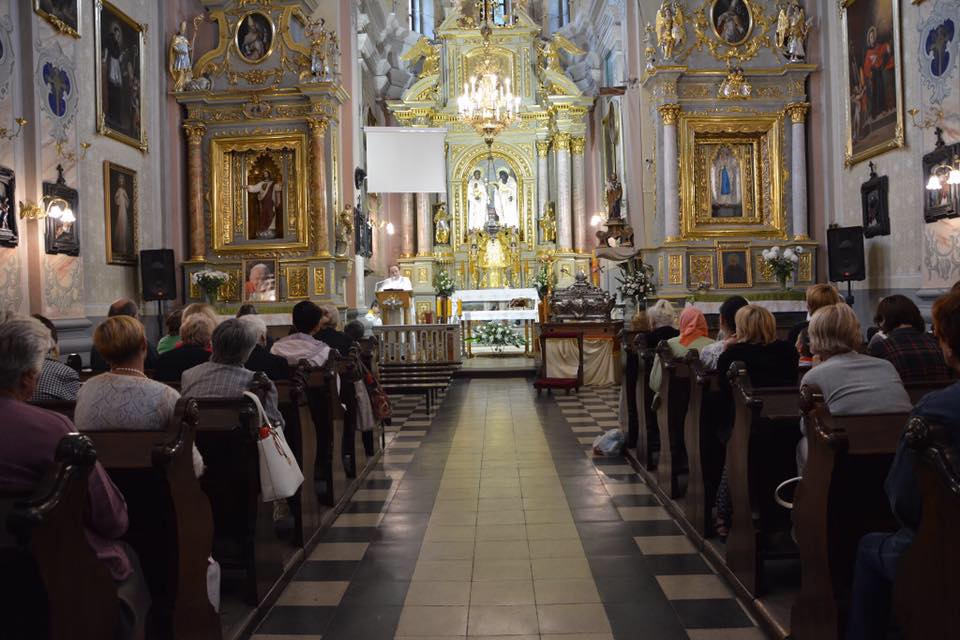
The church is rectangular in plan, with one nave. The entrance is arranged through the narthex. Chapels are attached to the nave on both sides (the Chapel of the Crucified Christ and the Chapel of St. Barbara and St. Joseph). A sacristy is attached to the east of the presbytery. The entrances to the chapels are arranged in the middle of the side walls of the nave; the entrance from the presbytery leads to the sacristy. The nave is three-stranded, with an emporium supported by two pillars under the first string. A narthex is arranged under the emporium. The stairs leading to the emporium are arranged in the thickness of the eastern wall (the entrance is in the narthex). The presbytery is two-step, closed by a triangular abscissa. The roof over the nave is a two-pitched copper roof topped with a signature. The roof over the presbytery is two-pitched, turning into a faceted roof over the abscess. There are 7 rectangular windows in the lunettes formed by the presbytery vaults. Three more windows are located on both sides of the nave. One window is located on the second tier of the façade.
The façade has a single tier, with an attached porch. It is flanked on two sides by pilasters and decorated with a built-up cornice. It is crowned with a pediment with volutes and decorated with decorative vases. The pediment has a niche with a stone balustrade and a frescoed image of St. Anthony. The portal is decorated with Ionic pilasters and crowned with a top with volutes. The facades of the chapels are decorated in a similar way.
By the end of the century, only the foundations and possibly the altar part of the church had been built. The work was resumed in 1718. In 1755, a staircase with a sculpture of the Immaculate Conception of the Virgin Mary was built. To the left of the entrance is a second sculpture of St. Anthony of Padua. Both works are attributed to the sculptor Sebastian Fesinger; earlier Tadeusz Mankowski suggested that the author of the statue might have been Fabian Fesinger. The chapel interior was painted by Tadeusz Pelczarski.
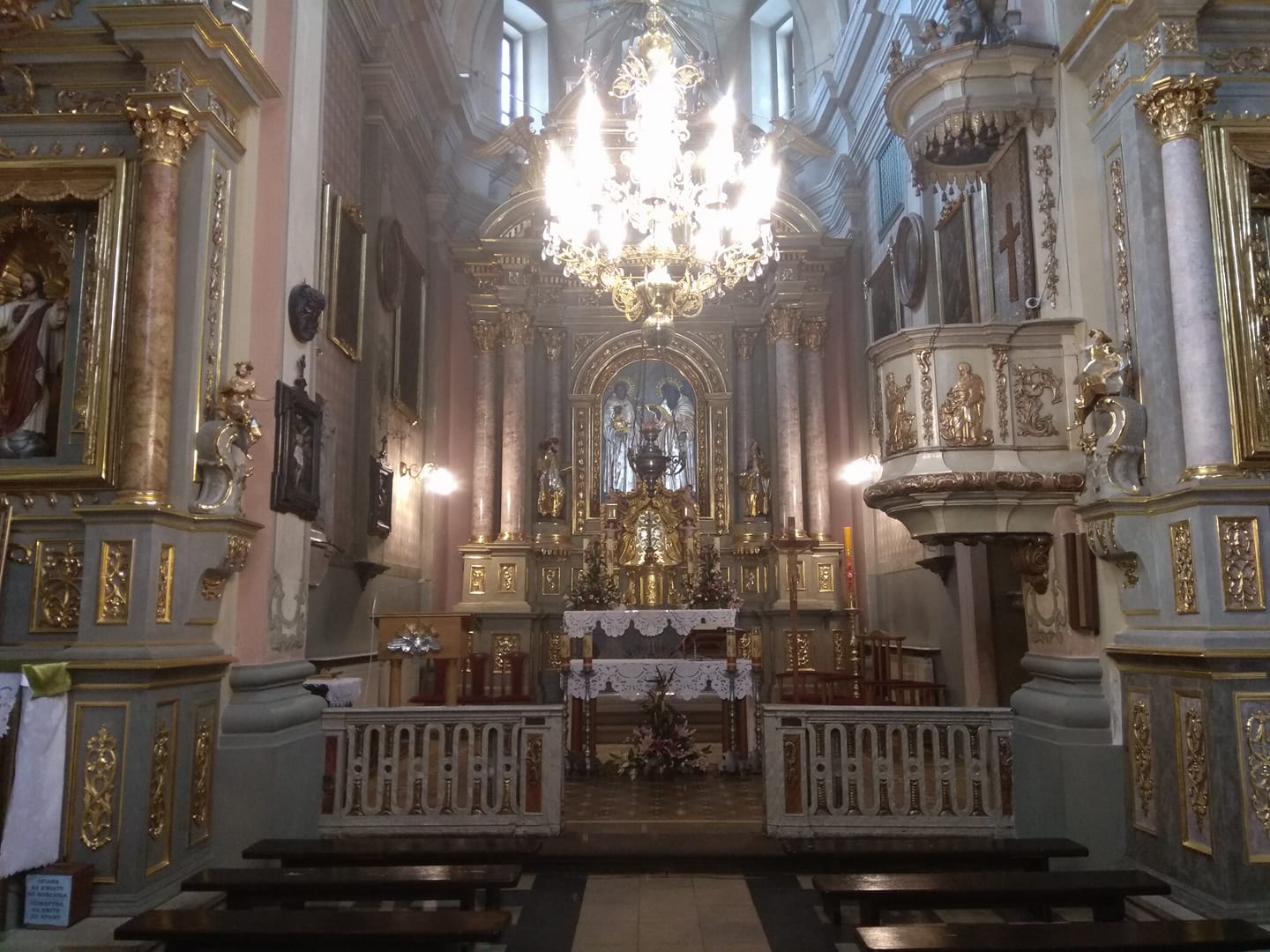
There are 5 late Baroque altars in the church, made around the 1740s. The main altar is single-tiered with a top, wooden, painted in pale green with gilding. The central icon depicts St. Anthony of Padua and St. Anthony the Hermit. At the entrance to the presbytery, two altars with the same structure are installed on both sides. They are also painted pale green and gilded. In the central field of one of the altars there is a sculptural image of the Sacred Heart of Jesus, in the second altar - the Mother of God of Lourdes. On the right side of the nave is a wooden pulpit from the second half of the eighteenth century. In the narthex there are two wooden late-baroque confessionals. In the side chapel of the Crucified Christ there is an eighteenth-century altar with a crucifix from the destroyed Church of the Holy Cross in the central field. The side chapel of St. Barbara and St. Joseph has an altar painted in white and cream colors with an image of St. Barbara in the central field.
Inthe choir there is a two-section organ made in 1937 in Piotrków Trybunalski by the Stanisław Kruczkowski and Son company. It is the youngest of the organs in Lviv. The instrument has a typical romantic character with the addition of chamber voices. There are flute and string voices, as well as the Vox humana ("human voice") and Amabilis ("gentle") registers. The organ has two manuals, a pedal, a pneumatic tract, 17 registers, a copulation, and a tremolo. Information about the previous two-part organ dates back to the nineteenth century. The exterior was decorated in the Neo-Baroque style, polychrome, and partially gilded.
Before the First World War, the church had three bells. The largest (79 cm in diameter) was cast in 1701. Another bell (54 cm in diameter and weighing 72 kg) was made in 1747. The third bell was 40.5 cm in diameter and weighed 35 kg. Currently, only one bell (about 60 cm in diameter) is used in the church.
The main attraction of the church is the main staircase with a porch and a sculpture installed to the left of the entrance.
During services, pastors preach in Ukrainian, Russian, and Polish. Nearby, you can see the unusual St. Michael's Church with its very expressive architecture.