Church of the Holy Trinity, Olesko
TheChurch of the Holy Trinity is a religious building, a parish church (formerly the RCC) in the village of Olesko (now Zolochiv district, Lviv region). It is currently used by the Orthodox community of Olesko.
The parish of the RCC in Olesko (Brody Deanery) was founded in 1481 by the grandfather Peter Olesky, son of Jan of Senn, and included the villages of Yangelivka, Chekhy, Chishky, Yuskovychi, Kuty, Brakhivka, Labach, Ozhydiv, Pidlysia, Razhnov, Rozvazh, Sokolivka, Zabolotsi, and Zakomarya. The Church of the Holy Trinity in the village of Olesko in the Lviv region was founded in 1481 by a Polish-Ukrainian nobleman from Olesko, Petro Seninsky, and is located in the historic center of the village, at a crossroads, not far from the castle. In 1597, the church was consecrated by Lutsk Latin Bishop Bernard Maciejowski.
On August 8, 1627, the later owner of Olesko, the Russian voivode Ivan Danylovych, established the income of the Latin church in Olesko. He recognized the affiliation of the village of Rozvazh to the church, and also introduced the same amount of rent and tribute to be paid by both the city as a whole and the estates of the Olesko parish. For his own estates: Yuskovych, Ozhydov, Kutiv, Stovpyn, Khvatov, and half of Chekhiv, he assigned a tithe of the income of the inhabitants of these villages. For the estates of Zakomarya and Komarivka, according to an old agreement, he set a fee of 10 gold market pieces.
In 1625-1627, I. Danylovych donated 5000 golden rynski [source?] to have two side chapels added to the ancient church, which were later consecrated in honor of the Most Holy Mother of God and St. John the Theologian. A parish priest was elected, who in turn promised to support four vicars. One of the vicars was to oversee the city hospital.
He also asked for the help of the bishop of Lutsk, in whose jurisdiction Olesko was at the time, to influence the local parish priest, who did not want to fulfill the duties assigned to him and replace him with another. The reason for this was that the current parish priest reserved the right of patronage for himself and his immediate descendants, and only in the event of a change of faith or renunciation of one of them, would the right to choose a parish priest belong to the bishop of Lutsk.
On April 11, 1797, according to a papal decree, Olesko was annexed to the Lviv Archdiocese.
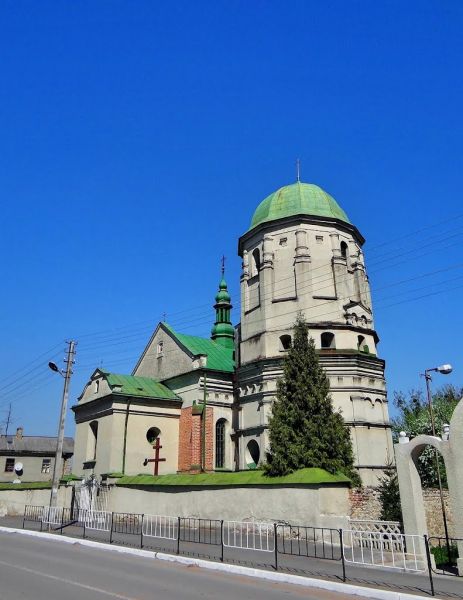
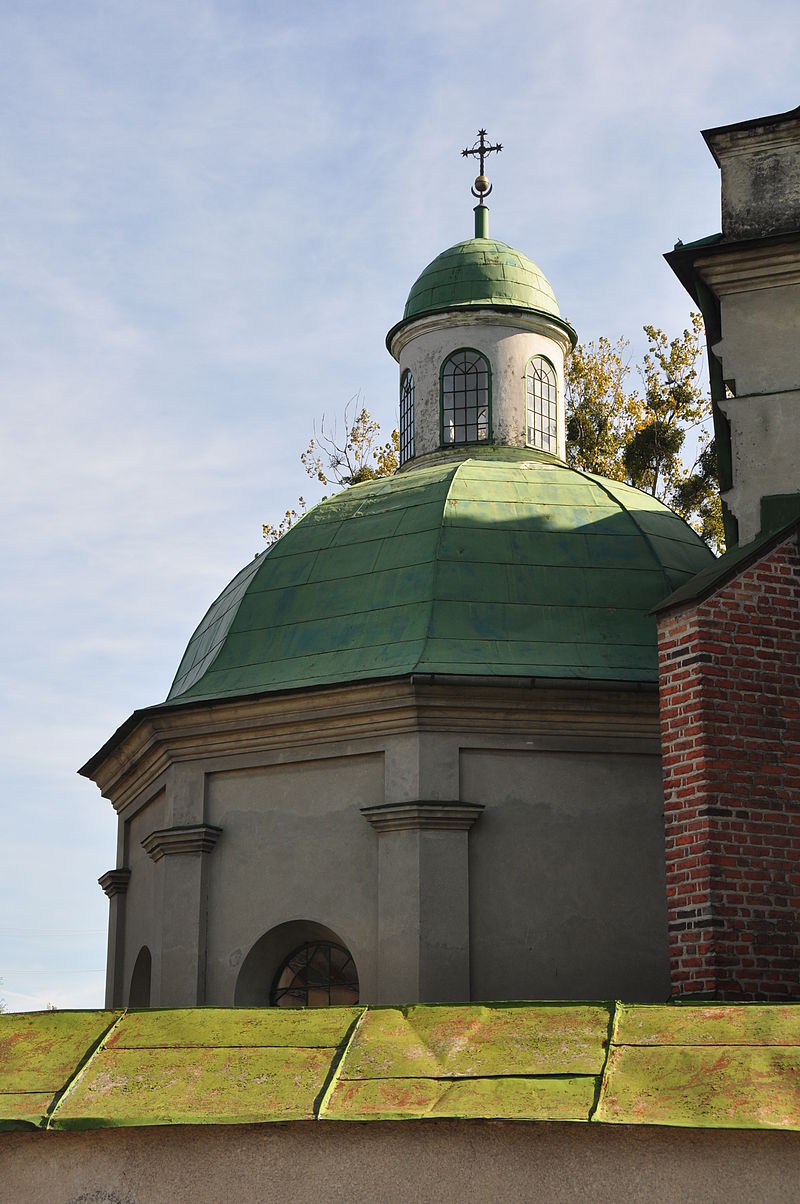
The church, whose architecture did not impress with anything special, was surrounded by two beautiful chapels. Above the chapel, which was located on the right side of the entrance to the church, there is an octagonal, very voluminous, 22-meter-high tower that was used as a bell tower. Another tower has defensive loopholes, which probably remained from the church wall. In front of the exit from the church, several mammoth bones found in the vicinity of the town hung on a chain. Inside the church there are several beautiful altars and the family tomb of the Russian princes Danylovych.
On September 22, 1618, Ivanko Danylovych, the son of Ivan Danylovych and Sofia Zholkevska, died. The child's parents, who were in mourning, asked that the tombstone be moved closer to the high altar. This monument, which was an oval shield of red marble 2.5 meters high, 1 meter wide, decorated with ornaments, was installed near the high altar opposite the pulpit.
The following year, Ivan Danylovych built a tomb for himself and his family in the church, which is still located in front of the high altar. I. Danylovych died in 1628 in Lviv, and his body was later transported from Lviv to Olesko and buried in the family tomb in the church.
In 1733 or 1739, representatives of the Order of the Friars Minor Capuchin appeared in Olesko. They built their monastery of St. Joseph and Antonina[2] and the church of St. Joseph. The history of the coexistence of the two shrines in Olesko is closely intertwined.
In 1806, a fire caused the vaults to collapse, burning down the chapel, the bell tower, and the church's parish priest's house. The parishioners of the burned church moved to the monastery church until their shrine was rebuilt, and the parish priest and vicars settled on the territory of the Capuchin monastery. It was restored after 1809. It burned for the second time in 1841, and was rebuilt in 1847. As a result of the renovations of the first half of the nineteenth century, the interior lost its original Gothic character and received support pillars that divided it into naves.
In 1927 the church was restored (architect Bronisław Wiktor). At that time, a triangular pediment was built on the western façade of the main volume, the pediment above the narthex was rebuilt, the southern chapel-tower acquired a new pseudo-barrelled ending, and the northern chapel was given a new roof. A new signature was installed on the roof, the exposed brickwork on the altar part and on the western façade was restored, the stone frieze was restored, and a new stone fence was built.
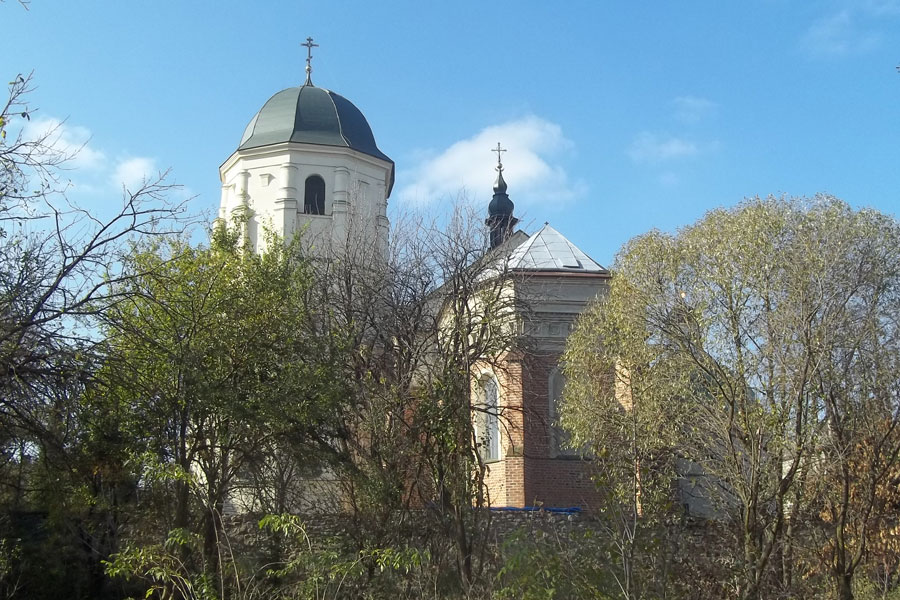
The church is a hall type, built of brick, with a cross masonry system, partially plastered. The church consists of a square (11.80×12.80 m) four-pillar main volume, which is adjoined on both sides by faceted chapels, an elongated altar part with a faceted apse, a square narthex, and a room on the north side. The walls of the nave and presbytery are fortified with buttresses. They are completed, except for the western façade, by a high entablature with a stone frieze characteristic of Renaissance architecture. The frieze's methods are filled with decorative carvings. The entablature also extends to the south tower, but there the metopes are smooth. The roof of the nave is crowned with an openwork signature, the northern chapel is covered with a Renaissance vault with a skylight, and the southern chapel, which looks like a three-tiered tower, is completed with a helmet dome. Loopholes have been preserved on the second tier of the tower, and the third tier served as a bell tower. Both chapels are decorated with angular pilasters. The interior has four pillars that support the system of cross vaults of the main volume and divide it into three naves. The presbytery is covered with a semicircular vault with arches and Gothic niches; the chapels, which open into the nave with arched openings, are covered with spherical vaults; the narthex with the choirs arranged on it has box vaults. The doorways from the narthex to the nave and from the altar to the side rooms are decorated with white stone carved Renaissance portals. The presbytery preserved a baroque wooden high altar of the late eighteenth century (it has certain similarities with the high altar of the Church of the Assumption of the Blessed Virgin Mary in Buchach[3]), and there is a marble epitaph of Ivan Danylovych from 1618 by the sculptor Johann Pfister. Two coats of arms are depicted on the southern pediment of the bell tower: on the left, Sas (Danyłowicz), and on the right, Lubicz (Żółkiewski). The coats of arms probably represent Ivan Danyłowicz and his second wife, Sofia Żółkiewska (daughter of Crown Hetman Stanisław).
From 1945 until the mid-1980s the church was closed and its premises were used as a warehouse. The church was restored once again in the 1960s, when the southern defense tower received the helmeted ending it had before the 1927 restoration. In the 1980s, the shrine was restored and transferred to the Lviv Art Gallery as a storage facility, which remained there until 1993.
In the 1990s, the former Roman Catholic church was transferred to the Ukrainian Autocephalous Orthodox Church, which uses the building to this day. The church occupies a small area next to the city park and the monument to Taras Shevchenko, on the right and on the side of the altar, and on the left is a private building. Thus, the best view of the church is from the facade, from the street, but the fence hinders the view.
So nowadays the stone church of the Holy Trinity in Olesko, Busk district, belongs to the diocese of the Ukrainian Autocephalous Orthodox Church, is a functioning church and is one of the outstanding architectural monuments of national importance.