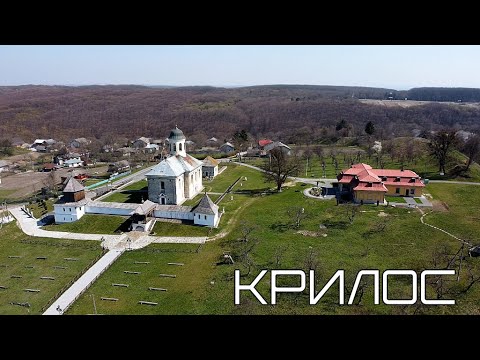
Foundations of Sacred Monuments in the Village of Krylos
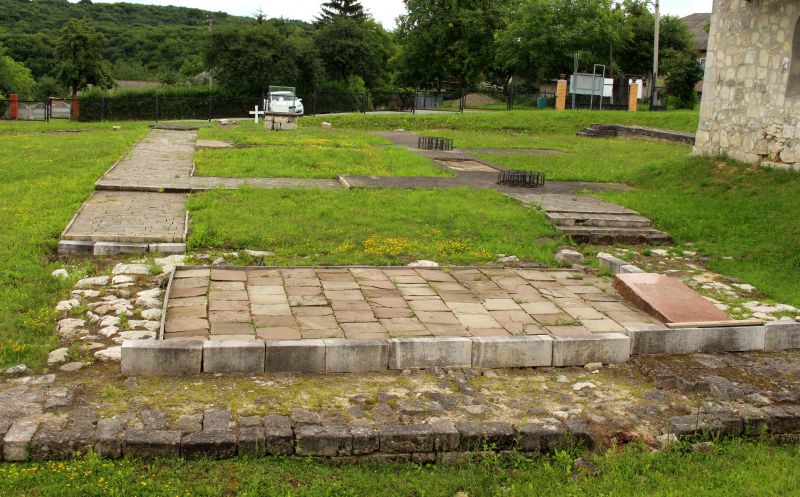
Foundation of the Church of the Annunciation – Near the hamlet of Chetverky, in Krylos, on the Church field on the left bank of the Lukva River, L. Lavretsky, with the participation of I. Sharanevych, excavated the foundation of an elongated single-nave white stone church in 1884-1885. The excavated ruins were considered by I. Sharanevych to be the temple of the Annunciation. In 1987 and 1990, the Annunciation Church was re-examined by an archaeological expedition from Lviv. It established that the foundation outlines a stone single-nave church. The foundation of the Church of the Annunciation is built of river stone on a strong lime-sand mortar. Fragments of a mosaic floor, laid with glazed tiles of various shapes and colors, have been preserved. In addition to typical repetitive forms, there were so-called figurative tiles with fragments of two-colored images with embossed and scratched patterns. Based on architectural analysis and archaeological finds, archaeologists date the Church of the Annunciation to the beginning of the 13th century, with its functioning lasting until the mid-15th century.
Foundation of the Church at Tsaryntsi – An unexpected discovery of a stone slab in the Tsaryntsi area in early 1986 contributed to the opening of the remains of another unknown archaeological monument of ancient Halych. An expedition of Lviv archaeologists discovered here the remains of a medium-sized but richly decorated church, or rather a burial temple at Tsaryntsi.
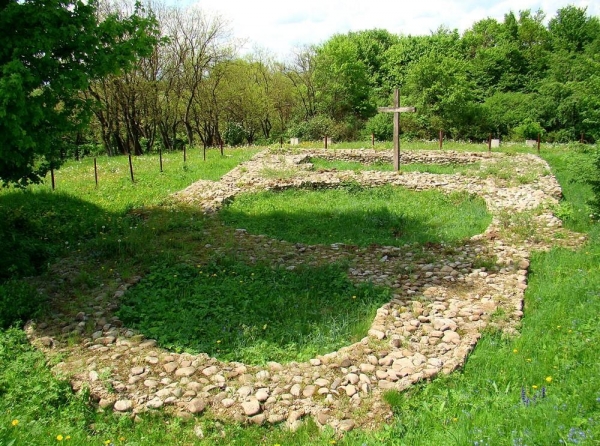
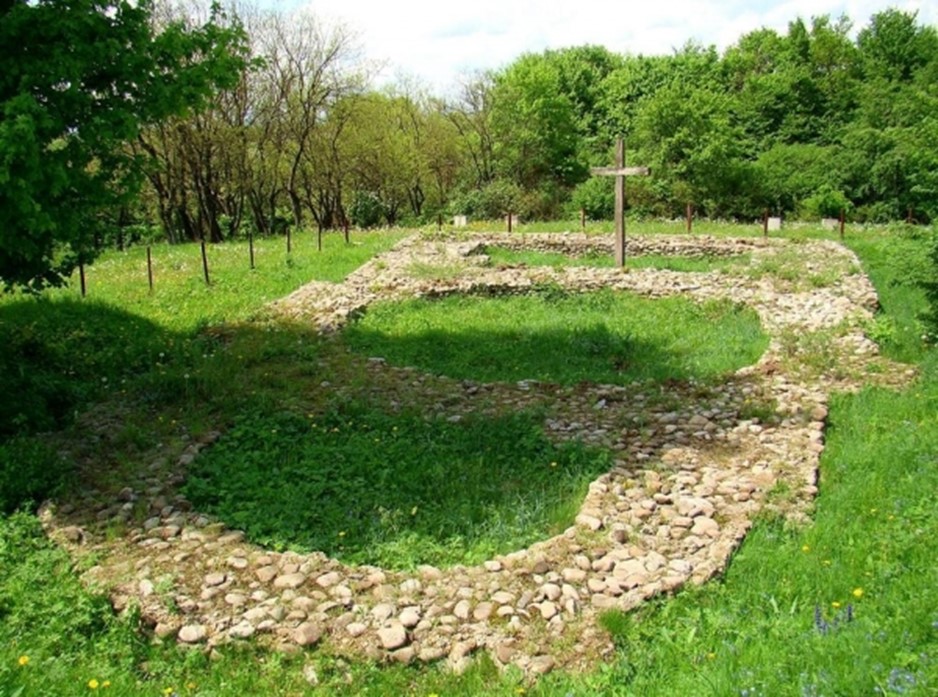
Foundation of the Resurrection Rotunda – In the area of Voskresenske, opposite the Krylos settlement, on the right side of the Mozolevyi stream on a low hill (8-12 m), lies the foundation of the Resurrection Rotunda. The attractive external features of the hill and its mysterious name intrigued the first researchers of the chronicle Halych. L. Lavretsky excavated here in 1884 the foundation of an unknown octagonal building, which he believed it to be. I. Sharanevych concluded that the foundation is similar in shape and material to the church at the Polygon in the Karpii Hay area and considered it to be the remains of the Resurrection rotunda, which he believed existed as early as the 18th century. Professor V. Antonovych, who examined the excavation in 1885, believed that this foundation should be attributed to defensive stone towers. Scholars concluded that this foundation of a round building, whose external contours are quite vague, forms a circle with a diameter of about 10 m. Archaeologists suggested that the structure represented a log-built two- or three-tier wooden church-chapel, the plan of which was most likely octagonal. The material from which the foundation was built indicates a relatively late construction time. The structure should be dated to the 13th century.
Foundation of the Church of Cyril and Methodius – The former metropolitan forest of Dibrava stretches along the right bank of the Limnytsia River west of Krylos. In the times of ancient Halych, this area was free of forest, as indicated by the burial mounds of the 9th-10th centuries discovered here. In 1882, L. Lavretsky and I. Sharanevych discovered a massive foundation of a four-column three-apsidal stone church here.
Initially, scholars considered the building to be the remains of the Chronicle Assumption Cathedral. In the early 20th century, the monument was re-excavated by O. Pelensky. Based on the toponym "Kyrylivka," the researcher named the church Kyrylivska. In 1981-1984, the ruins near Dibrava were already investigated for the third time by a team of the Halych archaeological expedition from Lviv. It revealed the dimensions of the monument to be 15.15x20.20 m. The width of the foundation walls ranges from 1.7 to 2.6 m. Lviv scholars attributed this archaeological monument to tower-like temples of a new stylistic direction in the architecture of Ancient Rus in the late 12th – early 13th centuries and dated it to the last third of the 12th century.
Foundation of the Church of the Prophet Elijah – On the hill of Ubich, cut off from the Krylos Mountain by the Mozolevyi stream, where the road from Halych to Ivano-Frankivsk now runs, lies the area of Prokaliiv Sad. Here, from ancient times until the mid-18th century, there was a monastery with a white stone church of the Prophet Elijah.
The first excavations of the lost structure were conducted by L. Lavretsky and I. Sharanevych in 1886-1887. It turned out that it was a rotunda, to which a rectangular narthex adjoined from the west, and a semicircular apse from the east. During the research, architectural details of the temple, frescoes, church inventory, and remains of a stone sarcophagus were found. With its planning, construction features, and decor, the cathedral illustrates the lively interactions of the Halych architectural school with Western European architecture. Interestingly, the author of the First Ukrainian Constitution, Hetman Pylyp Orlyk, visited the Church of the Prophet Elijah.
In the early 18th century, the Church of St. Prophet Elijah was raised from the ruins by Bishop Yosyp Shumlyansky after a Tatar pogrom. Fifty years later, the Halych townspeople donated money once again for the restoration of the temple. Unfortunately, the shrine was doomed to perish... Today, a symbolic memorial cross has been erected at the site of the former Church of the Prophet Elijah, and its foundations have been museumified.
To add a comment you can: login or register.
Accommodation around Foundations of Sacred Monuments in the Village of Krylos:


Nearby hiking trails near Foundations of Sacred Monuments in the Village of Krylos:
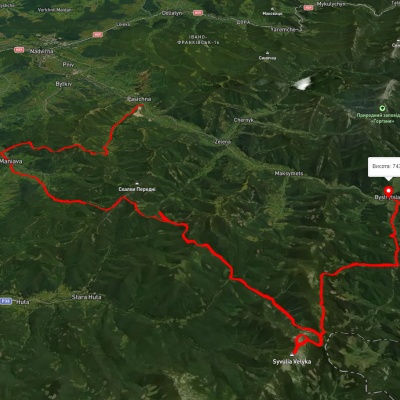
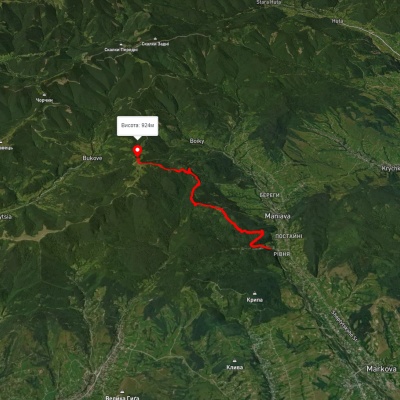
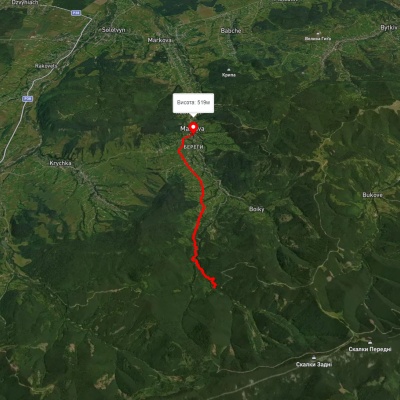
Which trails pass by Foundations of Sacred Monuments in the Village of Krylos?
We suggest these hiking trails through or near Foundations of Sacred Monuments in the Village of Krylos: Pasichna village, via Maniava village, Maniava Waterfall and Mount Velyka Syvulia to Bystrytsia village, Maniava village - Monastyretska polonyna, Maniava village – Maniava Waterfall, Huta village – Pasichna village, Pasichna village, via Mount Syniachka to Yaremche, Dora village, via Mount Syniachka, Pereslip Pass, Turshuhuvata polonyna and the Yavirnyk ridge to Yaremche