Muratovych's house, Lviv
Lvivis attractive to tourists. It combines European architecture and Ukrainian flavor. Walking through the streets of the city, special attention is drawn to the historical buildings, their uniqueness and beauty.
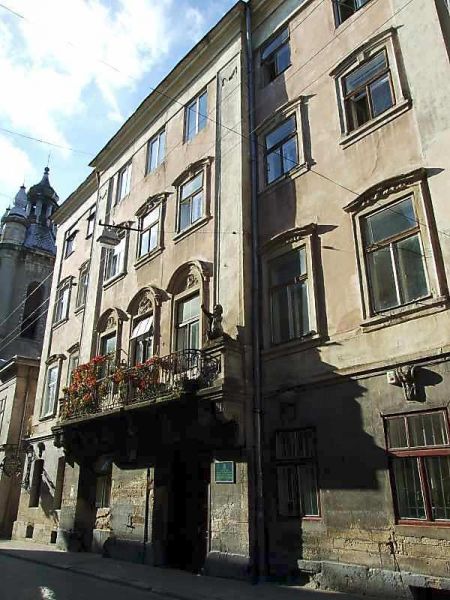
Muratovych 's House (also known as the Palace of the Worlds, Palace of the World; conscription No. 118) is an eighteenth-century residential building, an architectural monument of national importance (protection No. 319), and a historical monument of local importance (protection No. 1281). It is located in the historic center of Lviv, on Virmenska Street at #13.
On the site where the modern building No. 13 stands, there were originally two stone houses built in the 16th and 17th centuries that belonged to the Ubalevych (Cefty) and Muratovych families. The Muratovych house was home to the Armenian first printer Govganes Karmatanyants (Ivan Muratovych).
In the last half of the eighteenth century, these buildings were almost destroyed, so in 1773 the architect Petro Poleiowski decided to build his own house in their place and purchased the plot for 2,500 gold rynski. He personally designed the three-story building, and the construction was supervised by the master of the bricklayers' shop, Yosyp Dubliovskyi. However, in the spring of 1776, Polejowski died suddenly, and soon, in 1778, a fire that broke out in the Armenian quarter significantly damaged Polejowski's unfinished house. The architect's widow, Marianna Polejowska, sold the half-burned building to the starost of Busk, Count Josef Mir, who ordered the house to be restored. The reconstruction work was carried out in 1781-1783 under the design of the architect Pierre Denis Gibeau, under the supervision of the master builder Johann Gentzel.
Since 1857, the building housed the Imperial and Royal Treasure Prosecutor's Office, which moved to a new building on the present-day Saksahanskoho Street before the First World War. In 1928-1930, the Religious Library Society with a printing house operated here, in 1930-1933 the Archdiocesan Union of the Armenian Diaspora, and in 1936-1940 the museum of the Armenian diocese was located in the building.
In 1999-2001, the building was reconstructed by Oksana Kurdydyk. During the restoration work, the original elements of the interior and exterior were discovered and restored, and the original level of the Armenian courtyard and its authentic natural stone pavement were recreated. In addition, traces of an ancient sewer system made of wooden gutters were found in the basements, and a tombstone with an inscription in Armenian and the date "1559" was found in the courtyard. In parallel with the restoration of the house, an archaeological expedition from the Institute of Ukrainian Studies conducted archaeological research in the courtyard. The excavations revealed the remains of ancient stone and wooden structures, in particular, at a depth of 3.5 meters they found a 14-winged wooden log house of the 11th century, above it - the arched vault of the former passage tower of the 16th-17th centuries, at a depth of 2.4 meters - a layer with traces of a severe fire in about 1527. The expedition also collected a significant number of antique glass, metal, ceramics, etc. After the restoration work, the basement and first floor of the house were adapted into the Kilikia restaurant.
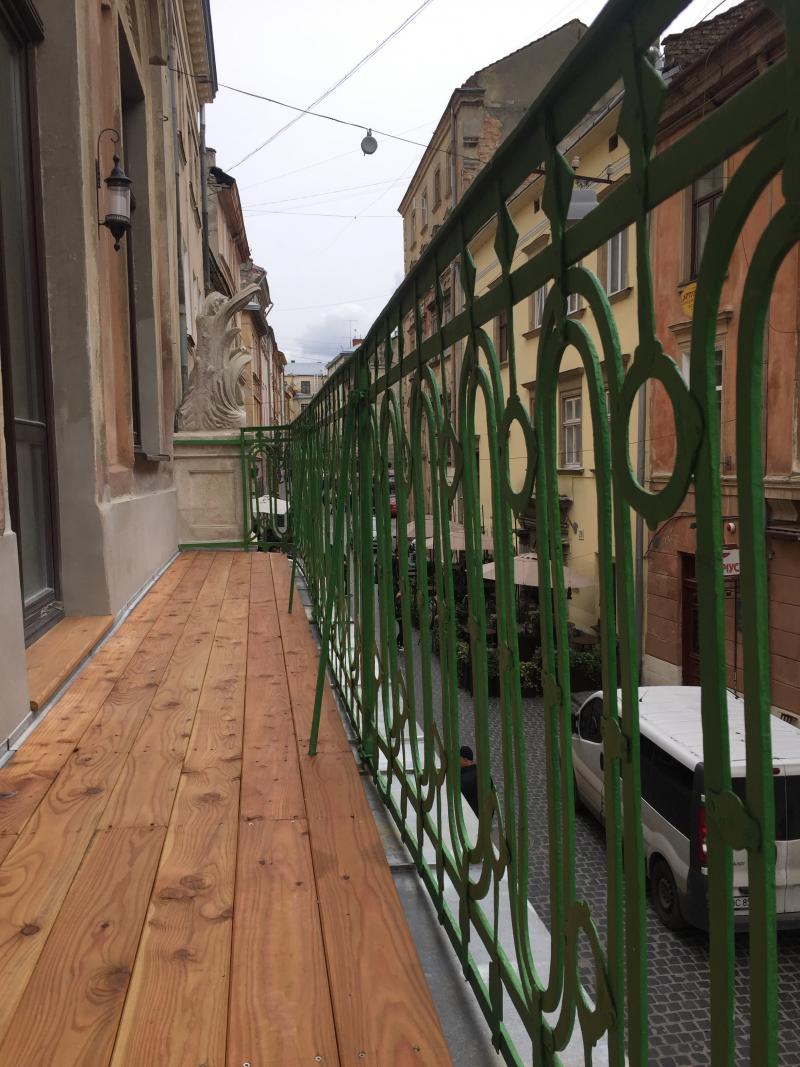
In November 2017, the balcony, consoles, and putti figures were restored. In November 2018, the first restaurant in Lviv, Bilyi Nalyv, opened in the former townhouse as part of the Kyiv chain of similarly named establishments.
The building is four-story (originally three-story), brick and plastered, and has an irregular rectangle with a small courtyard and a smaller courtyard wing. The main façade is symmetrical, with seven windows, and is divided vertically by a risalit located on the central axis. According to the description of the building, dated May 13, 1783, the façade was originally crowned with a Baroque attic with stone decorative flowerpots on pedestals, between which stood a metal grille. Later, the attic was removed and the end of the façade was rebuilt in a more classicist style. The Rococo façade decoration has been partially lost.
On the central axis, in the right part of the risalit, there is the main entrance in the form of an arched portal; in the left part there was originally a similarly shaped gate leading to the courtyard, but later the passage was closed and a window was cut through instead of the gate.
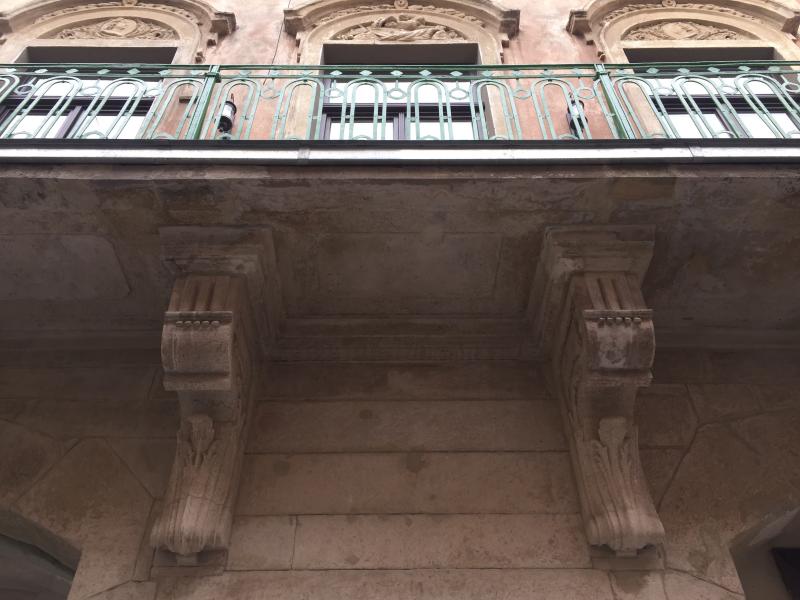
The central risalit is bordered by flat lobes with garlands at the level of the top floor and is emphasized by a large, full-width balcony with wrought iron lattice, which is the artistic and compositional center of the building's façade. The balcony is supported by eight shaped consoles carved in stone, arranged symmetrically and slightly different in shape. The two central consoles and two pairs of side consoles are decorated with acanthus leaves on their pedestals and triglyph inserts on their front ends, and the side planes of the two outermost consoles are decorated with a volute-like pattern. The last two consoles, located above the main entrance and above the former entrance gate, are also decorated with acanthus on the pedestals and mascarons in the form of bizarre demonic creatures with large ears at the ends. The balcony is flanked by two putti figures on pedestals decorated with laurel garlands similar to those on the risalit's blades. The balcony is decorated with delicate openwork wrought-iron lattices with geometrized sinuous ornaments. The mascarons on the balcony consoles and the putti figures were made around 1775 by the sculptor Matvii Poleiovskyi, brother of Petro Poleiovskyi.
The ground floor is visually separated from the main plane of the façade by a horizontal profiled rod. The ground floor windows, located on both sides of the risalit, have a small arched end and are decorated with identical decorative consoles, decorated with acanthus and floral ornaments based on the main, balcony consoles. A separate decorative cartouche-shaped console in the Rococo style, decorated with shells, acanthus leaves, and floral ornaments, stands out on the building's cut-off left corner; this console serves as a pedestal for the Virgin Mary figure installed in 2002.
On the second floor, the two windows and balcony doors of the central risalit have rich decoration that enhances the artistic expressiveness of the façade. They are decorated with sandriks with beam pediments, in the tympanums of which there are bas-relief compositions: above the balcony door, a reclining figure of a winged putto holding a crown and military attributes (shield, helmet, mace); above the windows, human busts in profile (a woman's above the left window, a man's above the right window) and an arabesque ornament. These bas-reliefs were created in 1820 by the sculptor Friederik Baumann. Above the tympanums under the pediment cornices are floral garlands with small rosettes. The second-floor windows on both sides of the risalit are decorated with bowed sandriks with floral ornaments under the cornice.
The three windows of the third floor of the risalit are also decorated with bow sandriks; above the central window, in the center, there is a decorative volute tied with a gathered rim; the other two windows are decorated with a keystone in the form of a volute with acanthus leaves and small volutes on the sides. The windows of the third floor on both sides of the risalit have more modest decorations: bowed sandriks with trapezoidal keystones. The windows of the fourth floor, which was added later, have a simple rectangular shape without any decoration.
The rear façade also has balconies supported by volute-shaped brackets. The interior layout is of the sectional type. The interiors preserve, among other things, the mosaic flooring made in 1909 by G. Zuliani. The interior elements show features of classicism. The courtyard originally housed a stable and outbuildings.
House No. 13 on Virmenska Street is a classic example of a Lviv residential palace building of the eighteenth century.
Muratovych's house has a convenient location, close to many interesting sights, including the Armenian Cathedral or the Bandinelli Palace.
The architecture of the city gives you an opportunity to understand its life, history and enjoy the beautiful view of the Muratovichi stone house.