Mickiewicz Square, Ivano-Frankivsk
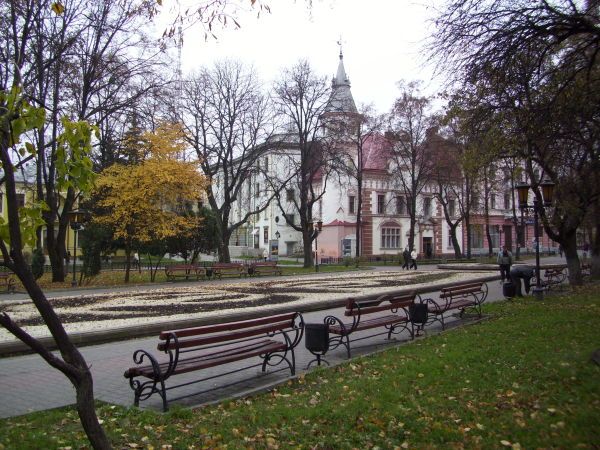
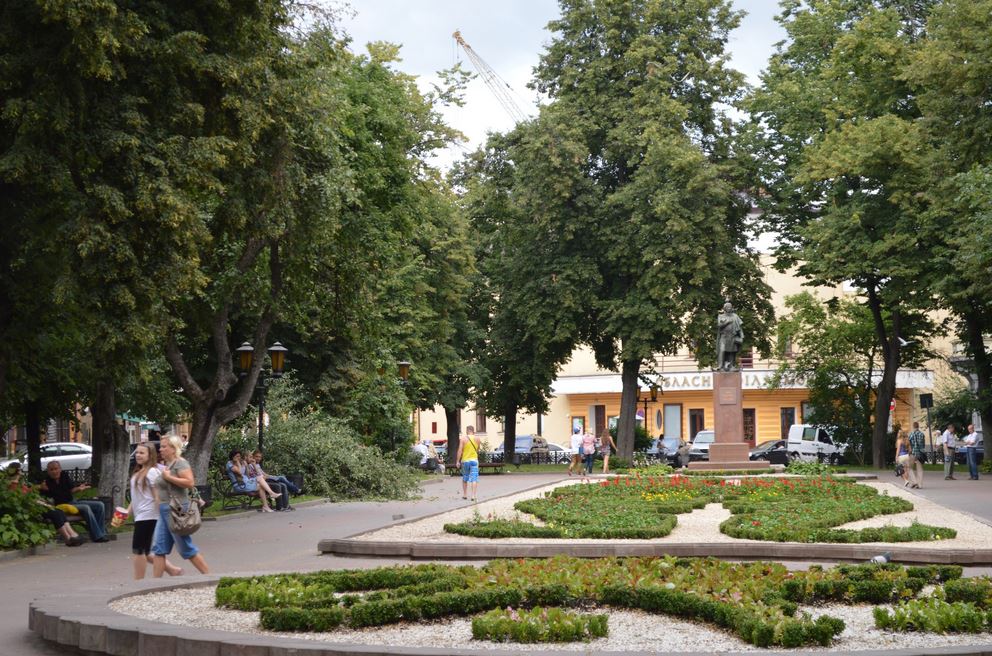
Mickiewicz Square in Ivano-Frankivsk has become a favorite place for locals to relax. The square is surrounded by architectural monuments and a park, where passers-by enjoy relaxing in the shade of the trees in summer. The square has a peculiarity: it has never changed its name since its foundation.
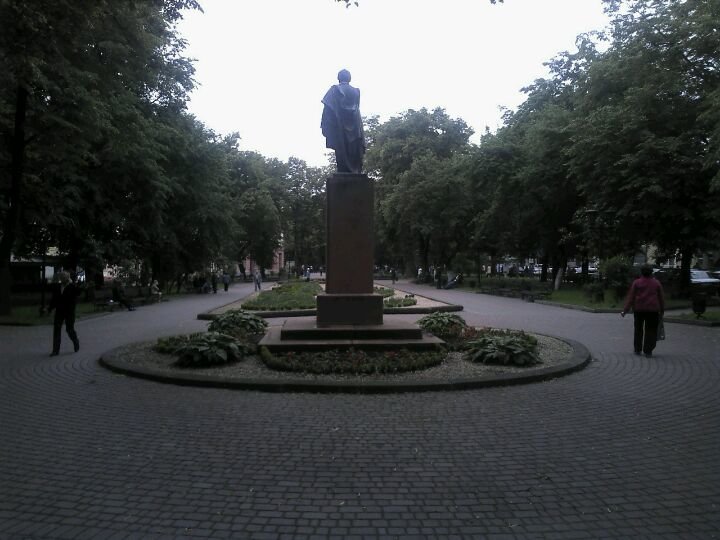
Mickiewicz Square was founded in 1870. In 1898, fans of Polish literature celebrated the 100th anniversary of the poet's birth (1798-1855). A decision was made to decorate the square named after Mickiewicz with a monument to him, although the poet had never been to Stanislaviv. The sculptor Tadeusz Blotnicki won the competition for the monument's design . Donations in the amount of 3000 rynski were collected for the construction of the monument . The figure of the poet was made of Italian marble and depicted with a book in his hands at the moment of inspiration.
The figure of Mickiewicz was made of Italian marble, and the poet is represented in the composition with a book in his hands. During the Ukrainian-Polish war of 1918-1919, the monument was damaged, and in 1930 it was restored in bronze, and moved slightly, and it has remained as it is today.
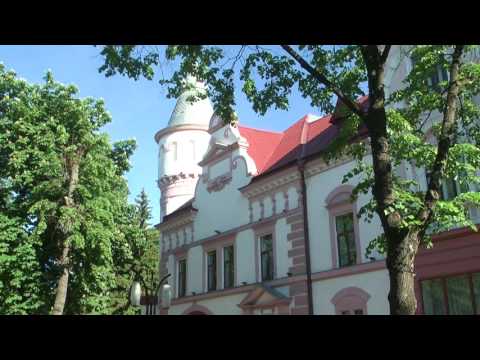
Behind the monument is the Regional Music Philharmonic. However, the building was originally erected as the theater of the S. Moniuszko Musical Society. It was built in 1891 on what was then Bielowskiego Street (now L. Kurbasa Street). The competition for the architectural design of the theater was won by Józef Lapicki, an engineer of the city railroad, and he received a gold ring for it. At that time, the Philharmonic building looked quite different from what it does now. This can be seen on old postcards of Stanislaviv. In 1939, the building belonged to the Ivan Franko Music and Drama Theater, which in 1980 received new premises on Nezalezhnosti Street.
The present building of the regional children's libraryonce housed the Polish gymnastic (cultural and sports) society Sokil (there was also a Ukrainian one in the city, in the Prosvita). The Polish Sokil appeared in the city in 1884, and its activities were based on the physical and moral education of young people. There was even a special "falconry" gymnastics, whose exercises were so well thought out and combined that most of them were used in Russian military schools, and later in the Soviet and Ukrainian armies. These were mainly fencing, weightlifting, and gymnastic exercises.
The Stanislaviv Society was quite poor and for some time did not have its own separate premises. There was not enough money even for the project, so the committee turned to famous Lviv architects for help, who soon sent as many as 14 versions of the drawings. At first, they settled on Wisniewski's design, but eventually chose the project by Karol Zaremba (a Krakow architect). A well-known local architect, Jan Tomasz Kudelski, was also involved in the design.
The house was built on September 22, 1895. It was decorated with a tower that made the building look like a medieval castle. Today, the weather vane that crowned the tower's dome has been preserved, but the concrete figure of an eagle on the pediment, a symbol of the Polish state, has not. Ten years later, the building was painted by local artist Rubczak. He created a fresco on the facade, a copy of Jan Grotger's painting The Battle. It depicts an episode of the Polish uprising of 1863-1864, in which several Poles defend their flag from the soldiers of the Russian Empire.
The name of the institution, SOKOL, was embossed above the painting in a rectangular frame, and a little lower, in niches, were images of 24 coats of arms of Polish lands. The owners of the Sokol insured the building after the explosion that occurred on September 23, 1907, on Mickiewicz Square as a result of the detonation of gas that leaked from a pipe in the basement. At the beginning of the twentieth century, it was used for lighting, and from time to time this happened in the city.
On October 19, 1913, a memorial plaque to Prince Józef Poniatowski was unveiled on the building. In 1927 the building was damaged by fire. There is a version that the Poles deliberately set fire to their Sokol in order to obtain insurance in the amount of 200,000 Polish zlotys and use the proceeds to rebuild the building. There is no reliable evidence for this version, but in 1929 the Sokil was rebuilt and expanded; additionally, a room was built for the Ton cinema, which at that time became the first sound cinema in Stanyslaviv. Now the Lumiere cinema operates here.
With the advent of Soviet rule in 1939, the Sokoli (both Polish and Ukrainian) ceased to exist. Since August 1945, the building has housed the regional children's library.
In 1977, sculptor Toporkova and architect Popychenko decorated the library's facade with a bas-relief depicting barefoot residents of the region holding a flag and the inscription "On November 13, 1905, a demonstration of workers took place on this square in support of the first revolution in Russia in 1905." In fact, the demonstration was not in support of the events in Russia, but to demand the introduction of an eight-hour workday.
In 1984, the artist Yaroslav Sokolan painted the ceiling of the lobby with frescoes based on the best fairy tales of the world. In addition to the characters, storytellers such as Charles Perrault, Hans Christian Andersen, and Alexander Pushkin are also depicted.
In the early 2000s, during the renovation of the building, the emblem of Galicia, the black eagle, was removed. The fresco with the defenders of the flag and possibly some other coats of arms will be restored later.
Mickiewicz Square is located in the city center and can be reached by any minibus going towards the center.
Accommodation around Mickiewicz Square, Ivano-Frankivsk:


Which trails pass by Mickiewicz Square, Ivano-Frankivsk?
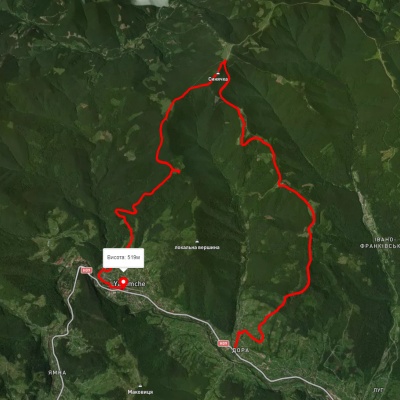
We suggest these hiking trails through or near Mickiewicz Square, Ivano-Frankivsk: Pasichna village, via Maniava village, Maniava Waterfall and Mount Velyka Syvulia to Bystrytsia village, Maniava village - Monastyretska polonyna, Dora village, via Mount Syniachka, Pereslip Pass, Turshuhuvata polonyna and the Yavirnyk ridge to Yaremche, Dora village, via Mount Syniachka and Pereslip Pass to Yaremche, Dora village, via Mount Syniachka and Chornohorytsia polonyna to Yaremche, Dora village, via Mount Syniachka and the Chornohorytsia ridge to Yaremche

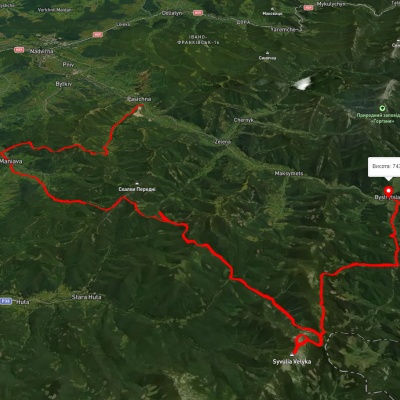
Pasichna village, via Maniava village, Maniava Waterfall and Mount Velyka Syvulia to Bystrytsia village
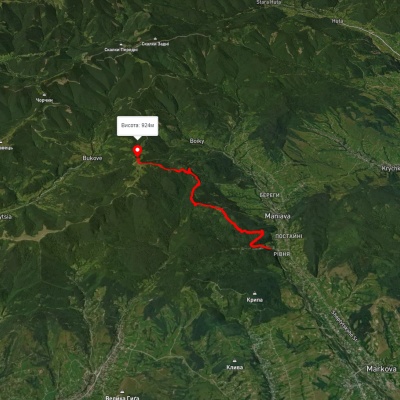
Maniava village - Monastyretska polonyna
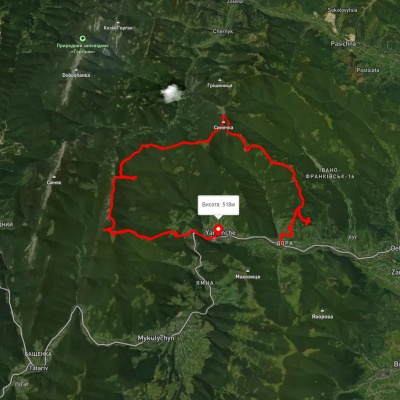
Dora village, via Mount Syniachka, Pereslip Pass, Turshuhuvata polonyna and the Yavirnyk ridge to Yaremche
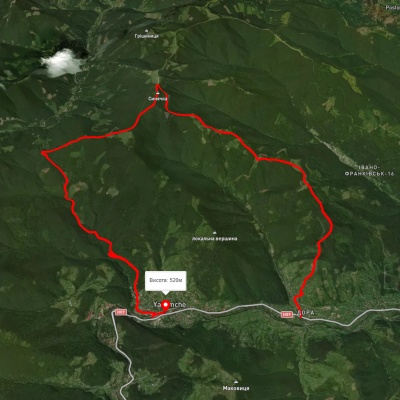
Dora village, via Mount Syniachka and Pereslip Pass to Yaremche