Holy Trinity Church (Sacramento Monastery), Lviv
TheChurch of the Betrothal of Mary and the Convent of the Sacramentals is an ensemble of religious buildings in Lviv, located at 9 Tershakivtsi Street. In the 1990s, the church was transferred to the UGCC and consecrated in honor of the Holy Trinity. The monastery of the Sacramentans (Benedictines from the Adoration of the Most Holy Sacrament) was founded in 1710. During one of the epidemics, the nuns, who arrived from Warsaw, stayed in a room rented at the expense of Princess Jablonowska at the church of St. Anthony. The nuns educated the daughters of the gentry.
In 1718, the first church of the Betrothal of the Blessed Virgin Mary and St. Joseph was built. The construction became possible after Smolensk voivode Franciszek Zetner recorded a fund for the construction of a church and a convent at the request of his daughter Zofia (née Aniela, her portrait hung on the wall of the church in the early 1920s), who became a Sacramentarian nun. It was a half-timbered building that lasted until 1743. In 1743, Archbishop Mykola Vyzhytskyi, using the nuns' dowries and the help of various benefactors, including King Stanisław Leszczynski, began construction of a brick church.
In 1744-1780, the church was rebuilt in stone according to the project of the famous architect of German origin Bernard Meretyn, who himself supervised the construction for the first two years. In 1785, the fence and the first half were completed; after the Josephine kasata, the church was closed for a long time. Monastic cells and walls were also built. A garden was laid out on the territory of the monastery, which existed until the twentieth century.
In 1884-1887, the church was rebuilt according to the design of Adolf Minasiewicz. The literature often mentions erroneous years of completion, as well as 1881 as the year of the beginning. The latter was refuted by the historian Jan Ostrowski. He also suggested that the project dates from 1881, and construction began three years later. By analyzing newspaper articles of the time, Lviv historian Yurii Smirnov was able to reconstruct the list of completed works to some extent. These included the completion of the neo-Baroque tower, the replacement of the roof, and possibly the rebuilding of the vault. In 1883, the Polish sculptor Tomasz Sosnowski visited Lviv and created a white marble statue of St. Josaphat in Leonard Marconi's workshop, which was installed in the church probably after the reconstruction was completed.
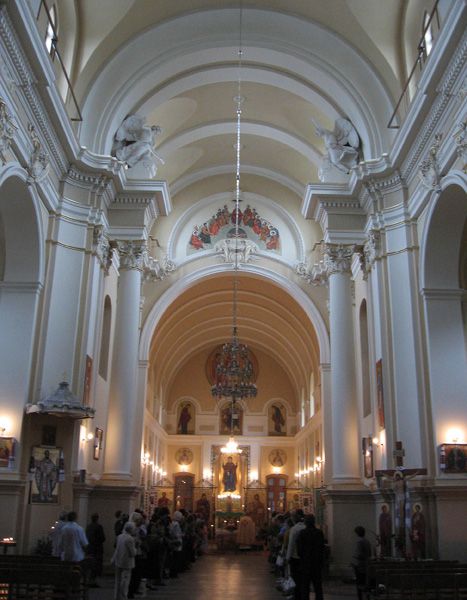
In 1902-1904 another reconstruction was carried out. In the literature, without substantiation or references to primary sources, Władysław Sadłowski is often mentioned as its author. It is also not specified what detailed work was done during this period. Jan Ostrowski saw Sadłowski's handwriting in the successful overall design of the main façade and the altar, as well as in modernist elements such as simplified neo-Baroque capitals and pedestals on the side towers. Yurii Smirnov brought more clarity to the history of the second reconstruction. He found that Edmund Żykhovych developed the project and supervised the reconstruction. Sadlovsky was responsible only for the design of the main altar (the old Baroque altar was removed). The stonemasonry and construction of the new facade were carried out by Ferdinand Majerski's company. The statues of the angels were created by sculptor Petro Wijtowicz. The Piotrowicz and Schumann factory was responsible for the artistic and locksmithing work. As part of the renovation, the wall separating the nave from the presbytery was dismantled and the floor was laid anew. It is not known, however, to what extent the current appearance of the church corresponds to the original plan of Bernard Meretyn. Lviv art historian Hryhorii Ostrowski saw distinct Austro-Bavarian influences in the church's appearance.
In Soviet times, the buildings and territory of the monastery were transferred to the Zooveterinary Institute. A dormitory and a club were set up in the cells, and a gymnasium in the church. It is said that it was within the walls of this club that the idea of creating the People's Movement of Ukraine was first voiced in 1988.
Therestoration of the complex of the Sacramento nunnery began in the 1990s. Teachers of the zooveterinary university repaired the Church of the Betrothal of the Blessed Virgin Mary and St. Joseph at their own expense and with donations collected. It was handed over to the UGCC and consecrated as the Church of the Holy Trinity in December 1995.
In 1995-2017, the wall paintings, iconostasis, and hanging icons of the Holy Trinity Church were created by Mykola Rybenchuk, a well-known Ukrainian icon painter, Honored Artist of Ukraine.
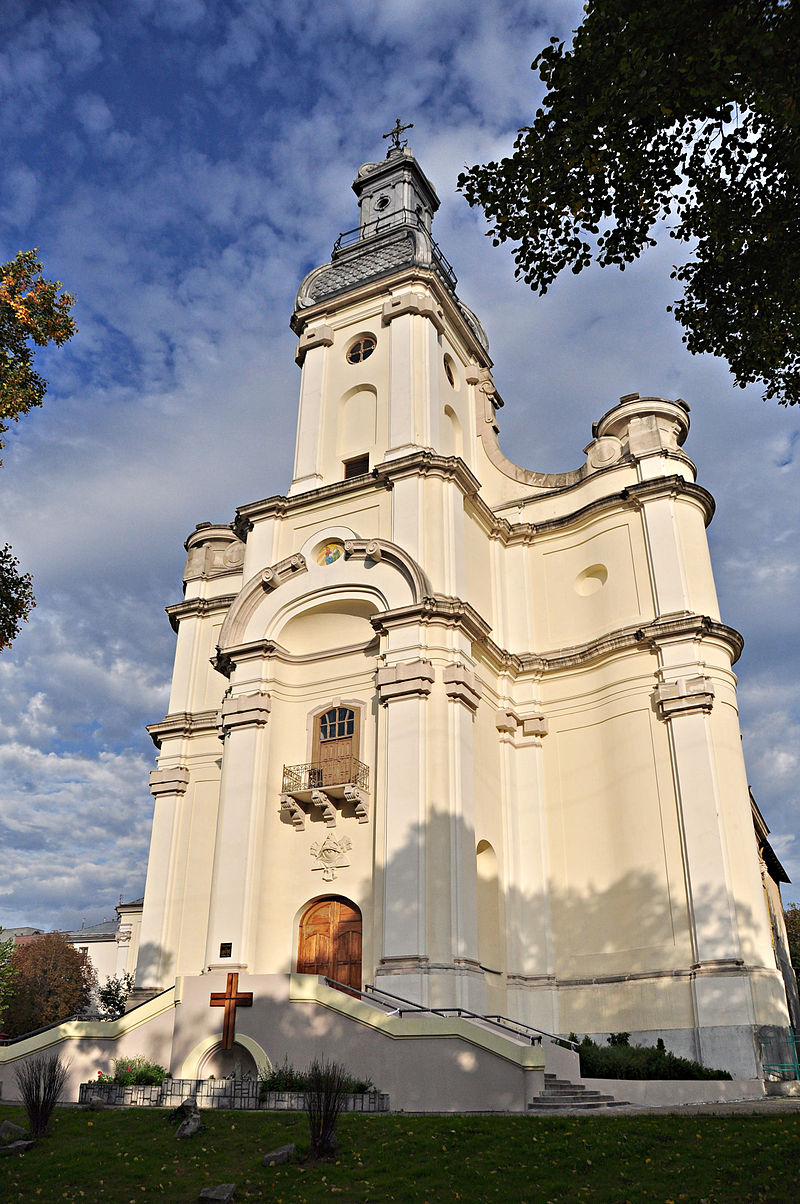
The monastery complex of sacramentals, which once adorned the southeastern city outskirts and now finds itself in the heart of Lviv, is a three-nave, six-pillar rectangular (35m*20m) basilica with a square apse (10m side) in the eastern part of the Trinity Church and a complex contour of cell buildings.
The architectural dominant feature of the church, decorated with round, box, and arched window openings around the perimeter framed by floral stucco ornamentation and Ionic order pilasters that divide the wall plane into mirrors, is the central façade with a three-tiered bell tower above the Babinets.
Its outline, dominated by the bell tower's projection and symmetrically arranged round towers with massive flowerpots on top, is decorated with elegant Baroque overhangs and two-layer Doric pilasters, the scrollwork of the portal of the main entrance and a graceful balcony on brackets, a turret-overhead above the closed roof and a braced cornice, arched niches and, of course, an all-seeing eye in a triangle symbolizing the triple power of heaven, which is sacred to Christians.
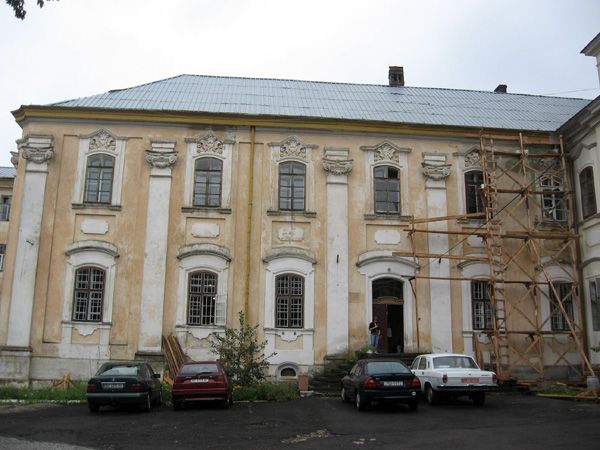
The two- to four-tiered monastery buildings of the sacramentals attached to the northeastern part of the Trinity Church have a complex geometric configuration with a courtyard. Their central facade, which now faces Tershakovtsiv Street (formerly Gosiewski Square), is decorated with Ionic pilasters that echo the church, dividing the space into mirrors and rich platbands of box arches of windows crowned with floral ornaments on the second floor.
You can get there by car by the highways M06 (E471) (Kyiv - Zhytomyr - Novohrad-Volynskyi - Lviv - Stryi) / M09 (E372) (Rava-Ruska - Zhovkva - Lviv) / M12 (Ternopil - Lviv) / M11 (Przemysl - Horodok - Lviv) / M10 (Radymno - Yavoriv - Novoyavorivske - Lviv). Further around the city from the bypass: Lychakivska Street - Chekhova Street - Tershakivtsi Street, with the Holy Trinity Church as its central facade.
By intercity transport to Lviv railway stations, and then in the direction of Lychakivka to the Chekhova Street stop, and then two blocks south along Chekhova Street, which turns into Tershakivtsi Street to the former monastery of the Sacramentans. Nearby is Levytskoho Street, a one-way street. On Zelena Street, a few blocks away, near the intersection with Shota Rustaveli Street, there is a bus stop for routes 24, 37, 43, and 46.