City Banske Lake (Kosiv)
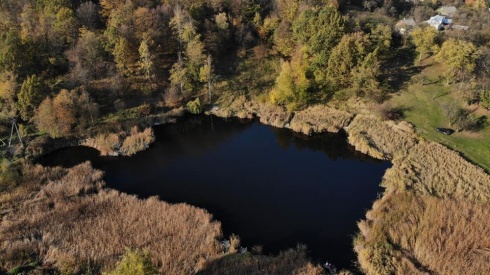
There are lakes of technogenic origin in the Hutsul mountains. One such lake is Banske Lake (near the former factory "Hutsulshchyna") in Kosiv. It was formed in the 18th century on the site of salt mines, is quite deep, and rich in fish. Now, its picturesque shores are favored not only by local residents but also by numerous guests of the city.
In the southwestern part of Kosiv, between the Church of St. Nicholas and the Huk Waterfall, valuable deposits of salt lie on an area of 3 sq. km, appearing as sludge, stone, and brine (raw material). These deposits, along with layers of soft sandstone, red slate (shale), and accumulations of exotic boulders and gravel piles, belong to the Subcarpathian salt formation, formed 25 million years ago in the early Neogene when the territory of Kosiv was under the waters of the Carpathian Sea. Under the dry climate conditions of that time in the Carpathians and Precarpathians, in shallow bays, the bottoms of which gradually sagged, and the inflow of seawater was slowed, salt-bearing rocks and salt gradually settled as the sea slowly disappeared.
In historical times, a salt mine, known as a "zhupa," was established based on these salt deposits. It was first mentioned in 1472 - almost half a century after the earliest mention of "the village of Kosiv with the monastery" and approximately a hundred years before the emergence of "Kosiv - the town", which arose and developed due to the local zhupa, one of the largest in Pokuttya. The zhupa was located immediately behind the monastery, on the site of the present Banske Lake, stadium, pool, and the production and artistic association "Hutsulshchyna"; its territory, covering over 15 hectares in the south, ended near the Banske Bridge, which leads across the Rybnytsia River towards the mountains, and in the north reached beyond Lisna Street, which runs along the ridge of Horb. Since both rock and evaporative salt were produced, the zhupa included both mines (so-called shiby, wells, salt windows) and boiling houses or towers, which is why the zhupa was also called a bathhouse or saltworks, or simply salina (in Old Ukrainian), salina (in Polish), or solyarnya (according to modern Ukrainian terminology).
During the interwar period, salt production gradually decreased, and in 1938 it was completely halted. This important industrial enterprise of Kosiv, which had served for nearly half a millennium, was decided to be closed by the authorities because it employed almost exclusively Ukrainians, who were inclined to anti-government activities; and also because the Kosiv saltworks was a competitor to the salt mines in Bochnia and Wieliczka near Krakow.
On the site of the liquidated zhupa, a therapeutic salt institution was established. For this purpose: the previous bath was significantly expanded; the ice house was rebuilt into an inhalatorium, equipped with foreign equipment; the office building was adapted for a casino with a restaurant, café, library, and reading room; a very beautiful but neglected park was put in order; two tennis courts were built.
In September 1939, a Red Army regiment camped on the territory of the former saltworks, which, during its retreat in the summer of 1941, blew up ammunition depots and specially planted explosives, destroying many buildings.
To this day, remnants of the saltworks remain: the abandoned area with Banske Lake and several buildings housing the workshops of the "Hutsulshchyna" factory; from the therapeutic salt institution, there remain: a distorted entrance due to reconstruction and an abandoned pool. But even in this form, the grounds of the former salt zhupa with preserved remnants constitute a particularly valuable ensemble of geological, archaeological, historical monuments, as well as industrial and resort architecture, based on which it is advisable to create a reserve, and at the reserve - a salt mining museum, a research department, and a therapeutic salt institution verified by pre-war experience.
In the territory of Kosivshchyna, there are many mineral springs with various healing properties, including sanatoriums and resorts that have all the necessary therapeutic and diagnostic offices. These resorts mainly treat respiratory diseases. Regarding healing springs, the well-known therapeutic spring "Berkut" is located in the upper reaches of the Chornyi Cheremosh in the Carpathians. To improve health, the famous Ukrainian poetess Lesya Ukrainka stayed here in the summer of 1901, as did Ivan Franko and Mykhailo Kotsiubynsky.
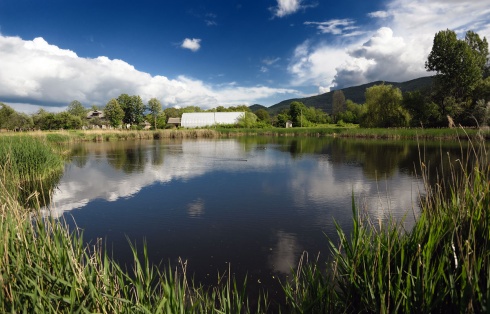
Legends of Kosiv: About Banske Lake (Source: Kosiv Central Library)
Once, under the Osikova Mountain, there was a monastery. It was founded by monks from the Kyiv-Pechersk Lavra, who came here seeking refuge from Mongol invaders. They brought with them the Gospel in a precious cover, a silver cross, and a golden chalice, which they placed in the newly built church. The monastery and its surroundings became known as Monastyrske, and the stream flowing nearby was named Monastyrchyk. Over time, the monastic brotherhood grew in number. And since the monks led a truly pious life, fervently prayed, and helped the needy, orphans, and widows, good fame spread about them. Princes, boyars, and townspeople brought generous gifts to the monastery and the Church of St. Nicholas, so the monastery accumulated considerable treasures for the glory of God and to aid the Christian people.
But one day, the quiet, peaceful life of both the monks and the townspeople of Kosiv came to an end. The Tatars attacked the town and completely destroyed it. This happened on Easter Sunday. Only those who hid with their children behind the monastery walls survived. Both the monks and the townspeople fiercely defended themselves. And the bell ringer Mykhalko in the belfry did not cease to ring in glory of the Resurrection of Christ. The forces were unequal. The attackers broke into the monastery and began to brutally kill not only the armed defenders but also women and children. Blood flowed in streams. Only the bell did not cease. Enraged Tatars set fire to the belfry and the monastery and began to plunder its treasury. And then a miracle happened! The monastery with the Tatars and the dead and living defenders sank into the ground. From all sides, waters surged from the earth, and in a moment, a lake was formed here.
…If you come to the lake on Easter night, you can hear the Music of the drowned Easter bells and the cries and moans of people tortured by the enemy. Faintly, a strange gentle music can be heard, the weeping of innocently killed children… From the tears of the tortured, the water in the lake became salty. And it was called Banske Lake because the few survivors from Kosiv mourned heavily for their deceased relatives. In memory of the bell ringer who perished but did not cease to fulfill his holy duty, the highest peak near Kosiv was named Mykhalkov. Later, Mykhalkov became a favorite gathering place for Hasidic Jews, who sang their songs there, admired the views, and praised God for this earthly beauty.
And some say that Banske Lake was formed on the site of the saltworks. Once, salt was as expensive as gold. In their greed to get rich, the lords - owners of the saltworks forced the salt workers not only to boil salt from the brine that flowed from the earth but also drove them deeper underground to extract expensive rock salt. The spirit that reigns in the underground world became very angry with those who intruded into his domain. One day, when the lord - owner of the bath came to satisfy his insatiable eyes with the precious salt blocks extracted from the ground, the earth above the mine suddenly sank, and a lake was formed. And since it was formed on the site of the saltworks, it was named Banske. This lake still warns that greed for underground treasures, like any other treasures, is severely punished.
Accommodation around City Banske Lake (Kosiv):


Which trails pass by City Banske Lake (Kosiv)?
We suggest these hiking trails through or near City Banske Lake (Kosiv): Nimchych Pass – Protiate Kaminnia, Smuharski Waterfalls, Sheshory – Rosokhata, Bukovets village – Pysanyi Kamin – Bukovets village, Pysanyi Kamin – Bukovets village, Kosmach village, via Mount Rotylo, Mount Hrehit and Mount Bila Kobyla to Bukovets village

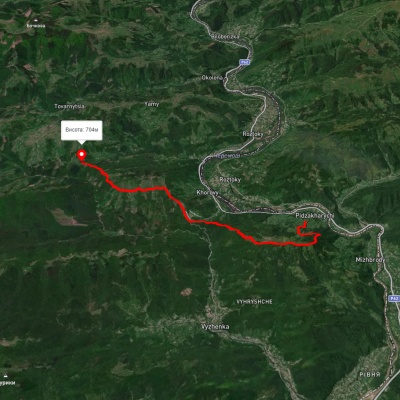
Nimchych Pass – Protiate Kaminnia
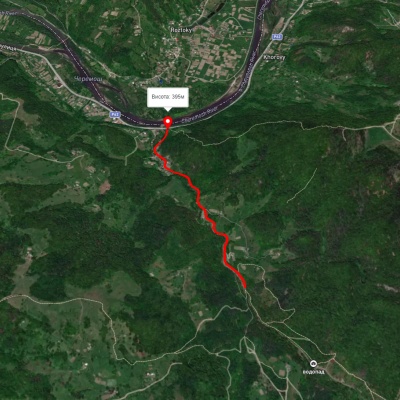
Smuharski Waterfalls
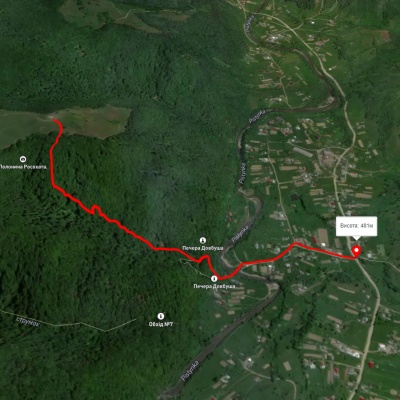
Sheshory – Rosokhata
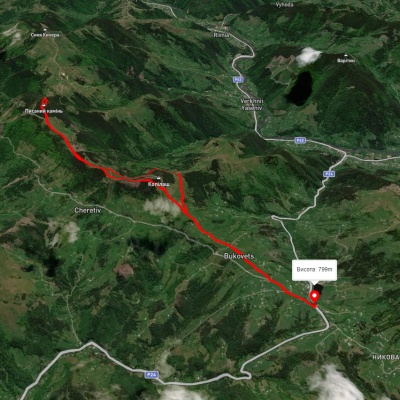
Bukovets village – Pysanyi Kamin – Bukovets village