Church of Saints Peter and Paul (Jesuit Church), Lviv
Among the religious places in Lviv, the Jesuit Church has a special aura. This church is now known as the Church of Saints Peter and Paul, and, above all, as the Garrison Church. Similar shrines exist in many countries around the world. They help to promote spiritual values among the military, along with strength and valor. The Jesuit Church belongs to the Greek Catholic community, and services are held here. Ordinary tourists also visit the garrison church of Saints Peter and Paul on Teatralna Street, as it is the first Baroque architectural monument in the city of Lviv.
TheChurch of the Holy Apostles Peter and Paul is a cultural heritage monument of national importance, one of the most significant religious buildings and the first monument of Baroque architecture in Lviv on Teatralna Street, built in 1610-1630 by the Italian Jesuit architect Giacomo Briano, who also belonged to the Jesuit order and built the church on the model of the Roman cathedral church of the Society of Jesus, where Ignatius Loyola is buried.
Jesuit missionaries began to arrive in Lviv after 1584, and in 1590 the first wooden church of the Society of Jesus was built on a plot next to the western part of the city's defensive walls, where the Jesuit gate was arranged. This was the name of one of the passages formed after the Jesuits received a plot of land under the High Wall to build their monastery. Later, the magistrate transferred the city park (also known as Ivan Franko Park, Kostiushko Park, and Jesuit Park) to them, where they laid out the farmstead. To shorten the way to it, the Jesuits cut a passage in the High Wall without the magistrate's permission, which caused a dispute.
Thus, the first church in Lviv was wooden. The one we see today began to be built before Briano arrived in the city. At that time, the walls of the future church were already partially built. The Italian worked out the finished project in detail and changed the interior. It was Briano who gave the church the Baroque forms that were common in European architecture at the time.
A century later, a tetrahedral tower was built on the south side of the apse, which was then the tallest in the city. It was soon dismantled for fear of destruction (the tower of the Lviv City Hall had fallen shortly before).
Mieczysław Orłowicz claimed that the founder of the first Jesuit church was Zofia Hanel. In 1607, the founder of the modern church, Elżbieta Lucia Sieniawska, transferred 40,000 zlotys secured in Dobriany, Brody, Krasiv for the construction of the Jesuit church in Lviv, paying the first installment of 17,000 zlotys, which made it possible to begin construction of the church; the next installments of 14,300 zlotys were paid on January 22, 1613, and 8700 zlotys in 1616. She also signed a will in Ratne in 1611, according to which she donated rich clothes and utensils to the future church.
On July 31, 1610, the cornerstone was dedicated by Lviv Latin Archbishop Jan Zamoyski, but E. L. Seniawska did not allow her name to be left on it.
The author of the original project is unknown. In 1613-1614 the construction was supervised by Sebastian Lamchius. When Giacomo Briano arrived in Lviv in 1618, the walls of the church were already three cubits high. He did not develop a new project, but only elaborated on the existing one and modified the interior. Briano, who was raised on the models of Italian architecture, introduced into the church building the forms that first appeared in the facade scheme of the Il Gesù church in Rome, built by Giacomo Vignola and Giacomo della Porta. This scheme spread in the European architecture of the seventeenth century and became characteristic of the Baroque style.
A tetrahedral tower was built on the southern side of the abbey in 1702 (by Valentyn Godnyi), which became the tallest in the city. It was dismantled in 1830 because of the possibility of destruction after the fall of the Lviv City Hall tower on July 14, 1826.
In 1736-1737, the sculptor Thomas Gutter, together with Konrad Kutscherreiter, made altars for the church.
In 1740, a thorough reconstruction was carried out, with funds provided by the crown stable boy Yurii Stanisław and his wife Marianna Teresa of the Zamoyski Diduszycki family. In particular, the memorial tombstone of the founder buried here was "removed." It was then that the naves appeared on the site of the side chapels, and the walls and vaults were frescoed by the artists Francis and Sebastian Eckstein, natives of Brno in Moravia. F. Eckstein (who began work in the church late due to a conflict with a local shop, which was defended by Bishop Samuel Glowinski of Lviv) created four compositions on the vault of the main nave; after his death in 1741, his son Sebastian continued the work, creating frescoes over the choirs and side aisles. A valuable work of art is the sculptural crucifixion by Jan Pfister in the side aisle.
On July 23, 1741, the relics of St. Benedict, brought from the estate of J.-S. and Marianna Diduszycki (now Vilkhivtsi), were solemnly placed in the newly built chapel (founded by Marianna Diduszycki) at the western wall of the church, with Mykola Wyżycki participating. Faustyń Grodzicki, a professor of architecture at the Jesuit College in Lviv in 1741-1749, may have designed the main altar. In 1773 the church was a garrison church. In 1775-1848, the meetings of the Galician Diet of the State were held in the Jesuit church. After the partition of the Polish-Lithuanian Commonwealth, the Greek Catholic Bishop of Lviv, Petro Bilyansky, sometimes held services in the church. In 1836 the church was returned to the Jesuits.
The monument was restored in 1842, 1879, and 1896. In 1946-2011, the church was used as a book depository and belonged to the Stefanyk Library. On December 6, 2011, the former Church of Peter and Paul of the Jesuit Order was opened for worship. Now it is called the Church of Peter and Paul and belongs to the Curia of the Lviv Archeparchy of the UGCC. All the books of the Stefanyk Library, which were stored in the church, were moved to a building located on the territory of the military unit at 1 Aviatsionna Street.
In 2016-2017, a thorough restoration of the facade and interior began, which is scheduled to be completed in 2022.
The Church of Saints Peter and Paul is one of the largest religious buildings in Lviv: it is 41 m long, 22.5 m wide, and 26 m high. Its most interesting architectural element is a baroque portal that opens onto Teatralna Street.
The church is three-nave in plan, with a weakly expressed abscess on the outside. The side naves are very narrow and low in relation to the central nave. To increase the area above them, galleries were built - emporiums. At the initial stage, instead of side aisles, there were only separate chapels, i.e. the naves were divided by transverse walls, which is typical for the shrines of the Jesuit order.
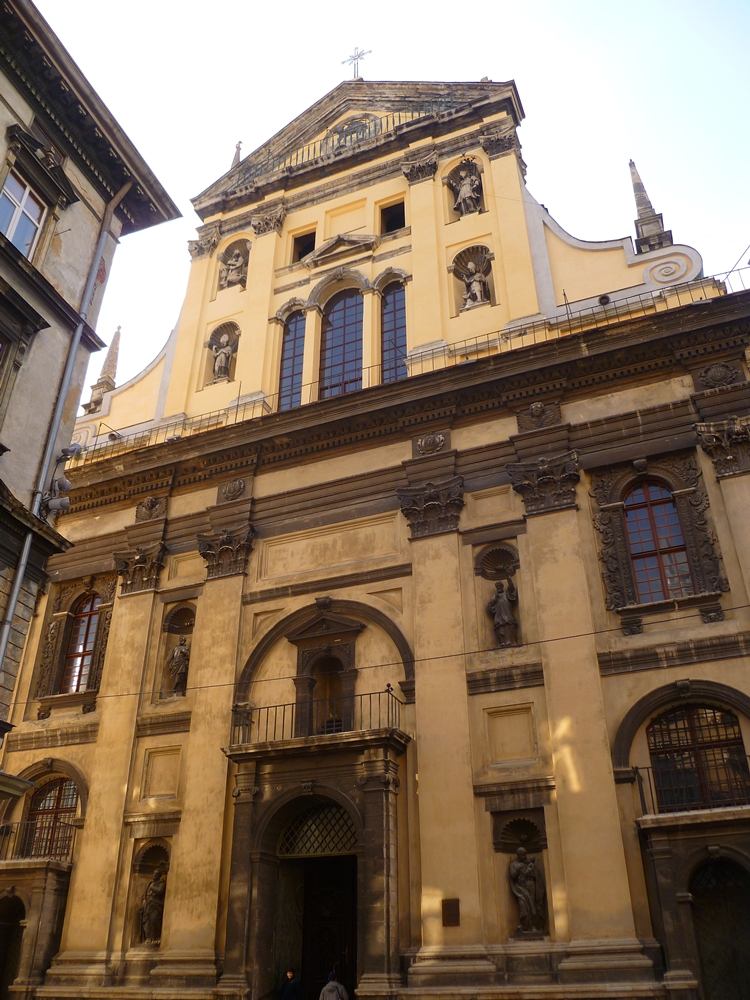
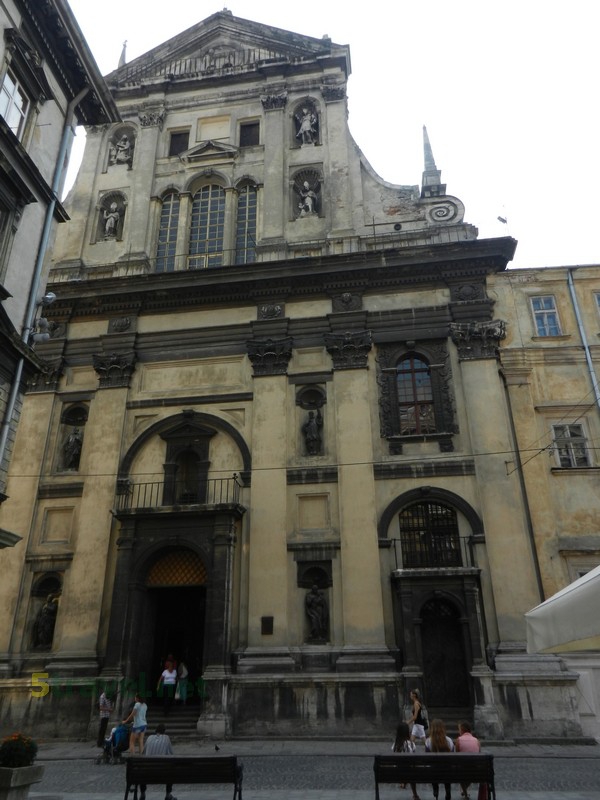
The building's main façade, which faces Teatralna Street, isthe dominant feature. It was created in the Baroque style, decorated with Corinthian pilasters, as well as niches with statues of saints and carved ornaments on the window frames.
The sculptures on the upper tiers were installed in the 17th century. In particular, there are statues of the Blessed Virgin Mary and the Archangel Gabriel at the top. Below them are St. Wojciech and St. Stanisław Szczepanowski. The figures on the two lower tiers appeared much later, in 1894. They depict four saints of the Jesuit order: the bottom row is Blessed Andrzej Bobola (left) and St. Stanisław Kostka (right), the second row is St. Ignacy Loyola (left) and St. Francis Xavier (right).
The main altar is the centerpiece of the building: it is powerful, with four columns, made of stone and decorated with marble. Near the columns are statues of Jesuit saints, larger than a human being. During the eighteenth century, the interior of the shrine changed its appearance. During the restoration of 1896, statues were installed in the niches of the first tier.
The crypt of the Church of Peter and Paul in Lviv houses the burials of many prominent figures of their time who made a significant financial contribution to the existence of the church.
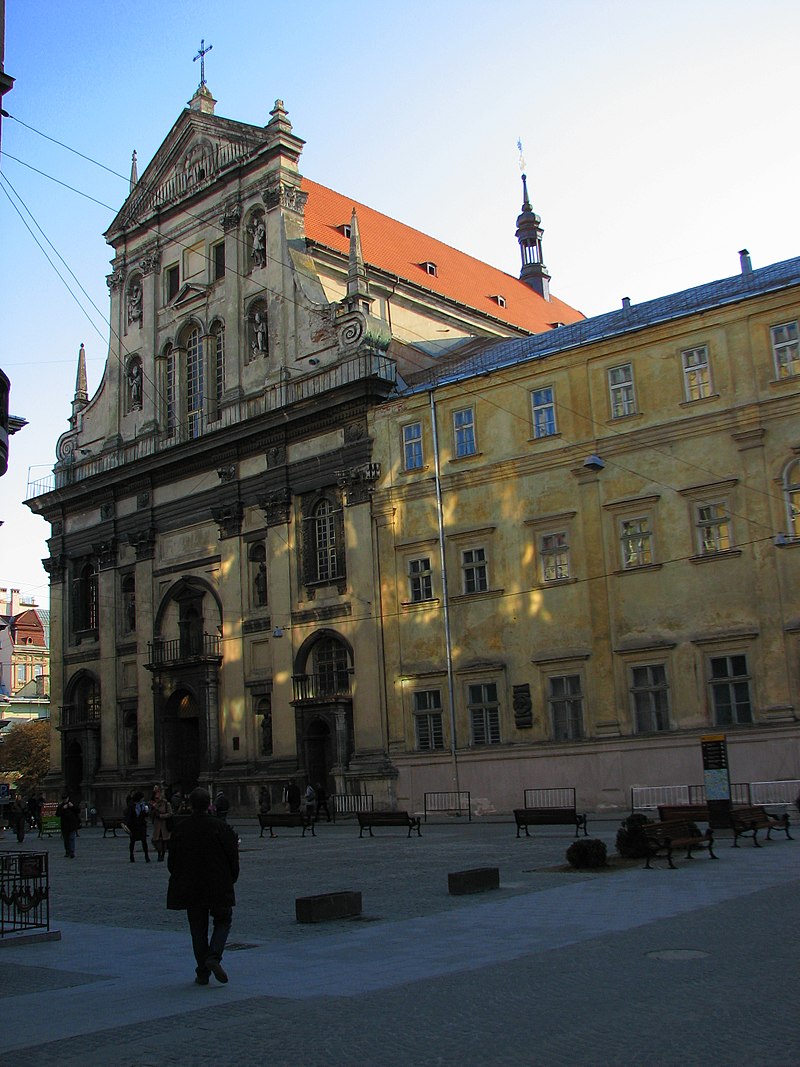
The three-story building of the former Jesuit College, rebuilt in 1723, adjoins the church on the north side. The project of the previous collegiate building was designed by Giacomo Briano, but later the building was reconstructed. Students of this college included Bohdan Khmelnytsky, Yarema Vyshnevetsky, and the famous traveler and architect Vasyl Hryhorovych-Barsky. During the restoration of 1906, fresco paintings of the eighteenth century were discovered in the college's premises.
Experts date the organ of the Jesuit church to the 18th century. It was not used in Soviet times, and some of its functional components were lost. The instrument has 22 registers. The wooden ornamental and sculptural decorations in the Rococo style are well preserved. Among the sculptures that decorate the organ are biblical characters with musical instruments: King David with a lyre, St. Cecilia with an organ, and two figures with a mandolin and a flute (experts believe that these are muses).
They were buried in the crypt of the church: Francis and his son Yurii Stanisław Diduszycki, Elżbieta Lucia Sieniawska, Aleksander Stanisław Bielżecki, Jan Stanisław Jabłonowski and his wife Marianna of the Kazanowskis, Stanisław Jan Jabłonowski, Marcin Nykanor Anczewski, Tomasz Karczewski...
In the left nave of the church there are tombstones and commemorative tablets with epitaphs of the Jablonowski princes: Jan (1659), Jan Stanisław and his wife Marianna from Kazanowski, Stanisław Jan, and Stanisław Wincenty. On one of the pillars separating the central nave from the right one there is a memorial plaque to Piotr Skarza, and on the others - to representatives of the Wyżycki and Didushytski families.
Today it is a garrison church of Saints Peter and Paul, belonging to the Curia of the Lviv Archeparchy of the UGCC, where regular services are held. The church requires a large amount of restoration and renovation work. In the dungeon of the church is the Snail Gallery, located under the southern nave of the church. In the late 1990s, archaeological excavations were conducted and the premises were restored, and the Lviv City Council granted the gallery a lease for the space. Close to the church stands a large three-story building of the former Jesuit monastery and college, where Hetman Bohdan Khmelnytsky once studied. Today this building houses a secondary school. Next to the church is a monument to Taras Shevchenko, and on the other side of Lviv's main street, Svobody Avenue, is the beautifully decorated building of the Ethnographic Museum.
You can get to the Church of Saints Peter and Paul from the Lviv Railway Station by tram #1 to the Rynok Square stop, #6 to the Severin Nalyvaiko Street stop, or #9 to the Ruska Street stop.