Church of the Holy Great Martyr George of the UOC-MP, Lviv
St. George the Great Martyr is an Orthodox church in Lviv at 3 Korolenko Street. It belongs to the Ukrainian Orthodox Church (Moscow Patriarchate). Since 1992, it has served as the cathedral of the Lviv Diocese of the UOC-MP.
Before the outbreak of World War I, the church was the only legal Orthodox church in all of Galicia and belonged to the Bukovyna Metropolis. In the interwar period, it was the center of the Galician Deanery of the Polish Orthodox Church within the Warsaw Diocese. In 1945-1946, the church was the see of the Lviv Diocese of the Ukrainian Exarchate of the Russian Orthodox Church.
After the Lviv Brotherhood and later several Galician monasteries accepted the Union in 1708, the only Orthodox church in Galicia was the Maniavsky Skete. During the Josephine kasata of 1785, the skete was forcibly liquidated.
At the same time, the Lviv Orthodox community sought to establish its own parish and church. In 1787, during the visit of Joseph II to Lviv, representatives of the Orthodox community presented the emperor with a petition for the establishment of an Orthodox pastorate and the construction of their own church. A favorable patent was quickly obtained. Fundraising was organized and in the same year a room in the Besiadecki Palace (10 Halytska Square) was rented for the chapel. From 1816 to 1822, the house of Count Borkowski was rented for the church, and in 1822 a separate building belonging to the Ossolinski National Institution with a facade facing Copernicus Street was rented.
In 1832 there was an acute crisis in the merchant movement, which led to the departure of many Orthodox merchants, and to settle debts the community was subordinated to the Bukovyna Metropolis in 1832, which undertook to maintain the Lviv parish. After some time, the metropolitanate refused to maintain the parish, but thanks to government intervention in 1848, it accepted it into its fold, while simultaneously abolishing parish autonomy.
Due to the departure of the merchants, the house purchased in the early 19th century for later conversion into a church was also sold, which was never started. The community continued to rent the premises. In 1839-1844, they rented the house of Oleksandr Fredr, and from 1844 to 1850, the house of Kelerman. In 1850-1856, the church was again located in the Ossolinski's house.
In 1856, the consistory of the Bukovinian church bought a plot of land (conscription number 78 1/4) with two residential buildings on Franciscan Street (now Korolenko Street) for 14,500 florins for the parish. The two-story house was intended for the priest and church staff, and the one-story house was converted into a church.
In 1862, the Austrian government recognized the right of publicity ("citizenship") for the Orthodox Church in Lviv, but the right of the parish was never recognized, although in fact the church functioned as a parish church, keeping metric books of all Orthodox people born in Galicia.
On October 8, 1895, the project of the new church was approved, designed by Viennese architect Gustav Zachs. He also designed the plebiscite and the fence. Initially, the plebeian house was planned on the axis of the entrance, but later the project was changed and the house was moved to the east of the church. In the same year, the company of Vincent Ravsky won the tender for construction work.
On November 1, 1897, the cornerstone was laid. In the same year, a construction committee was organized, which included Josef Braunzeis, an architect of the construction department of the Galician governorate, as a technical advisor, Anton Hauf, an engineer of the governorate, as the head of construction, Yevhen Vorobkevych, the administrator of the parish, and Mykhailo Hrushevsky, a university professor, as a church trustee.
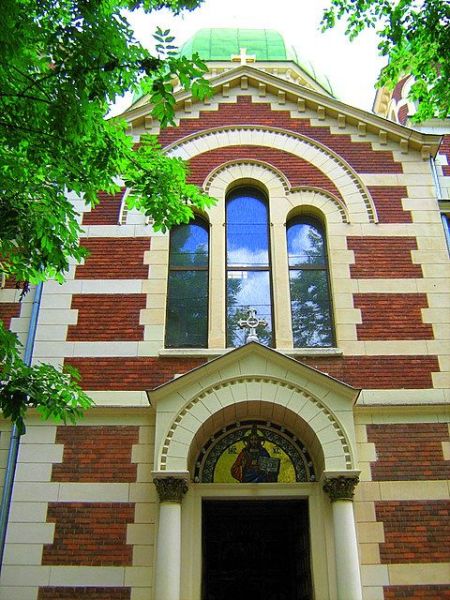
In October 1899, the main work on the construction of the church and plebeianage was completed, and the work on its completion continued until the following year. In 1901, a four-tiered iconostasis was installed, made by Viennese masters: carver Karl Wormund and painter Friedrich von Schiller. The stone altar was made in Lviv by sculptor Ludwik Tyrovych. The polychrome in the church was painted in 1902 by the Viennese painter Karl Jobst. Stained glass windows and a mosaic insert in the soupçon above the main entrance were made and installed by the Viennese company Tiroler Glas Malerei und Mozaik Anstalt. The subject of the mosaic was originally supposed to be St. George, but due to the limited space, it was decided to depict Jesus Christ blessing (Pantocrator). Seven bells were cast by the Karl Schwabe company (all dated 1898). On October 27, 1901, the church was consecrated in honor of St. George.
In 1902, two commemorative marble tablets were installed, as required by the Consistory of the Bukovyna Metropolis. The first one is dedicated to the 50th anniversary of the accession of Emperor Franz Joseph I to the throne, and the second one commemorates the dedication of the church. Both tables were also made by Ludwik Tyrovych. In 1905, the monks of the St. Elias Skete on Mount Athos painted and presented the church with a copy of the Tikhvin Icon of the Mother of God.
Before the First World War, the community was dominated by Muscovites. Services were performed in Church Slavonic and Romanian. The services were performed by two priests, one of whom was the rector of the church and parish, and the other was a chaplain for the Orthodox soldiers of the Lviv garrison. The Russian consul and his family regularly attended the services.
With the outbreak of World War I, the church was closed. During the Russian occupation of Lviv, the church functioned, but after the Austrians returned, it was closed again. Services resumed only in November 1918 after the collapse of Austria-Hungary and the November Order.
In 1923, the Polish government transferred the church to the Romanian Orthodox Church, and after several trials in 1930, a court decision recognized the supremacy of the Polish Orthodox Church over the church.
After World War I, Ukrainians began to predominate among the parishioners. In particular, they included emigrants from Eastern Ukraine, as well as natives of Volyn who served in Lviv. Services were held in the Church Slavonic language, and from 1937 onwards twice a month in Ukrainian.
During the first Soviet occupation in 1939-1941, the church was administered by the newly formed Exarchate of the Western Regions of Ukraine and Belarus as part of the Russian Orthodox Church. For some time, the head of the Exarchate, Archbishop Mykola (Yarushevych) of Volyn and Lutsk, lived and served at the church.
After the conquest of Galicia by the Third Reich and its annexation to the General Government, the parish again became part of the Polish Orthodox Church, being subordinated to the Archbishop of Krakow, Lemkiv and Lviv.
In 1945, the church was again subordinated to the Ukrainian Exarchate of the Russian Orthodox Church. The Lviv Diocese was formed on the territory of Lviv, Ternopil, Ivano-Frankivsk, and Drohobych regions. The newly ordained Bishop Makariy (Oksiuk) settled in the plebeian church of St. George, which served as the cathedral.
After the Lviv Council of the Ukrainian Greek Catholic Church in 1946, St. George's Cathedral was transferred to the Orthodox Church and became the cathedral, the bishop moved to a new residence, and St. George's Church became a parish church.
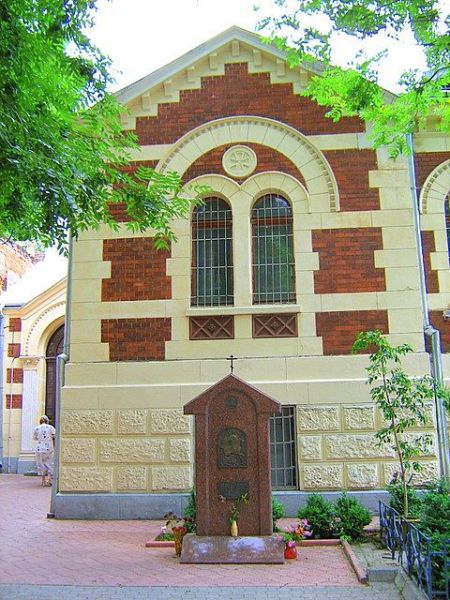
During the split of the Ukrainian Orthodox Church in 1992, the church was the only one in Lviv that remained under the jurisdiction of the Moscow Patriarchate. It began to serve as a cathedral, and the bishop's residence and diocesan administration were arranged in the plebeian church. In 2001, a memorial sign "in honor of the 2000th anniversary of the Nativity of Christ and the 100th anniversary of the Church of St. George" was installed at the entrance to the plebeian.
On June 1-2, 2011, the church was visited by the fair head of the Holy Great Martyr Anastasia the Resolver; on December 1-2 of the same year, the right hand of the Holy Great Martyr Dmitry of Thessalonica.
On Christmas Day 2012, the Peace Light of Bethlehem was brought to the church for the first time. It was received by Archbishop Augustine (Markevych) of Lviv. The church was one of the first in the jurisdiction of the UOC (MP) to join the campaign.
On December 1-3, 2013, during a religious procession through some churches of Ukraine, the church hosted the honest relics (right hand) of the Great Martyr George the Victorious and a list of the ancient icon of the Great Martyr George from the 10th century from the Xenophontos Monastery of Mount Athos.
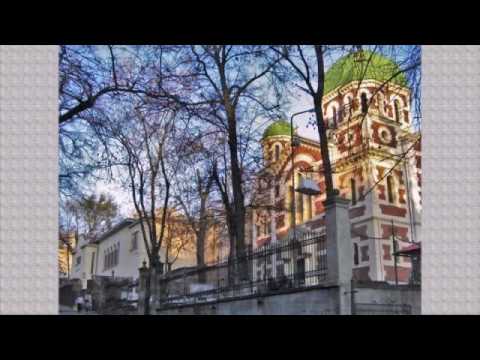
The church is located in the Lychakiv district of Lviv, on the odd side of Korolenko Street. The plot of land on which the complex is located is sloping and slopes down to the south. It is separated from the street by a metal fence on a brick plinth. The fence has an entrance gate and a firta that is on the same axis as the main entrance of the church. The main façade and entrance are located to the west (from the street). To the rear is a separate two-tiered plebeian pavilion, built in the same construction technique as the church and forming a single architectural ensemble with it. The architectural style of the building is characterized as a mixture of Neo-Romanesque and Neo-Byzantine styles (historicism).
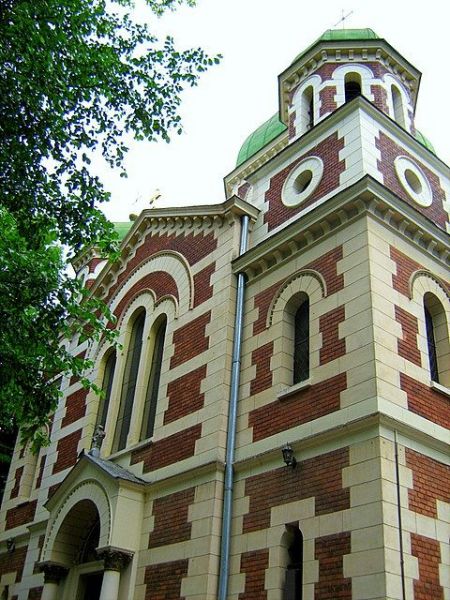
The plan of the church is central and has the shape of a Greek cross, with tetrahedral towers in the corners, which together form a square. The cross's frames on the plan slightly protrude beyond the square, forming risalits on the four sides of the façade. The towers on the street side (western) serve as bell towers. The eastern towers have two-story baptisteries. In general, the three-dimensional solution of the church resembles the seminary church of the residence of the Bukovinian metropolitans in Chernivtsi, designed by Josef Hlavka.
It is built of brick and white Polianske and Ternopil stone. The cornice and window openings are lined with stone blocks. The façade has red facing bricks of special firing. The risalits on all four sides are two-tiered and crowned with triangular pediments. The rear is adjoined by an absida covered with a conch vault, pentagonal on the outside and semicircular on the inside. The rest of the risalits on the second tier have triple windows under one common archivolt. The main entrance has its own triangular pediment, placed on two columns flanking the entrance. The corner towers are four-tiered, the first tiers of each having two narrow windows with miniature stylized cantilevered arches. The second tiers have wider windows with semicircular finials. The third tier is low with small round windows. The fourth tiers of the towers are formed by octagonal drums with tall, narrow, semicircular windows on each face. The temple is crowned with five Byzantine-shaped domes, of which the central one significantly dominates the rest. The central cupola, like the side ones, is placed on a much larger octagonal drum with the same windows. The inner surface of the central dome is spherical. On the edges of the gables and in the eaves of all five towers there is a cornice with modillions of a very simple shape. The same intermediate cornice separates the second tiers of the towers from the third.