Church of the Assumption of the Blessed Virgin Mary, Lviv
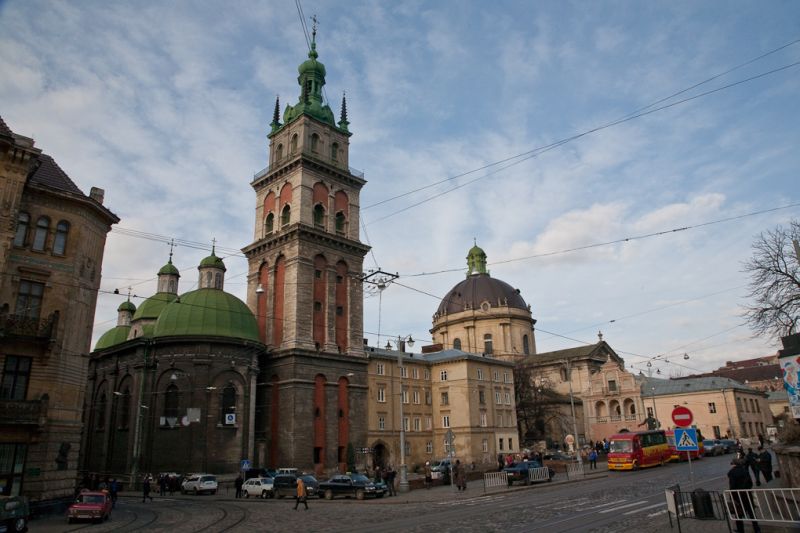
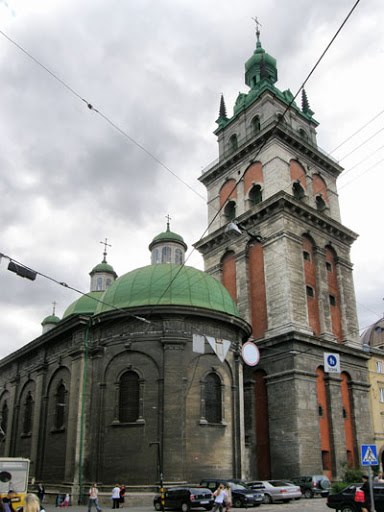
The Assumption(Walnut) Church in Lviv, also known as the Stavropegial Church of the Assumption of the Blessed Virgin Mary, is a functioning stone church in Lviv, built in 1591-1629 according to the plan of Paul the Roman, with the participation of Wojciech Kapinos and Ambrose Prykhylnyi, commissioned by the Lviv Brotherhood. The parish belongs to the Lviv Eparchy of the Orthodox Church of Ukraine.
The church built by the Assumption Brotherhood had three predecessors. The first Church of the Assumption probably existed in princely times and was burned down during an attack on Lviv by Polish feudal lords in 1340. The second, brick church, first mentioned in 1421, survived until a fire in 1527. The church destroyed by the fire was rebuilt in 1547-1559 by architect Petro the Italian, a native of Lugano. In addition to the local population, the funds for its construction were provided by the Moldovan owner Alexander Lopushanin (Lopushnyanu) and his wife Roxane: in memory of this, the church was called Voloska. It also did not stand for long, burning down in a fire in 1571. A schematic image of this church was preserved on the seal of the Stavropegian Brotherhood.
On January 3, 1584, Lviv Latin Archbishop Jan Dymytr Solikowski and his supporters attacked the church, expelled the parishioners, humiliated the church priest, and sealed the church; he wanted to force the brotherhood to celebrate the new Gregorian calendar.
The brotherhood beganconstruction of the fourth Assumption Church, which has survived to this day, in 1591, immediately after the consecration of the Chapel of the Three Saints. The author of the project and the head of the construction work was Paul the Roman (d. 1618), assisted by Wojtych Kapinos in 1597, and joined by Ambrose Prykhylnyi a year later. The images were painted by Mykola Petrakhnovych.
The construction was largely financed by Moldovan owners. On April 17, 1598, King Sigismund III of Poland granted a privilege to the Moldovan owner Jeremiah Mohyla, which removed obstacles to such financing. From 1599 to 1606, Jeremiah sent over 6000 zlotys for the construction. After Jeremiah's death, his brother Simeon continued to finance the construction. After that, the late Jeremiah's wife Elizabeth Mohyla and her son Konstanty helped. At the final stage, the construction was financed by Myron Bernavsky, a female descendant of the Mohylas.
Initially, the church was built of brick, but after part of the walls were erected, the brotherhood decided to replace the brick with hewn stone. The construction of the church was completed in 1629, and it was consecrated on January 26, 1631, by Bishop Jeremiah Tysarovsky of Lviv with the participation of Archimandrite Petro Mohyla of Kyiv and many guests.
In the second half of the eighteenth century, the Ukrainian noblewoman Theodosia of the Strelbytsky family, the wife of the parish priest of Myklashev village, Father Oleksii Strelbytsky, donated 6,000 gold pieces to the Church of the Assumption. In memory of this, her portrait was installed in the Church of the Assumption, and today it is in the Borys Voznytskyi collection of the Lviv National Art Gallery in the exposition of the Olesko Castle.
Tadeusz Mankowski claimed that the main altar in the church was designed by Fesinger Cantius, the author of the main altar of St. George's Cathedral.
Julian Wieliczkowski was the first to preach a sermon in Ukrainian in the Assumption Church of Lviv in the 1830s.
The structure of the church is designed in the Italian Renaissance style, but based on the traditions of Ukrainian construction: on the west-east axis, it is three-dimensional and three-story, as the main type of Ukrainian wooden church.
The walls are divided by pilasters, with arches of windows and flat-carved metopes, carved jambs of the north and south doors, and the sails above bear the coats of arms of the donors (Simeon and Jeremiah Mohyla); the carvings were made by Lviv carvers Kostiantyn and Yakiv Kulchytskyi.
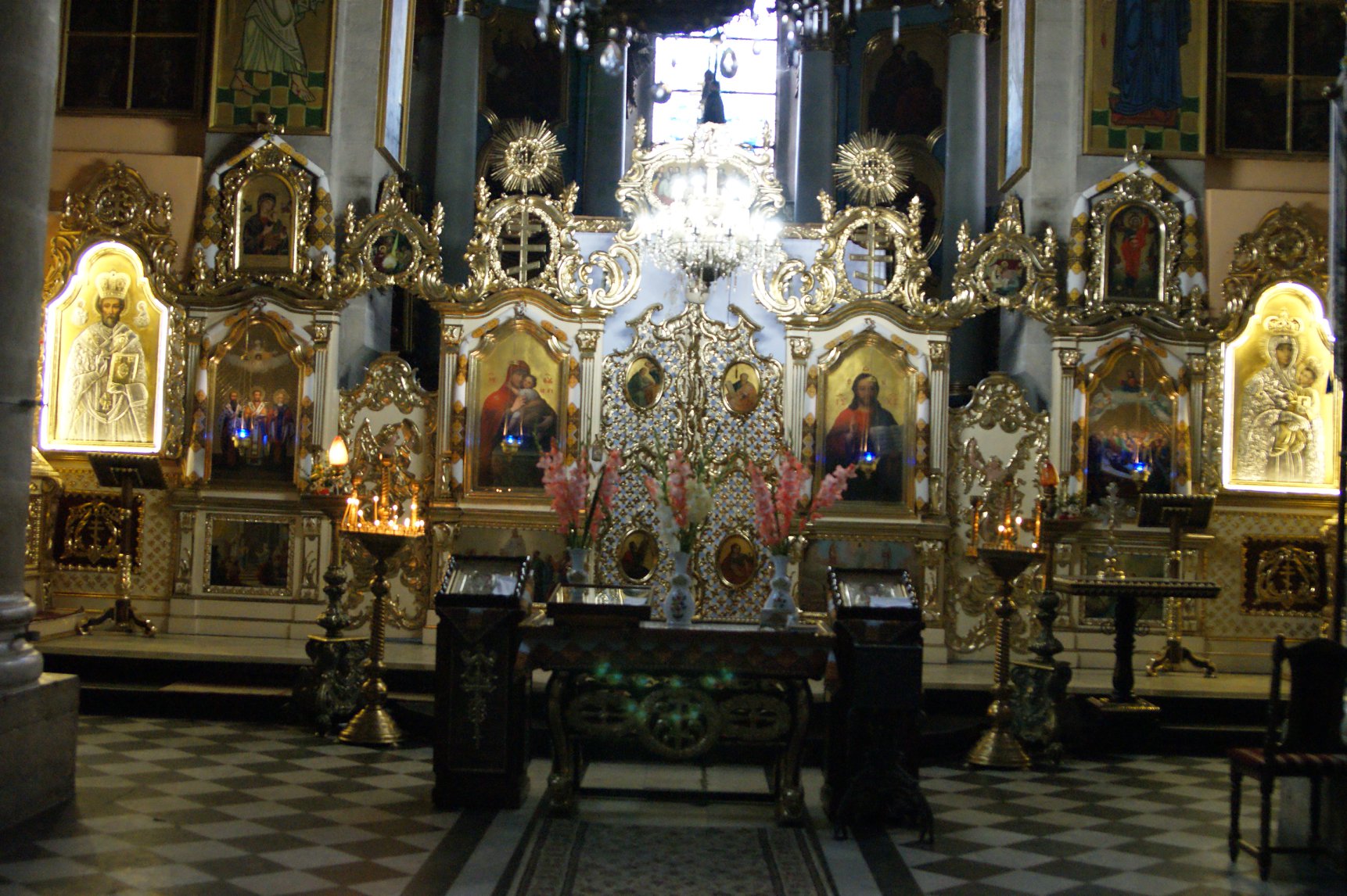
The church has preserved art monuments of the XVII-XVIII centuries. The most valuable of them are the icons of the Passion cycle, which remained from the original Assumption iconostasis of 1630-1638, made by Lviv artists Fedir Senkovych, 1630 (burned down) and Mykola Petrakhnovych-Morakhovskyi, 1638 (now in the church of Velyki Hrybovychi near Lviv), which was replaced in the 19th century by the iconostasis of Martyn Yablonskyi.
Of the 20 icons mounted in the diptych, three belong to the brush of F. Senkovych ("Entrance to Jerusalem," "Descent into Hell," and "Resurrection of Lazarus"), fourteen to M. Petrachnovych, and the rest date from the second half of the 18th century. The iconostasis itself is located in the village of Velyki Hrybovychi near Lviv, where it was sold in 1767.
In 1779 the church was damaged by fire. It was rebuilt in 1796, with changes to the roof and central dome. 1926-1927 - the church was decorated with highly artistic stained-glass windows by Petro Kholodnyi the Elder.
In 1965-1973, repair and restoration works were carried out.
The Church of the Assumption is a three-nave basilica extended along Ruska Street with a semicircular apse protruding towards Pidvalna Street. The church is crowned with three domes with lanterns; the central dome rests on sprung arches supported by four Tuscan columns. In this planning and volumetric structure, one can see the fusion of Western Renaissance and Ukrainian building traditions. The former is manifested in the basilica plan and architectural decor, and the latter in the traditional dome finials. The exterior walls are divided into symmetrical planes by Tuscan pilasters in accordance with the interior layout, in which window openings are cut (with 4 windows along the length and 8 in the so-called lantern window, decorated with rosettes; under it are the coats of arms of the Moldovan voivode Myron Bernavsky-Mohyla, Tsar Fyodor Ivanovich (the church's citor), and King Sigismund III Vasa) with archivolts. The façade is completed with an elaborate entablature, which includes a Doric frieze with metopes, triglyphs, and rosettes. In the fields of the metopes are relief compositions carved in stone on biblical and gospel themes.
In the interior of the church, which consists of three spatial volumes - the narthex, the main nave, and the altar part - the main aesthetic role is played by the material: white hewn stone with laconic architectural plasticity of columns, arches, and pilasters. The central dome, based on a Doric frieze, is decorated with caissons with rosettes. Its sails contain the coats of arms of the donors who provided funds for the construction of the church, carved in stone. The other two domes, in the narthex and the altar area, are based on a Doric frieze with metopes and triglyphs. The walls, as well as the exterior, are divided by pilasters, and the architectural solution of the interior is enriched by two flights of stairs leading to the side galleries at the north and south walls. Light enters the church through tall windows decorated with stained-glass windows by Petro Kholodnyi, a Lviv artist of the first third of the 20th century. There are examples of easel painting from the seventeenth century on the walls.
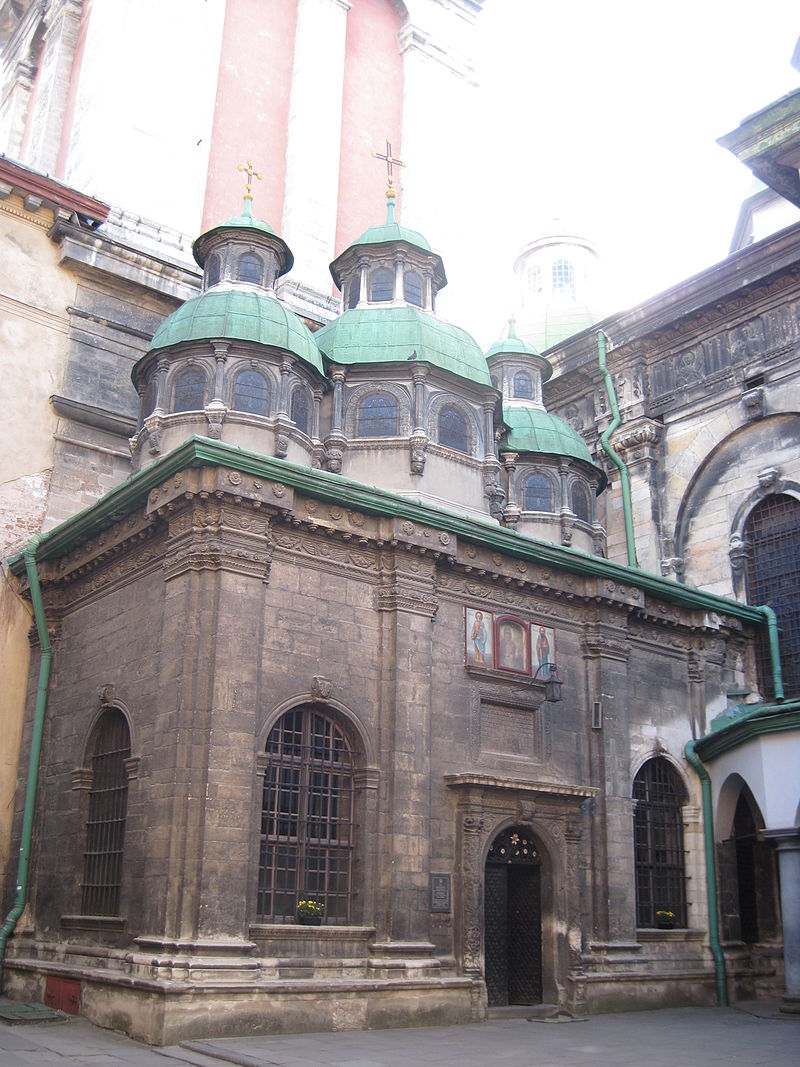
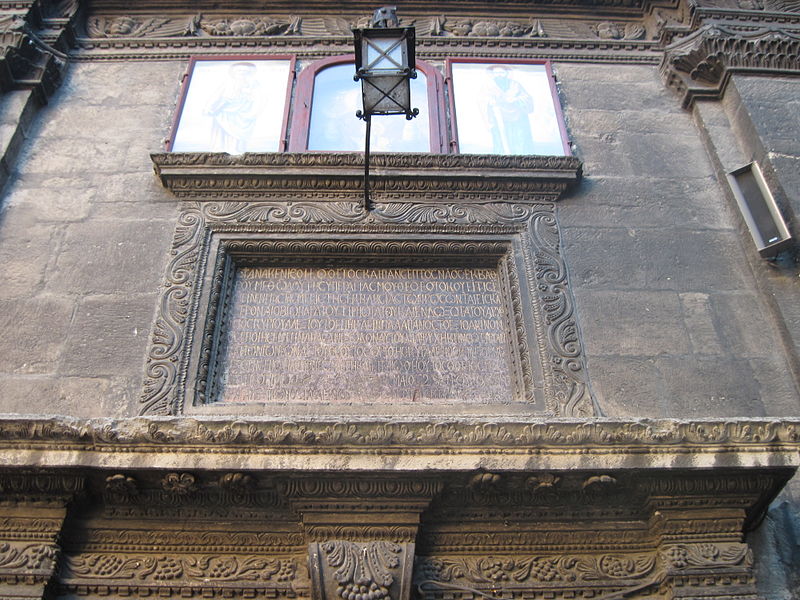
Later, the Chapel of the Three Saints was built (1590, dedicated in 1591) (named after a church destroyed during the devastation of Lviv in 1340). It was renovated in 1671 at the expense of the Greek Alexei (Alexander) Balaban. It is of a simple design: a rectangle with three domes crowned with lanterns. The portal, decorated with a relief ornament of vines, is one of the architectural masterpieces of Lviv. The chapel was built by Petro Krasovsky.
Hetman Ivan Pidkova, ruler of Moldavia, church benefactors, and honored brothers were buried in the crypt of the church; in particular, the founder Korniakt Konstantyn, three Moldavian princesses from the Ternavski-Mohyla family, Lviv burgher Varvara Lyangyshivna (?-1635), a burgher of Greek origin, and a member of the Stavropigian Brotherhood, Papara. The graves were covered with stones with inscriptions (not preserved).
The brotherhood at the Assumption Church appeared in the fifteenth century, and from the 1530s it developed more activities. In 1586, it received confirmation of a new charter from Patriarch Joachim V of Antioch and the title (status) of Stavropegia.
The brotherhood was open to representatives of any social class, burghers and bourgeois women, and prominent people from outside Lviv, including Cossack hetmans Ruzhynsky, Ivan Vyhovsky, Pavlo "Teteria" Moshkovsky, and others. The entrance fee (in the old days, "vpisove") was 6 grosz, and the annual fee was also 6 grosz. In addition, voluntary donations were made for the brotherhood's activities, and larger entries (legates) were made in wills. In 1586, there were 14 members of the brotherhood, and then 50. In addition to Ukrainians, there were Greeks, in particular, Kostiantyn Korniakt, representatives of the Papar and Lianhysh families.
Today, the church has a center of the Brotherhood of St. Andrew the First-Called, which is patronized by the Ukrainian Orthodox Church. Andrew the First-Called, which patronizes the parish's Sunday school and takes care of the Assumption Church, organizing parish spiritual and cultural life, and tries to contribute to the renovation of the church.
On November 29, 1989, the Assumption Church was transferred to the jurisdiction of the UAOC by a decision of the community. Since 2008, the parish has had a Sunday school "Christian Hope", where classes are held in three groups, and since 2012, a children's choir. The parish choir "Oranta" is a visiting card of the UAOC in Lviv: since 2006, the choir has been actively involved in spiritual events in Lviv, and has visited Kharkiv (2006), Hadiach (2007), Syianok (Poland, 2008), the Ujkovice Monastery of Saints Cyril and Methodius (Poland, 2007, 2008), and Freiburg (Germany, 2008) with missionary activities. The church has a center of the Brotherhood of St. Andrew the First-Called, which is patronized by the Church. Andrew the First-Called, which patronizes the parish's Sunday school and takes care of the Church of the Assumption, organizing parish spiritual and cultural life, and tries to contribute to the renovation of the church.
TheAssumption Church in Lviv is located on the corner of Pidvalna and Ruska streets. There is a tram stop near the church called Ruska Street. Trams #2, 1, 9, 10 stop here (the last three go to the church from the train station). Alternatively, you can walk from Rynok Square.
Location on the map
Comments
Places to stay nearby
All stays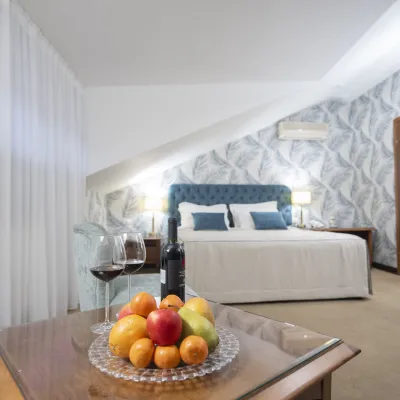 HotelHotel "Swiss" - Swiss Hotel LvivLvivunder 1 km from Church of the Assumption of the Blessed Virgin Mary, LvivSaunaSPABreakfastNearby: St. Andrew's Church 200 mTurkuliv-Comello Palace 900 m
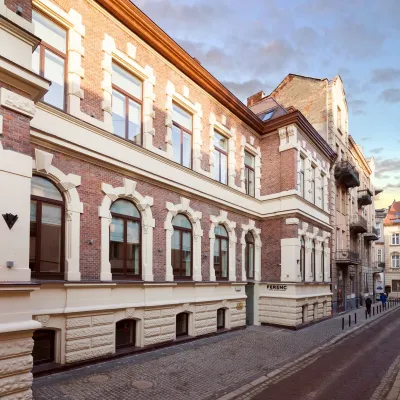 HotelHotel-Restaurant "Ferenc" LvivLvivunder 1 km from Church of the Assumption of the Blessed Virgin Mary, LvivSaunaKitchenWi‑FiNearby: St. Andrew's Church 500 mTurkuliv-Comello Palace 1.3 km
Nearby attractions
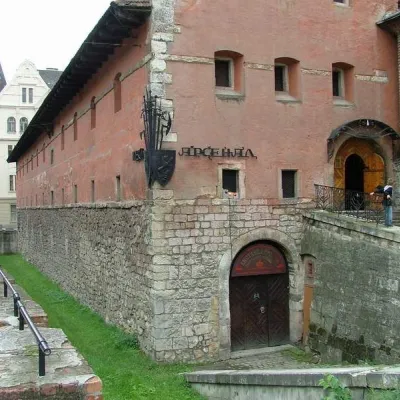 MuseumArsenal Arms Museum, LvivLvivunder 1 km from Church of the Assumption of the Blessed Virgin Mary, LvivThe Arsenal Historical Arms Museum is located on one of Lviv's central streets. It first opened its doors to visitors on May 18, 1981.
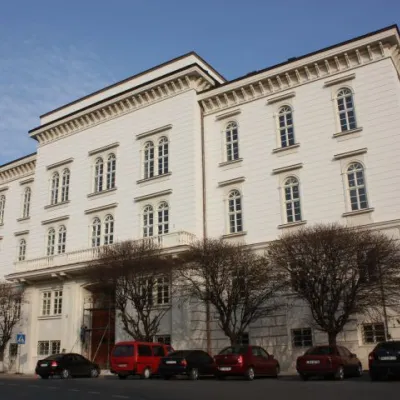 SightPalace of Latin ArchbishopsLvivunder 1 km from Church of the Assumption of the Blessed Virgin Mary, LvivThe site for the construction of the archbishops' palace was donated by the ruler of the Kingdom of Rus, Prince Władysław Opolczyk, in 1375 to Latin Bishop Matthew of...
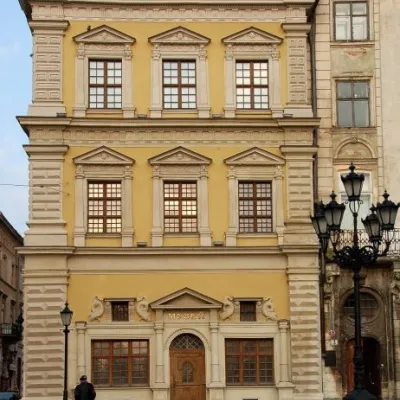 SightBandinelli PalaceLvivunder 1 km from Church of the Assumption of the Blessed Virgin Mary, LvivAn Italian merchant Roberto Bandinelli, who received Lviv citizenship, bought the house and started a classic European-style post office.