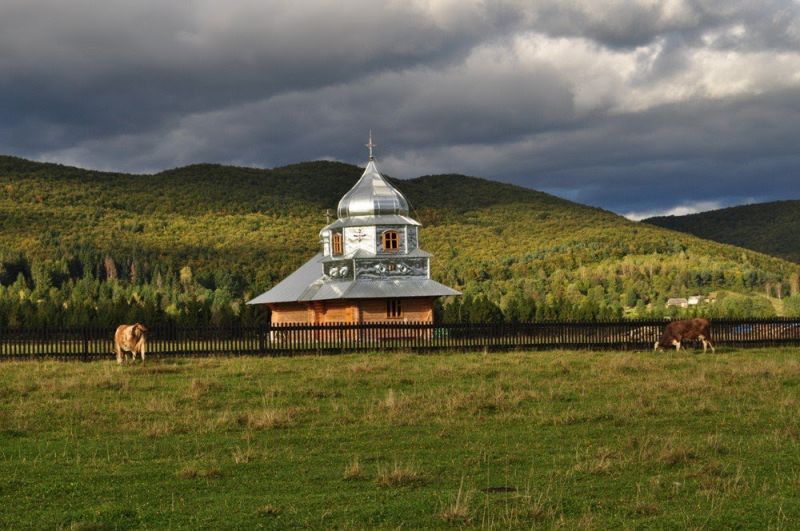
Church of the Ascension, Lucca
According to the surviving written documents, the mountain village of Liucha has been known since 1438. Perhaps its most important attraction is the Ascension Church and the bell tower, built in 1848. This shrine is considered the best example of Hutsul wooden folk architecture.
The story of the appearance of this church in the village is interesting. It became a reality thanks to the ingenuity and ingenuity of the locals and even formed the basis of several Hutsul fairy tales. The peasants asked for permission to build it immediately after the end of the uprising against the Polish gentry. But they did not get it. Soon, however, a lively and clever girl Olena managed to do so, persuading the owner to sign the permit. The main condition was that the construction would begin only 25 years after the signing. He thought that the villagers would simply lose the document and forget about it. But, to his surprise, after the deadline, the people showed him the paper. He agreed, but allowed the church to be built only on the outskirts in the hope that the construction would be delayed for many years. But the money had long been collected, and a year later the building was ready.
The cross-shaped church has one dome. It is built of wood. A rectangular low building adjoins the eastern part of the structure. The center of the temple is covered by a dome in the form of a tent on a small octagon, which rises half its height above the pitched roofs of the branches, crowned with tops. The choirs, which have an original design of side niches, are supported by two pillars. The walls of the church are decorated with oil paintings of the 19th century. The one-tiered bell tower is made of brick and stands on a high plinth.
It is known that in the second half of the XVII century there was already a church in the village. The next wooden church appeared in the early eighteenth century. In its place, a new wooden church was built in 1811. However, it did not last long, because in 1844 it was replaced by the church that exists today, which was dedicated two years later.
The current shape was given to the church after the rebuilding of the Babynets in the mid-1930s. Today, the architectural monument of national importance is used by the UGCC community. The church can be seen in the central part of the village, not far south of the main road, in the cemetery. The church is a large but low-rise one-story shrine, in which the western part of the building undoubtedly stands out sharply.
An equally wide sacristy is attached to the east of the altar. Its walls, like those of the church's narthex, were made of exposed log beams. The silhouette of the church is emphasized by six cupolas with old crosses. A masonry wall-type bell tower stands to the northwest of the church. In 1997 the bell tower was moved 10 meters away from the church walls. Father Myroslav Cherniavskyi (1945-1998) and Father Mykhailo Kitsyliuk (1949-2004) are buried in the cemetery.
Liucha is a modern Hutsul village that has preserved the spirit of ancient traditions and is doing its best to keep this flame alive. The main direction of further development of the village is tourism. Bison, deer, elk, roe deer, wild boars, several species of birds, trout, and crayfish are bred here. Natural attractions include the Huk waterfall, the Stone, and the arboretum near the forestry.
Accommodation around Church of the Ascension, Lucca:


Nearby hiking trails near Church of the Ascension, Lucca:
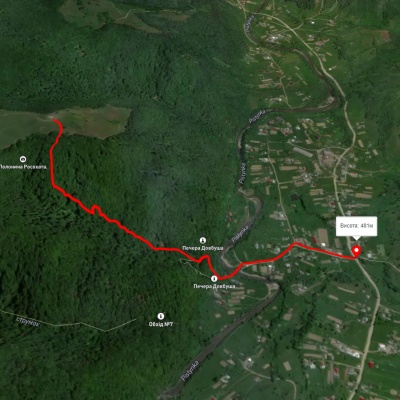
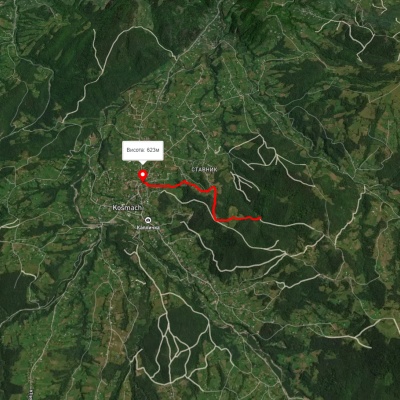
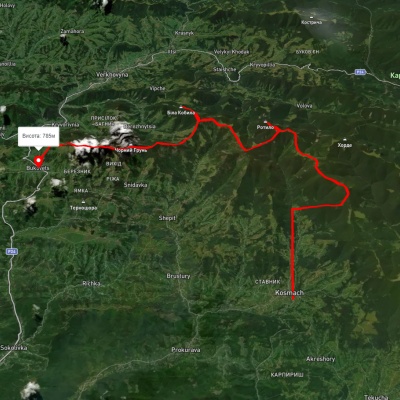
Which trails pass by Church of the Ascension, Lucca?
We suggest these hiking trails through or near Church of the Ascension, Lucca: Sheshory – Rosokhata, Opryshky Road, Kosmach village, via Mount Rotylo, Mount Hrehit and Mount Bila Kobyla to Bukovets village, Mykulychyn village, via Mount Khorde and Mount Rotylo to Kosmach village, Medvezhyi tract – Mount Kuratul, Verkhovyna, via Mount Bila Kobyla, Mount Makovytsia and Dovbush Rocks to Yaremche