Capuchin monastery, Olesko
The former Capuchin monastery is a late Baroque and Rococo architectural monument in the town of Olesko (now Lviv region, Zolochiv district). The fate of the monastery is closely linked to the history of the castle in Olesko, which in the late seventeenth century increasingly lost its fortification and defense function and was turned into a palace building by its owners.
Since 1716, the castle has been owned by the son of King Jan III, Jakub Ludwik. In 1719, he sold the building to Stanisław Mateusz Zewuski. His son, the Volyn voivode Severin Józef Zewuski, turned the castle into a luxurious residence. S. J. Zewuski also founded a Capuchin monastery in Olesko in the second third of the eighteenth century.
New times and new fashions also influenced the tastes of the Capuchin monastery's leaders. Even the monks preferred the beauty of the premises and the environment. The construction of the church and monastery was supervised by a Podillia architect, Father Andrzej z Szydłowiec (also known as Martin Dobrawski). The project included a church, a cell building, and a Baroque garden with ponds.
The Capuchin monastery and St. Anthony's Church were built in 1737-1739 by the Baroque architect from Podillia, Martin Dobrawski, and are located opposite the Olesko Castle. The architect of the monastery later became a monk in this monastery, which is noted for its ascetic decoration and restraint of the Baroque style.
No expense was spared in the construction of the monastery, so it turned out to be the best of all the monasteries of the Capuchin order in Poland at that time in terms of its beauty and decoration. The church was decorated with beautiful, massive sculptural compositions, both outside and inside the church, and a significant number of valuable books on theological, philosophical, and medical topics were brought to the library. Two fish ponds were also created on the territory of the monastery, and there was a third pond, but outside the monastery.
To perpetuate the memory of the founders of the monastery, Severin Joseph and Antonina of Potocki Zhevuski, they named their center the "Convention of St. Joseph and St. Antonina" and founded a theological school for young people at the monastery.
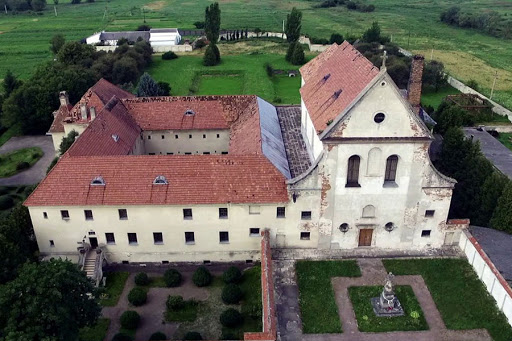
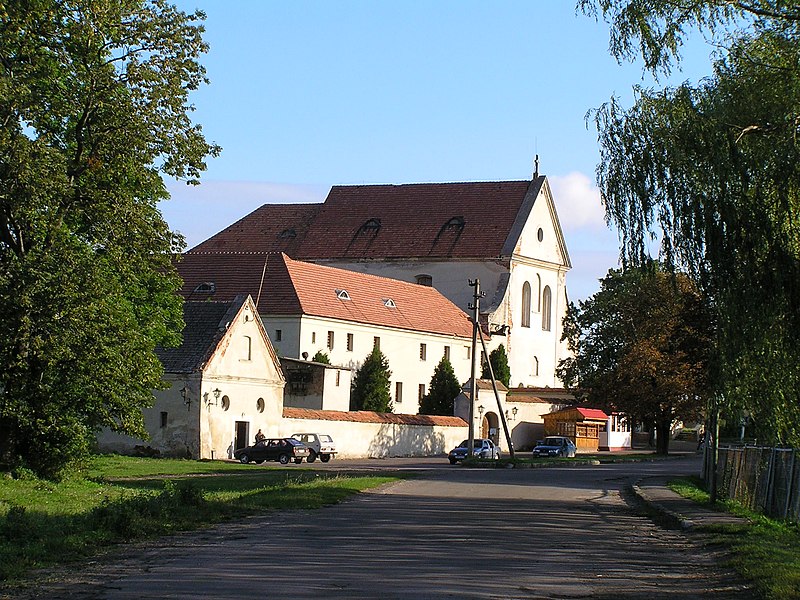
The monastery complex is oriented along the east-west axis. The main entrance to the church is oriented to the west. The complex is surrounded by a stone wall up to three meters high with a gate without corner towers. The austere facade of the church under a triangular pediment reminds us that it is not a palace but a monastery. That's why the facade's decorations are simple and ascetic, with flat pilasters and niches. Only the large size of the building makes the church the main part of the complex. Behind the altar is the chapter house, a place where the monks meet. A quadrangular cell building with a courtyard adjoins the church from the south. Further on, there was a refectory and a kitchen with its own well.
An almost three-meter high wall encloses the courtyard in front of and behind the church. The restrained, late Baroque style here forgot about restraint and decorated the courtyard with five chapels, statues of saints and a Baroque garden, parterres with medicinal plants, two Baroque water pools, a vegetable garden and an orchard. The plants were cut in shapes reminiscent of castle parks somewhere in the Czech Republic or Austria. The cell building is two-story, brick, and plastered. The building is rectangular in ground plan, with a corridor system with one-sided cell arrangement. The ground floor rooms are covered with cross vaults. The kitchen has a separate building and is connected to the cell building.
The Capuchin monastery was built according to the established scheme in the classical Baroque style. The project of the monastery included a church, a cell building, and a baroque garden with ponds. The complex occupies a huge area of 140x240 meters, surrounded by a stone wall, with a park occupying most of the territory. The park, in contrast to the harsh buildings, was beautiful and lush, with 5 chapels and figures of saints in the courtyard. The monastery complex includes cells located on two floors, as well as a courtyard with a well, a capitol (a meeting place for monks located behind the church altar), a kitchen, and a refectory. The plan of the monastery is a typical square building of cells with a corridor layout and cells on the outside, with the church attached to the right. The Bernardine monastery in Lviv, the Bernardine monastery in Zbarazh, the Reformed monastery in Rava-Ruska, and dozens of others in villages and towns of western Ukraine have a similar structure. An interesting element of the building is the kitchen with a giant oven, the size of a small room, which you can enter inside. The lower floor of the building is covered with cross vaults. The cell building measures 32x32 meters, and the courtyard is half that size. The roofs of the buildings are covered with a preserved authentic old roof.
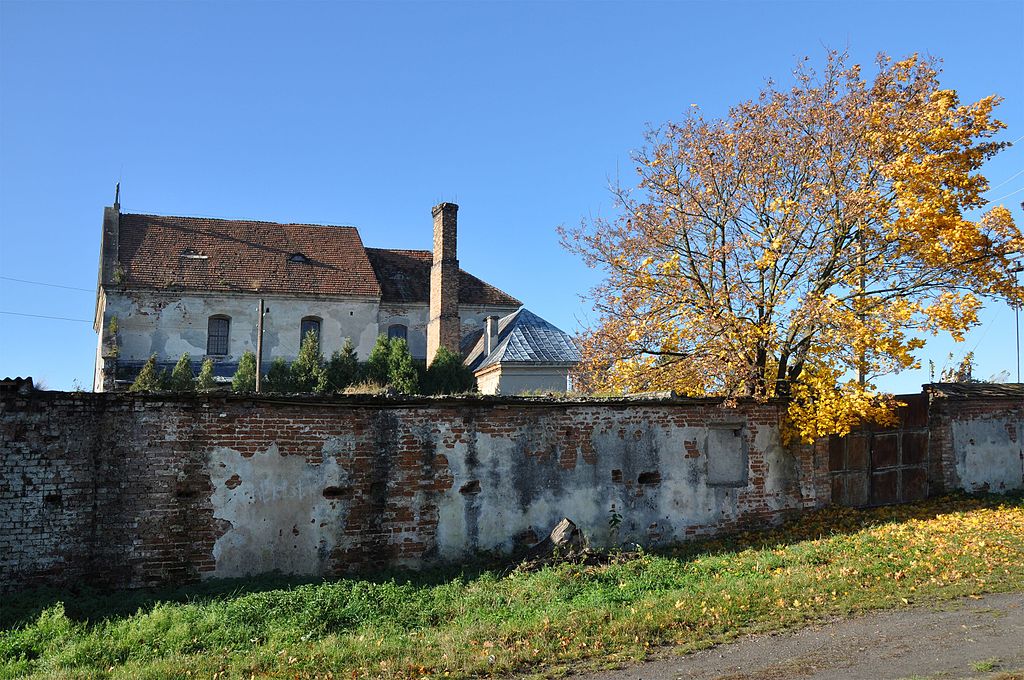
The courtyard of the Capuchin monastery is surrounded by a powerful, sometimes three-meter-high wall. Of course, unlike the castle, it was not a full-fledged fortress, but such protection from small detachments of Tatar light cavalry or from bands of robbers, of which there were many in those days, was quite appropriate. The walls surround the complex almost entirely, with only the church façade and the walls of the corner building facing outward. A small baroque gate is located in the center of the façade wall.
The compositional center of the monastery's square building is the Church of St. Anthony with a high triangular pediment, the facade and interior of which are decorated with wall paintings. The large church, measuring 34x14 meters in plan, is characterized by an extremely modest exterior decor. The façade is framed by two inconspicuous pilasters, and the most prominent feature is two large windows with semicircular ends, between which there is a niche for painting. In the lower tier there is an entrance portal with unpretentious carvings and a wooden door, and two semicircular windows on the sides (there is another one on the pediment above). The flanks of the façade are decorated with four rectangular windows, two on each side. There is another smaller niche for painting above the entrance, and the façade is crowned with a small stone cross. This Roman Catholic church housed works of painting and sculpture, and in front of its facade there are three figures of saints: St. Anthony on the left, St. Mary in the center, and St. Onufriy on the right, which were carved from stone by the famous sculptor Leblas. The figures are well preserved to this day.
On January 1, 1755, the owner of the castle, Severin Józef Zewuski, died in Olesko Castle. The body of the deceased was transferred to the chapel of the Capuchin monastery, where it lay until his burial in the crypt of the church, which took place on April 21, 1755. In 1763, the wife of Crown Hetman Wacław Żewuski, Anna Lubomirska, was buried next to him.
In 1765, the abbot of the monastery, Father Clemens from Krakow (née Franciszek Grigelski), who had served for a long time at the court of Polish King Stanisław Leszczynski in Lorraine, later was the abbot of the monastery in Kutkor, fell ill there and was transported to Olesko, where he led the Capuchin monastery until his death and was buried in the crypt of St. Anthony's Church. In the same year, 60 Capuchin fathers, representing the Capuchin Chapter of the order, arrived in Olesko and elected a Capuchin vicar, who administered the diocese under the auspices of the Chapter.
In 1768, Fr. Martyn Dobravskyi, who had once supervised the construction of the monastery and church, died and was buried in the cemetery of the former monastery.
Around 1769, the then famous adventurer Marcin Polianowski, the son of the owner of a village in the vicinity of Kolomyia, died in the monastery.
In 1765, the Capuchins were ordered to leave Olesko. This event caused great devastation, the decline of the monastery and the church, which was converted into a grain store. The most valuable images from the monastery were sold, while others were stolen. The largest bell from the church bell tower was sold to Jews. The monastery was stripped of almost all its decorations and in 1785, by order of the Austrian government, was turned into a military hospital. Significant damage was done to the church's paintings, which were used for other purposes. The images of St. Lucretius, a Bernardine, and the image of the Resurrection of St. Peter, painted by the famous painter Shimon Chekhovich, were destroyed.
The library of the former monastery disappeared without a trace. There were two of them, a theological one and an apothecary's one on medicinal plants. Even the bodies of the dead were dug up and taken out of the church crypt. The bodies of the founder of the monastery, Severin Zhevusky, and the wife of his brother Wacław were reburied in the chapel of the Crucifixion of Jesus Christ of the Latin parish church.
Shortly after this event, the Emperor of the Archduchy of Austria, the Kingdom of Bohemia and Hungary, the Kingdom of Galicia, and Volodymeria, Joseph II, on his way to Brody, visited the monastery in Olesko and, learning that the monastery had been converted into an infirmary, ordered the infirmary to be moved to another location and the monastery and church to be returned to the Capuchins. On January 30, 1788, Capuchins from various monasteries began to arrive here. The Austrian government allocated an advance of 12,000 gold pieces for the restoration of the destroyed buildings. The first abbot of the newly restored monastery was Honorat Churilo.
In 1806, during a fire, the vault collapsed, one of the two chapels burned down, and the bell tower and the house of the Latin church's priest were damaged. The parishioners of the burned church joined the Capuchins, and the rector and vicar were given a separate apartment on the territory of the monastery.
In 1808, the rector of the Capuchin church, Fr. Yukhnovsky, moved to Lviv, where he was ordained a canon. The Capuchins maintained their parish until 1809, and in 1837 the Capuchin chapter left Olesko.
On January 23, 1838, in the evening, an earthquake struck Olesko. The monastery cracked during the tremors, and in some places even the massive church walls cracked.
In 1939, these territories were ceded to the USSR. On November 14, 1939, the Communist village council issued an order to evict the Capuchin monks. The monastery was looted, and the monks were resettled by the faithful. The Capuchin monastery stood empty for years.
During the Second World War, a concentration camp was set up on the monastery's territory. In 1944, during the retreat of the German invaders, the monastery was burned down, especially the roofs, although the stone vaults withstood the fire. All the wooden parts of the roof collapsed. The worst part was that the main altar of the monastery church burned down and the organ was lost.
After the war, a vocational school was opened to train specialists in agricultural machinery. A dormitory was built in the monastery and occupied in 1961. Initially, the dormitory for the vocational school was planned to be located in the half-destroyed Olesko castle. They even managed to carry out repair work in the castle. The dormitory was finally located in the premises of the former Capuchin monastery. The vacated premises of the former castle gave rise to the idea of its relatively complete restoration and the creation of a museum in it. The Soviets could not have liked this idea, so the restoration of the castle premises was hidden for a long time. It was as if they were preparing the premises for a local recreation center.
In 1970-1974, under the leadership of Borys Voznytskyi, the castle was restored as an architectural monument, and it was restored to the appearance of the period of its greatest prosperity-the late eighteenth century. In 1975, the Olesko Castle Museum-Reserve was opened and, as it turned out, storage facilities were needed for a large number of exhibits rescued by Voznytskyi and museum workers from abandoned churches and monasteries. Under the care of the then director of the Lviv Art Gallery B. Voznytskyi, the Lviv Regional Council decided to build a new dormitory for students of the vocational school, and the premises of the monastery complex were given to Olesko Castle for a fund storage.
In 1979, the Capuchin monastery became the property of the Lviv Art Gallery and is used as a storage facility for this cultural institution.
Today, the Capuchin monastery and church in Olesko, Busk district, is part of the Olesko Castle Museum and Reserve and is an architectural monument of national importance. The monastery is an outstanding and well-preserved late Baroque gem.
The roofs were hastily restored with unsuitable wood during the Soviet era. All of this created a new problem when, in early January 2020, during another storm, the unsuitable wood failed to withstand the load and about forty percent of the roof (which rested on the outer walls of the church) collapsed onto the vaults.