Capuchin Monastery (Church of St. Josaphat), Lviv
St. Josaphat's Church is a functioning Greek Catholic church in Lviv, at 134 Zamarstynivska Street. The former Church of St. Francis of Assisi of the Capuchin Fathers (RCC). The location of the relics (remains) of the blessed UGCC Mykola Charnetsky.
Toward the end of the nineteenth century, the first plans to restore the presence of the Capuchins in Lviv appeared. In the eighteenth century there was already a monastery of this order, which was abolished during the Josephine reforms. The idea of returning the Capuchins was supported by the Lviv suffragan Józef Weber and the abbess of the Franciscan convent Maria Morawska. There were proposals to transfer the church of St. Wojciech to the order and to build a monastery on Zelena Street. Archbishop Józef Bilczewski suggested that they settle near Lviv in the village of Zamarstyniv, which was eventually accepted. The council of the Zamarstynów gmina donated one and a half morgas of land on which a temporary wooden church was built. At that time Zamarstyniv belonged to the parish of St. Martin's Church. In 1912, a part of Zamarstyniv, as well as the villages of Holosko Velyke and Holosko Male, was separated into a separate exposition, which in 1921 received the status of a parish. In 1937, the territory of the Zboiszcze Commune was added, which had previously belonged to the Malechów parish.
On June 3, 1904, Guardian Rudolf Ficowski consecrated the cornerstone of the cell house, and on June 12 of the same year, the first definitor Bronisław Stepek consecrated the stone for the church. A one-nave wooden chapel was built according to the design of the builder Zygmunt Krykiewicz and consecrated in the name of St. Francis of Assisi. There were three altars in the chapel. Nearby was a modest six-axis adobe monastery house built in 1905.
Around 1909, plans were discussed to build a new church. The existing site was muddy, which could have resulted in a significant increase in construction costs. A suitable site was even found in Holosk Velykyi, but the purchase was never completed. In 1918, due to financial difficulties, the Capuchins considered ceasing their activities in this area and moving to the Kingdom of Poland. The first sketches of the church by architect Jan Karol Zubrzycki date back to 1921 (there is also a false version that the project was created in 1903). In 1924, a committee for the construction of the church was formed, headed by the president of the Zamarstynów Commune, Martin Wojnarowicz. The cornerstone was consecrated on July 19, 1925, when the foundation was already completed. The same year, the commune donated another plot of land. In 1927, the construction of the monastery building began, also designed by Zubrzycki, and the project was modified by the construction manager Francis Kwiecinski. In 1929, Kwiecinski died, and Stanisław Kondera was invited to take his place. On November 5, 1930, the church was consecrated by Archbishop Bolesław Twardowski. In 1932-1933, the parish house was built according to the design of Wawrzyniec Dajczak.
The construction of the wooden chapel was fully funded by the Capuchin province. Most of the church utensils were donated by the residents of Zamarstyniv. Many donations were made for the construction of the stone church, including from legal entities. The major donors were the Lviv magistrate, the Lviv Metropolitan Curia, the Galician Savings Bank, the Banking Union, the Zemstvo Credit Society, the Oikos company, the Tlen factory, the Nowość leather goods factory, and the yeast factory from Lysynych. Among private individuals, Roman Frank, the deputy director of the Krynytsia sanatorium, contributed the most.
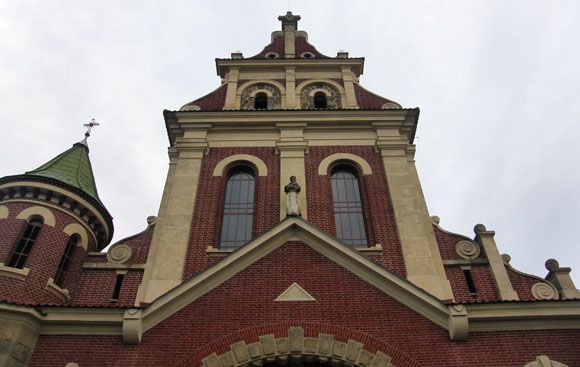
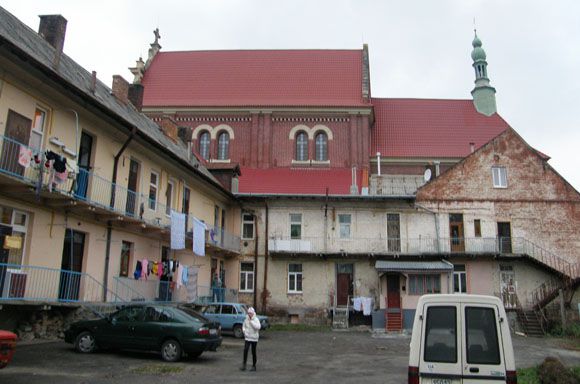
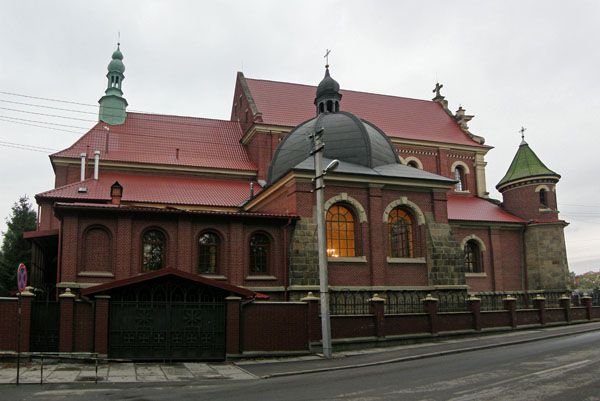
The monastery complex consists of a church, a monastery, and a parish house. It is located in the northern part of Lviv (Shevchenkivskyi district). The land plot is irregularly shaped, bounded on the north by the present-day Lincoln Street and on the south by Zamarstynivska Street. The church is oriented on the east-west axis with an entrance from the west (from Zamarstynivska Street). The monastery building is close to the letter P in plan and adjoins the church from the south. To the northeast of the church is a separate parish house. The church is made of brick and stone, plastered only from the inside. The monastery is brick and plastered. The parish house is brick, not plastered.
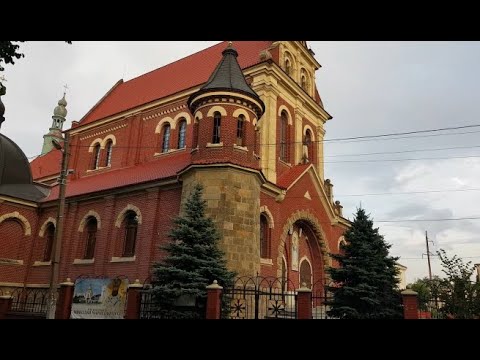
The church has three naves with an elongated presbytery. The central nave is much higher than the side naves, covered with two square vaulted aisles and one short aisle under which the choirs are arranged. Each of the two side aisles is covered with five vaults. The presbytery is lower than the main nave and somewhat narrower, rectangular in plan. The former chapel of St. Anthony, square in plan, is adjacent to the northern side nave. An octagonal low tower with a spiral staircase leading to the choirs adjoins the northwestern corner of the façade.
The space of the church is divided into naves by two rows of columns and foliations. The fillets correspond to the division of the main nave into strands. The side aisles have two shorter shafts, which correspond to the piers and filiars in turn.
The author of the project, architect Jan Karol Zubrzycki, was also a teacher and art historian. While designing countless churches in Poland, he actively promoted his own concept of the so-called "Zygmunt style," which consisted of the use of Renaissance, Mannerist, and Baroque forms with certain elements of medieval (Gothic and Romanesque) architecture.
The church in Zamarstynów largely corresponds to the ideas of Zubrycki's last phase of his work. In the late 1920s, such "historicizing" forms were perceived as archaic. Perhaps this gave rise to the widespread belief in the literature that the project was completed much earlier, in 1904. This seeming archaic nature did not bother Zubrzycki, who consistently embodied the ideas of what he considered to be authentic Polish architecture. It is noteworthy that at the same time a parish house was built in the style of functionalism, which was fully in line with the trends in architecture of the time. Probably on this basis, a conflict even arose between the architect and the monks, who tried to interfere with the details of the project (they managed to change a lot of things). The conflict was probably also caused by disagreements with the construction manager Kwiecinski and the monks' reluctance to pay fees to the architect. Perhaps because of this, the altar designed by Zubrzycki was not accepted for realization.
In 1927, Jan Karol Zubrzycki designed the main altar, which was not realized. Instead, the master Jan Wojtowicz created another single-tiered neo-Baroque altar made of dark wood. There were three bells in the church, named "Alexander" (the largest), "St. Czesław" (the middle one), and "St. Józef" (the smallest), cast by the Lviv company of Rudolf Matejszewski in the spring of 1930.
Some of the church's frescoes have not survived, having been destroyed in Soviet times. In 1990, the church was transferred to the Ukrainian Greek Catholic Church and consecrated in the name of St. Josaphat. Today, the church is run by monks of the Redemptorist Order. The interior has been adjusted to the needs of the Eastern rite, and new paintings have been made. The church was renovated, during which the chancel was rebuilt and a one-story antechamber was added. The former monastery was turned into a residential building. The main entrance on the western façade was turned into a window. The former parish house is well preserved and has never been plastered. In 2011, its reconstruction began.
After he was proclaimed blessed, the remains of UGCC Bishop M. Charnetsky were moved to the church from the Lychakiv Cemetery.
The Church of Jehoshaphat is located on the corner of Zamarstynivska and Lincoln streets. You can get here from the center on foot or by bus #26.