Boim Chapel, Lviv
TheBoim Chapel is a monument of sacred architecture in Lviv at 1 Kathedralna Square. It is one of the best monuments of the late Renaissance in Lviv. The Boim Chapel is located in the center of Lviv. It is well recognized by the statue of the grieving Jesus, who is watching the city bustle.
The chapel was built in 1609-1615 (according to other sources, 1606-1615) over the family tomb of the Boim family of Lviv patricians of Hungarian origin. The chapel was built on the territory of the city cemetery of the time, near the Latin Cathedral. The tomb for the family was commissioned and started by Heorhii Boim, and completed by his son Pavlo Boim. Archival materials indicate that Heorhii Boim was a Protestant, and when he moved to Lviv, he converted to Catholicism. A total of 14 people from the Boim dynasty are buried in the chapel.
It is not known why the Hungarian-born merchant Heorhii Boim decided to decorate his family tomb in this way. The Boim Chapel in Lviv has not been researched much, and you will hear more legends about it than truth. "Passerby, stop and think whether your suffering is greater than mine," are the words inscribed at the foot of the statue of the sorrowful Jesus in the Boim Chapel.
The names of the chapel's creators are not known for certain. According to the most reasonable version, its builder was Andreas Bemer, an architect from Wroclaw who at that time built the town hall and decorated the neighboring Campianów Chapel. The prototype of the Boim Chapel is probably the Zygmuntowska (Sigismund's) tomb in Wawel Castle in Krakow.
The chapel was built in the Dutch Mannerist style. The author is unknown, but it is assumed that it was built by the Wroclaw architect Andreas Bemer, who decorated the neighboring Campian Chapel. The interior of the chapel is no less interesting and mysterious: The crucifixion of Jesus and the Last Supper are not depicted in the center of the chapel. Probably, when they created the interior composition, they put a deep meaning into it. But scholars will have to solve this mystery later.
Now the Boim chapel looks gray and gloomy. However, scientists have proven that the building was covered with four layers of paint. All the sculptures on the facade were colored.
In the second half of the eighteenth century, the burials from the Boim chapel were moved to Lviv cemeteries, and the keys to the chapel, according to Heorhii Boim's will, were transferred to the cathedral (Latin Cathedral). A parastas for the deceased chairman of the Ridna Shkola society, Anton Hladyshovsky, was held in the chapel.
Itis not known where the Boims were reburied: either at the Lychakiv Cemetery or at the Stryi Cemetery. If they were reburied at the latter, then this cemetery was destroyed, and some of the tombstones were moved to the Lychakiv Cemetery. The rest of the sculptures were crushed and sprinkled with stones on the city's walkways.
In 1945, the Soviet government closed the chapel to visitors. However, in 1969 the sacred building became a separate department of the Lviv Art Gallery and was reopened to the public.
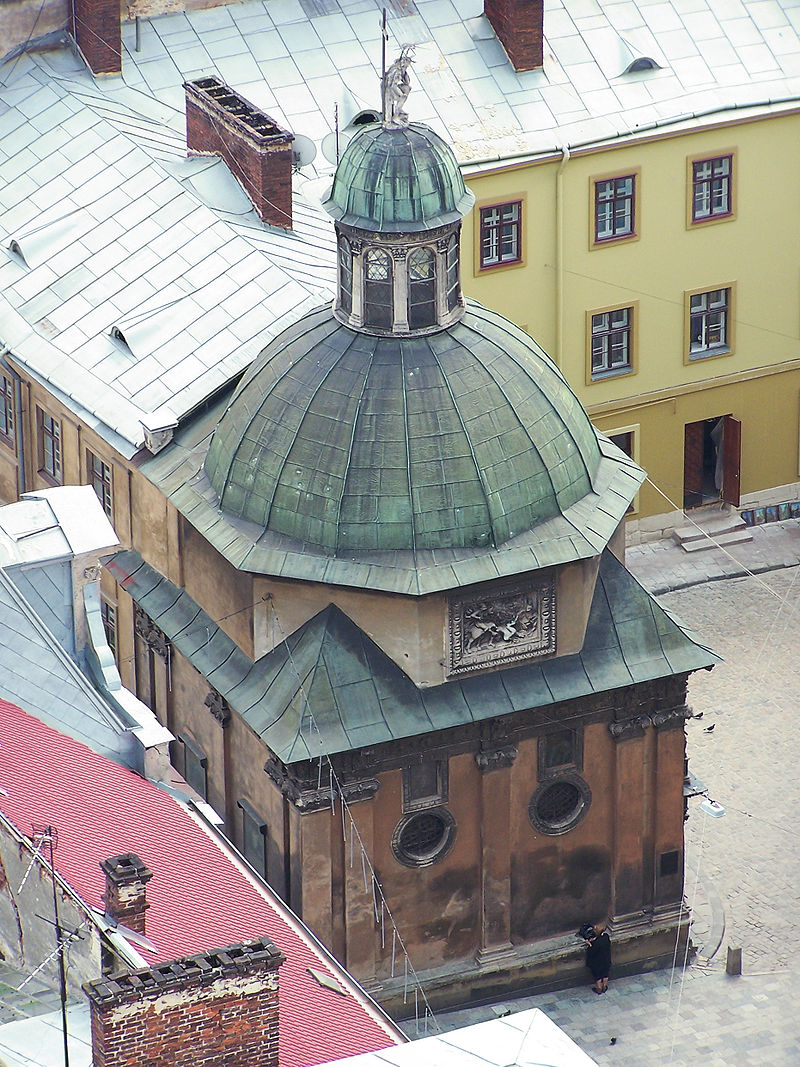
Externally, the chapel's architectural and volumetric composition resembles seventeenth-century Carpathian churches. Square in plan, the building is crowned with an octagonal dome with an octagonal skylight. The upper dome is crowned with a cross with the figure of Jesus.
The architectural style of the chapel is defined as a mature Renaissance with a transition to Baroque. It is also characterized as the most characteristic example of northern Mannerism in Ukraine. The architectural volume has a central composition characteristic of the Renaissance, a breakdown of the exterior walls with pilasters of the Ionic order, and a developed cornice. In a note about the chapel in the Encyclopedia of Ukrainian Studies, it was stated that the facade carvings were "composed on the principle of the Ukrainian iconostasis."
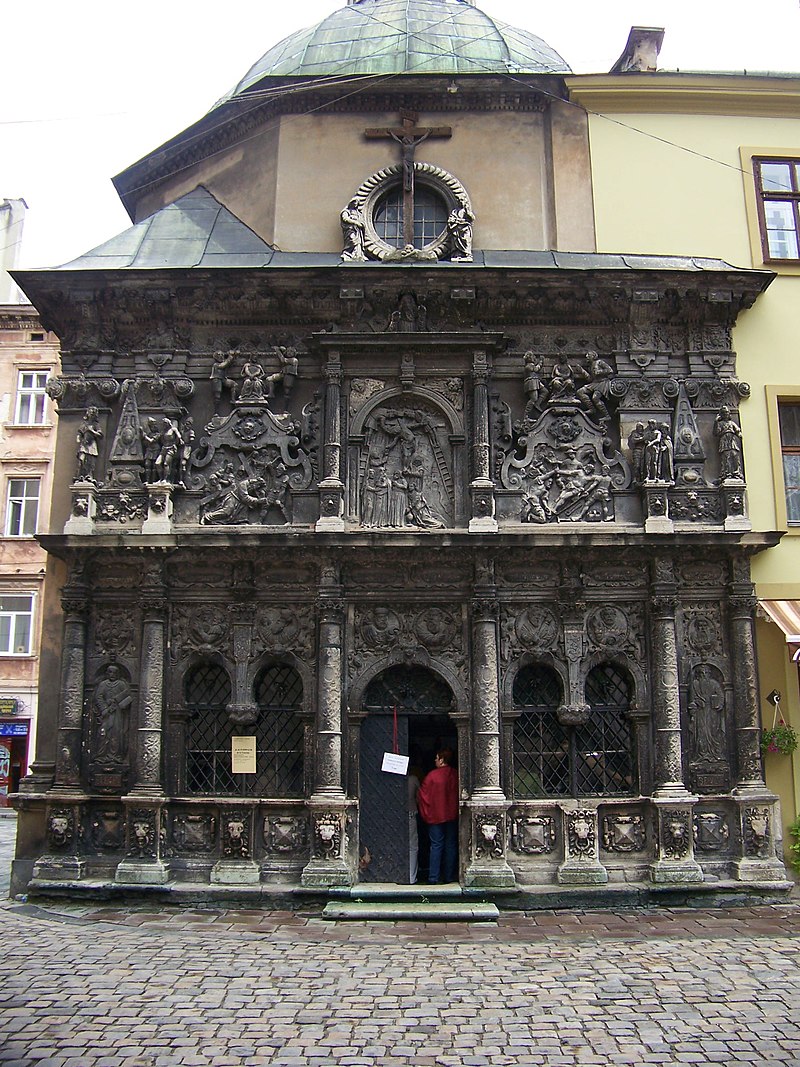
The walls of the chapel are oriented strictly to the cardinal points. The southern one is closed by a residential building that was built close to the chapel in the nineteenth century. The main, western façade of the chapel is the most richly decorated. The sculptural decoration of the western façade is known to have been created during the second stage of the chapel's construction in 1611-1615. It is believed to have been created by Hanusz Scholz, a Wroclaw-based craftsman. Over the past two centuries, art historians have repeatedly complained about the low artistic level of this sculptural decoration. Unlike the eastern and northern facades, the western one is divided by six vertical columns and two horizontal cornices. The decorative reliefs of the western façade are arranged in three tiers.
In the second tier, the cartouches above the sculpted images of the prophets contain quotes from the Bible in Latin (on the façade from left to right):
- "Morte turpissima condemnemus/ eum sapi I" ("Let us condemn him to a shameful death" (Book of Wisdom 2.20) - above St. Peter;
- "Foderunt manus meos et pedes meos/ DA Psal. XXI" ("They pierced my hands and my feet" (Psal. 22 (21). 17);
- "Corpus meum dedi percucientibus et genas vellentibus/ Esai. L" ("I have set my back to those who strike, and my cheeks to those who pinch" (Isaiah 50.6);
- "Mittamus lignum in panem eius. Et eradamus eum de terra viventium / Ier: XI" ("Let us cut down this tree with its fruit, and from the land of the living its howl" (Jeremiah 11.19);
- "Et post hebdomadas LXII occidetur Christus /DAN. IX" ("And after 62 weeks the Messiah will be destroyed" (Daniel 9.26);
- "Et appenderunt mercedem meam XXX argenteos /Zach XI" ("And they weighed my wages - thirty pieces of silver" (Zechariah 11.12) - over the entrance;
- In Virga percutien[t] maxillam ivdicis / Mich. V. ("The judge is struck on the cheek with a cane" (Micah 4.14)) - above the entrance;
- "Et dicent non est Rex Noster /Ose X" ("And they will say: we have no King" (Hosea 10.3) - over St. Paul.
The third tier is the most saturated with relief images. It consists of compositions on the theme of the Passion of Christ: "Scourging", "Carrying the Cross", "Crucifixion", "Removal from the Cross". Due to the expressiveness of the plastic, these compositions and the interior are called the "Bible for the poor" because one does not need to know how to read and write to understand the essence.
It faces Halytska street, is divided by five pilasters, and is decorated with two fresco portraits of Heorhiy Boim himself and his wife Jadwiga "de Nisniovs". The portraits were created in 1617 and are attributed to Giovanni Giani. Under the portrait of the chapel's founder is an inscription in Latin: "George Boim. Lviv rajist, founder of this chapel. Year: 1617". And under the portrait of his wife, the inscription reads: "Jadwiga of Nisniovs Boim" (Latin: Hedvygis de Nisniovs Boim).
It is also divided by pilasters. It has two frescoes: Our Lady and Jesus Christ. Above, on one side of the octagonal drum, is one of the most beautiful Lviv reliefs, St. George the Serpent-Slayer. In general, the image of St. George (the patron saint of Heorhii Boim) appears at least three times in the chapel's decorative design. It is believed that the author of the frescoes and bas-relief, as well as the sculptural images above the pilaster capitals, is Andreas Bemer.
Another unusual feature of the chapel's appearance is the figure of Christ on the dome. This is a rare image in Christian iconography of Christ the Sorrowful (Polish: Chrystus frasobliwy, English: Pensive Christ). The unusual thing about this version of the sculpture is that, unlike all other images of a seated Christ, here Christ rests his cheek on his left hand, while in most known images he rests on his right. Below Christ, the dome is surrounded by the following inscription in Latin: "Look and see, all you who walk the road: is there any pain like my pain? Lamentations of Jeremiah 1.12".
It is compositional and stylistically related to its appearance. Thanks to the skill of the architects, the inside of the chapel looks much larger and taller than the outside. The altar wall, which merges with the bowl of the chapel dome, creates an atmosphere of exaltation. Most of the sculptural works in the interior of the chapel were made by Johann Pfister. He used materials from places near Lviv for the decoration. The lower tier of the altar, as well as the façade, is made of Polyana limestone (deposits near the village of Polyana). The upper tier of the altar and the under-dome reliefs were made using the stucco technique (a mixture of lime, gypsum, and ground alabaster or marble). Some sculptural compositions were created using black marble and white or gray alabaster, which was known at the time as "Rusyn marble."
Altar compositions are the center of the interior. They are located on the eastern interior wall of the chapel, opposite the entrance. The plane of the altar wall is divided by cornices into three tiers, densely filled with sculptural works. The most important compositions are located in the upper two tiers.
The lower tier is separated by a cornice that rests on the figures of the four prophets. Two doors cover the altar niches. On the outside of the left door is a depiction of Jesus Christ, and on the right door is the Virgin Mary. Various techniques were used in the decoration of the doors, including intarsia, wood carving, forging, and painting.
The main theme of the altar compositions is the Passion of Christ. The central composition is the Prayer for the Cup. In a small area, the authors managed to place all the participants in the events in the Garden of Gethsemane: Christ communicating with an angel, the sleeping apostles Peter, James, and John, and the guards led by Judas.
To the left of the Prayer for the Cup is the composition The Last Supper. In the lower right corner of the composition, under Judas's bench, the devil is grinning with a malicious smile. The right part of the middle tier is occupied by the composition "Washing of the Feet".
The middle tier of the altar is separated from the upper tier by a cornice. It rests on the figures of the four evangelists who fell asleep sitting down. The upper tier of the altar wall consists of somewhat smaller compositions: "Worship of the Lamb" and above it - "The Last Judgment." The "Adoration of the Lamb" is complemented by four female figures representing Justice (Latin: Justicia), Love (Latin: Charitas), Patience (Latin: Paciencia), and Faith (Latin: Fides).
On the south wall there are two more famous works by J. Pfister: epitaphs to the Boims and J. Bresler, the son-in-law of H. Boim. The epitaph of the Boims is made of black marble and white and gray alabaster. The most expressive part of the epitaph is the sculptural group "Pieta" (mourning). In the center of the group is Mary, holding the body of Christ in her arms, with Heorhii and Jadwiga Boim on their knees on the sides, and the Boim children and grandchildren in the upper two tiers.
Above the entrance door to the chapel are two examples of seventeenth-century fine art. These are portraits of Heorhii Boim and his son Pavlo. The name of the author of the portraits is not known for certain, although it is believed that it was Matej Domaracki (Domaracki Matvii). The portrait of Heorhii Boim is the first bourgeois portrait made in Lviv.
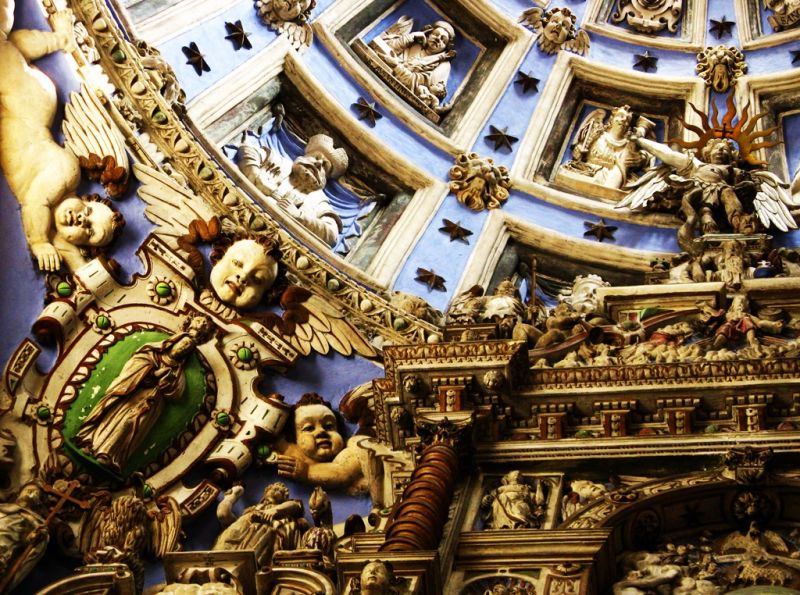
The inner bowl of the chapel's dome is one of the most important elements of the ensemble, which completes the integrity of the complex. The lower part of the dome has three rows of caissons, twelve in each row. In the third, highest row, in the recesses, five angels hold parts of a phrase in Latin from the Revelation of John the Theologian: "Sanctus sanctus sanctus Dominus Deus" ("Holy, holy, holy is the Lord God").
The size of the caissons decreases as they approach the top of the dome. This arrangement, the well-chosen blue color of the background, and the octagonal skylight create the impression of a much higher height of the chapel than it actually is.
Above the skylight is the upper part of the dome, decorated with eight bas-reliefs of angels. They are holding parchments with a quote from the Latin liturgy: "Gloria in excelsis Deo et pax hominibus bonae voluntatis" ("Glory to God in the highest and peace to men of good will"). At the very top of the dome is a somewhat stylized fresco image of the Holy Trinity.
Three round windows also illuminate the interior of the chapel. Two of them are located in the upper part of the northern wall and another one in the upper part of the under-dome vosmerik on the western façade. The four lower windows of the main façade provide additional lighting for the lower tier.
- The Boim chapel was also called the Ogrójców Chapel, from the Polish word ogrójec (garden). This is due to the fact that above the throne is a bas-relief depicting Christ in the Garden of Gethsemane.
- The Boim chapel is famous for its interesting energy: a museum worker told me that she once forgot a basket of apples in a corner of the chapel; more than a year and a half later, she unexpectedly stumbled upon it and discovered that the apples had not lost their juiciness and flavor at all during this time.
- The altar part of the chapel contains the "Last Supper," an interesting figure of Judas, who had already received silver pieces for betraying Christ and therefore the devil bared his green teeth from under his chair. It was because of this depiction of the devil that the then archbishop did not want to consecrate the chapel.
The Boim Chapel in Lviv is located at 1 Kathedral Square, near Rynok Square. The Latin Cathedral stands nearby. It is convenient to get to the center by tram #1.
Opening hours: from 10:00 to 17:00 (except Monday).