Armenian Cathedral, Lviv
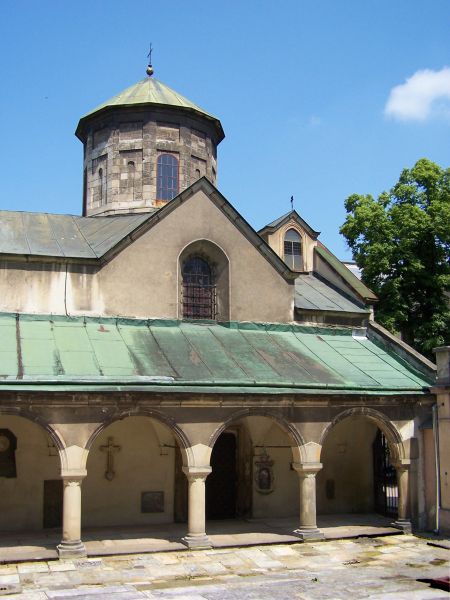
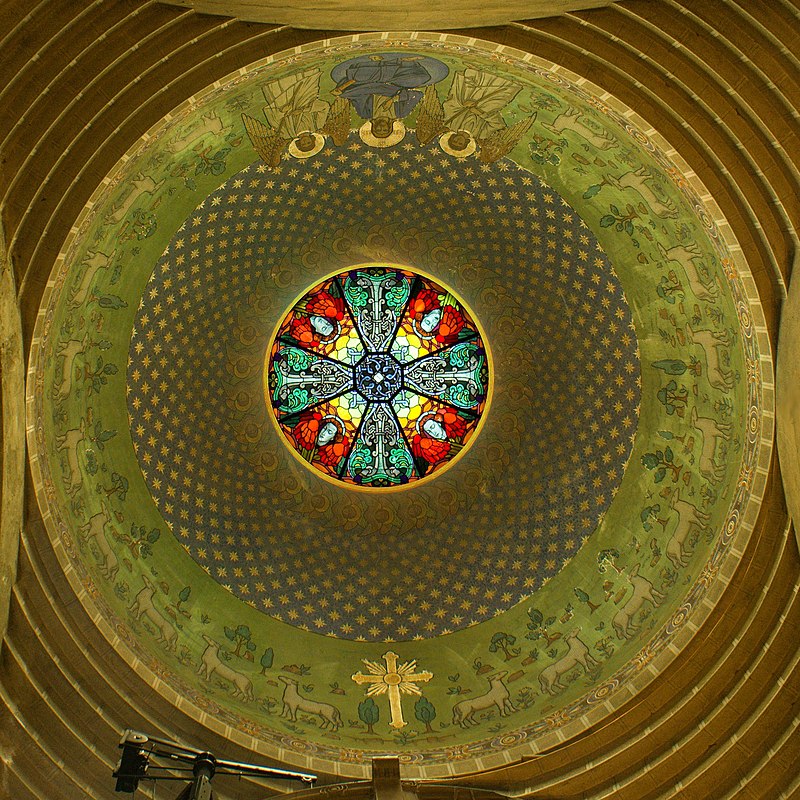
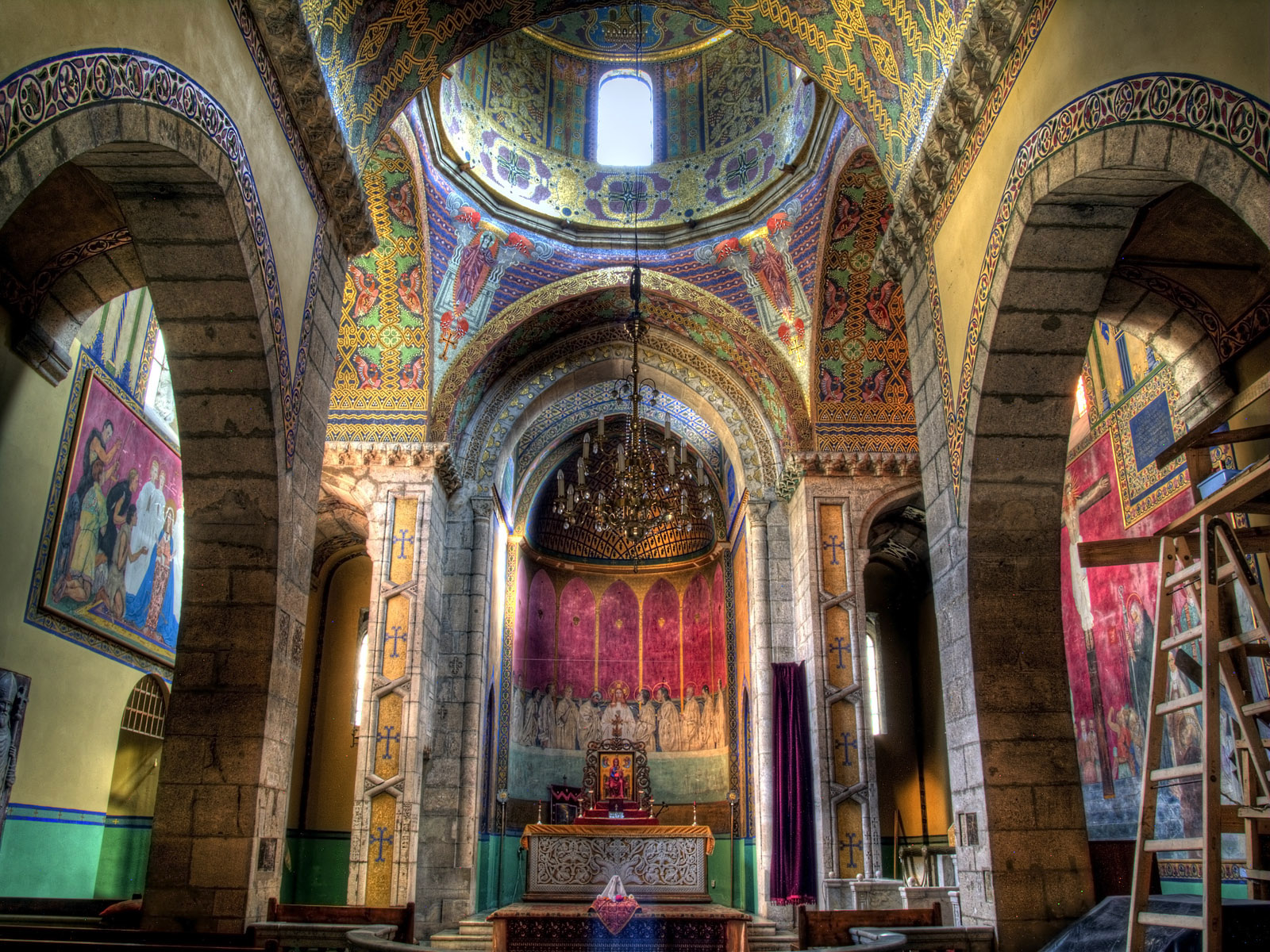
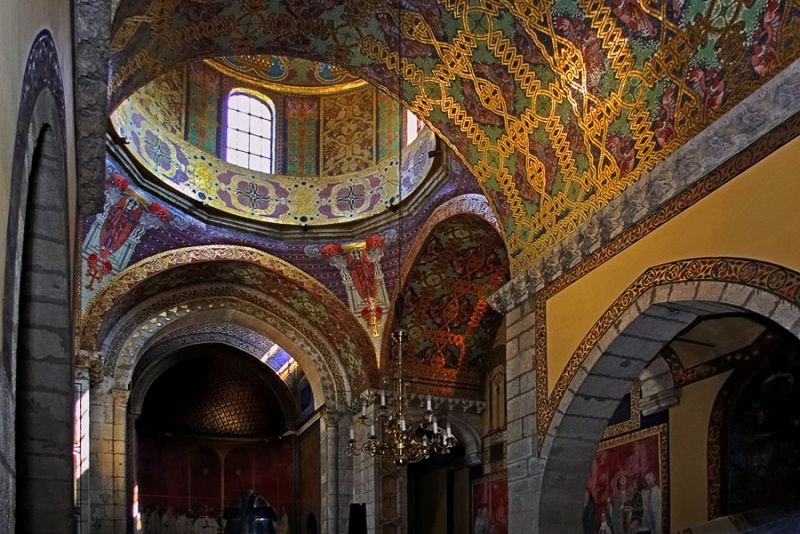
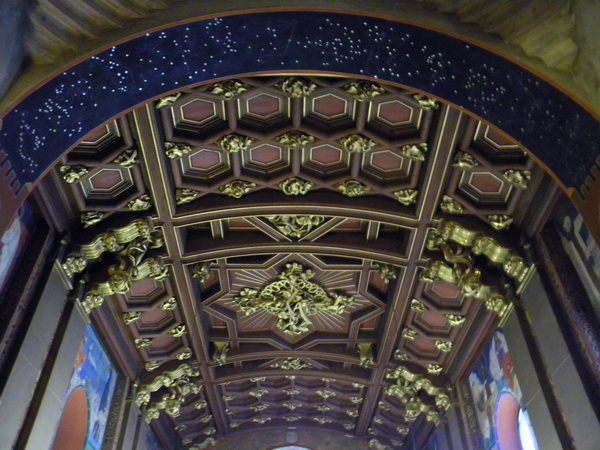
The Armenian Cathedral of the Assumption of the Blessed Virgin Mary is an architectural monument of national importance in Lviv, a UNESCO World Heritage Site; the only church of the Armenian Apostolic Church in western Ukraine; until 1945 it was the cathedral of the Lviv Armenian Catholic Archdiocese, and since 2000 it has been the Ukrainian Diocese of the Armenian Apostolic Church.
The cathedral itself has been rebuilt several times: in 1437 an open arched gallery was built around it, which was converted into a sacristy on the northern façade (1671) and later into a sacristy (1731). A rectangular western nave was added in 1630. After the fire of 1712, the interior acquired a Baroque character: the walls were plastered and new altars were installed. During the restoration of 1908-1927, led by the architect Franciszek Monczynski, the construction of the western entrance part was started instead of the dismantled residential buildings on the side of Krakowska Street, and the walls of the apses were decorated with stylized elements borrowed from ancient Armenian architecture, such as overhead arches and ornaments. The interior is stylized with a carved wooden ceiling above the seventeenth-century nave, frescoes, ornamental wall paintings, and stained-glass windows (by Jan Henryk Rosen), and a mosaic in the bathhouse (by J. Megoffer). In 1930, a new high altar, throne, and pulpit were designed by Witold Minkiewicz.
Under Bolshevik-Soviet rule, the Armenian Cathedral was closed. The Soviet authorities closed the structure of the Armenian Catholic Church. On November 26, 1945, the administrator of the Archdiocese, Father Dionysius Kayetanovich, and three other priests were arrested. Almost all Armenians left for Poland.
Initially, the building was used as a storage facility for the Lviv Art Gallery, and since 1953, the Lenin Museum. In January 2000, the church was returned to the Armenian community. On January 6, 2001, the first service was held, and on May 28, 2003, the cathedral was consecrated by Catholicos of All Armenians Karekin II.
Despite the reconstructions, the space-planning solution of the old eastern part of the church is well preserved, reflecting the traditions of ancient Russian and Armenian monumental construction dating back to Byzantium. The influence of Armenian architecture was reflected in the shape of the twelve-sided drum with a hipped roof that crowns the middle cross. It is evident in the careful decoration of the walls with hewn stone slabs with embedded khachkars, in the pattern of the stalactite frieze above the arch of the central apse, which has been preserved in the interior. The latter was decorated with a fresco painting (15th century) typical of Old Russian monuments, fragments of which were discovered in 1925 on the slopes of the south window niche. Some architectural details, epitaphs, and sculptures show the influence of Gothic, Renaissance, and Baroque styles.
The three-tiered, square bell tow er was built in 1571 by the Italian Renaissance builder Petro Krasovsky, a Lviv architect. After a series of fires in 1743, 1748, and 1778, it was significantly rebuilt. It is crowned with four round towers built into the cornerstones and made of galvanized tin in the early nineteenth century. Such round towers are characteristic of ancient Armenian architecture and can be seen on the upper vestibule of the Church of St. Ripsime in Etchmiadzin. The bell tower has a bell named after St. George, the baptizer of the Armenians.
From Armenian Street, through the gate under the bell tower, there is a passage to the courtyard of the cathedral complex, where the column of St. Christopher, erected in 1726, stands. There are also the buildings of the former Armenian bank and pawnshop "Holy Mountain" (Mons pius) and the palace of the Armenian archbishops, built in the seventeenth century. In the passage under the tower, a stone portal from 1570 has been preserved, leading to the Armenian court. Above the portal you can read: "In the year 1020 of the Armenian era, in the month of January, Andrew of Caffa ordered the construction of a bell tower for the parents of the deceased Khachares and Sarah and his brother Avedik and their family."
Between the cathedral and the palace lies the narrow Armenian Narrower Street (now Serhiy Parajanov Street), which was mentioned in 1598; in ancient times it rested against the city walls, and when the walls were dismantled in the eighteenth century, it opened onto Armenian Lower Street (now Lesia Ukrainka Street).
The cathedral complex has several epitaphs in Latin:
- "This is the grave of the venerable Father Stephen, Patriarch of Great Armenia, who was in Rome and gave his soul to God on his way to Lviv in the year of our Lord 1551."
- "Venerable Stefan Stcekiewicz, Kustosh. "Requiem" is performed. 1730";
- "Ignatii [Nu]rovych gave his land, his soul, to God in the year 1769."
- "To the best, the greatest God. The noble, worthy Yakov Theodore Bernatovych [...], having thrown off the garments of mortality, hopes for life without death. Pray for the same. [...] in the year 1772, at the age of 79, on May 5, Yakov Theodore Bernatovich Inal reposed in the Lord."
The ensemble of the Armenian Cathedral in Lviv is a complex of buildings of the XIV - early XX centuries, located in the part of historic Lviv where Armenians settled (7, 7/9 Virmenska Street). It is a unique monument of Armenian medieval architecture in Ukraine.
The ensemble of the Armenian Cathedral includes: The Armenian Cathedral, the bell tower, the Palace of Armenian Archbishops, the Armenian Bank, the Armenian Benedictine Monastery, the memorial column of St. Christopher, and the Calvary Altar. The cathedral serves as the architectural center of the complex; all other buildings are grouped around it, forming three small enclosed courtyards.
Themonastery (northern) courtyard near the northern wall of the cathedral on the opposite side is bounded by the building of the Armenian Benedictine monastery, built in 1682. In front of it, a statue by Tomasz Dykas was erected in 1881. The gallery, modeled after Italian loggias, serves as a passage from the monastery to the cathedral; its lower tier is open and arched, while the upper tier is closed. Two reliefs (16th - early 17th centuries) made of local limestone are embedded in the wall.
Theeastern courtyard is associated with the monastery's baroque gate (1671). It is called the Christopher's Yard, and in its center stands a commemorative column (1726). On all sides, the courtyard is enclosed by the buildings of the former Armenian bank (17th century), the archbishop's palace (late 18th century), the bell tower (16th-18th centuries), and the cathedral's apses. A through passage connects the eastern courtyard with Lesi Ukrainky Street. The gate arch bears the date "1779" - the time when the buildings were restored after the fire of 1773.
Thesouthern courtyard is connected to the eastern gate with a Baroque pediment (1877), separated from Virmenska street by a fence with metal bars. In the niche of the fence from the street there is a statue with the date "1664" - a typical example of Lviv sculpture of the second half of the seventeenth century, according to some researchers belonging to the carver of Lviv master M. Erlemberg. An open arcade-gallery, built in 1437, stretches along the southern wall of the cathedral. An eighteenth-century wooden high relief, the Calvary Altar, is installed near the blank wall of the building.
ThePalace of Armenian Archbishops (conscription no. 116) is an administrative and residential building, the former residence of the Armenian Archbishop. It is located in the historic center of Lviv, on Virmenska Street, to the right of the Armenian Cathedral bell tower. As a part of the Armenian Cathedral ensemble, it has the status of an architectural monument of national importance (protection number 318/3).
The building of the Palace of Armenian Archbishops was erected in the late seventeenth century by order of Archbishop Vartan Gunanyan. His successor, Archbishop Yakub Augustinovich, rebuilt and expanded the palace after a fire in 1778, and in 1802 another reconstruction was carried out by Archbishop Jan Shimonovich, who again expanded the building and arranged a chapel in it. The palace also housed the library, the office, and the archives of the diocese.
Until 1939, the palace building officially belonged to the Armenian Catholic Church.
The building is brick, plastered, L-shaped in plan, and closes the Eastern (Christopher's) courtyard of the Armenian Cathedral from the east. The front façade facing Virmenska street is two-story with four windows, and the rear façade is three-story with wooden verandas and covered stairs. The front façade is divided horizontally by rods, and vertically at the level of the second floor by flat blades between the windows. The façade culminates in a wavy pediment with a bas-relief of the Armenian archbishops' coat of arms in the tympanum.
The windows are rectangular, and the original stone window decoration, consisting of straight sandriks with ornaments of four-petal late Gothic rosettes, triglyphs, and metopes, and carved window frames, has been partially preserved on the ground floor. The original portal, decorated with canelure ornamentation, has also been preserved from the courtyard side.
The Armenian Cathedral is located at 7/13 Virmenska Street. The entrance to the church is from Krakivska Street. The cathedral is open every day, and every Sunday at 11:00 a church service is held here.
Location on the map
Comments
Places to stay nearby
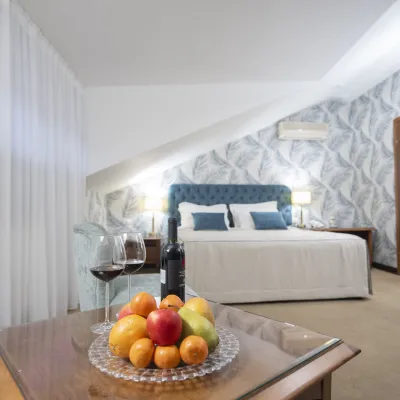 HotelHotel "Swiss" - Swiss Hotel Lvivunder 1 km from Armenian Cathedral, LvivSaunaSPABreakfastNearby: Turkuliv-Comello Palace 900 mSt. Andrew's Church 200 m
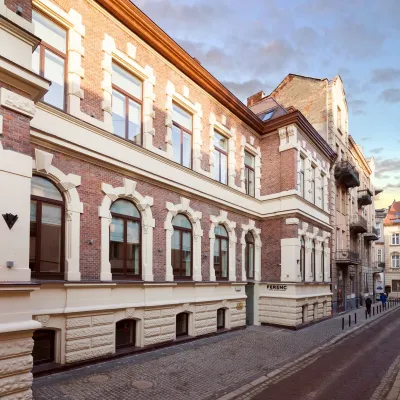 HotelHotel-Restaurant "Ferenc" Lvivunder 1 km from Armenian Cathedral, LvivSaunaKitchenWi‑FiNearby: Turkuliv-Comello Palace 1.3 kmSt. Andrew's Church 500 m
Nearby attractions
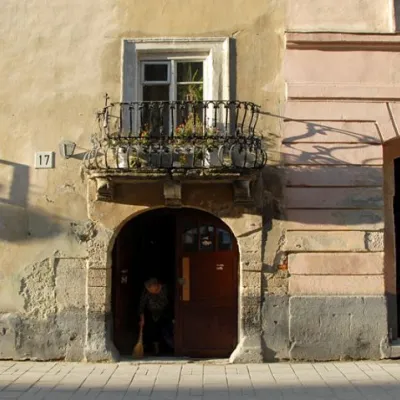 ArchitectureArmenian Quarter (Armenian Street), Lvivunder 1 km from Armenian Cathedral, LvivOne of the oldest neighborhoods in the ancient city of Lviv is Armenian. For centuries, the community has been creating a center of national culture and architectural...
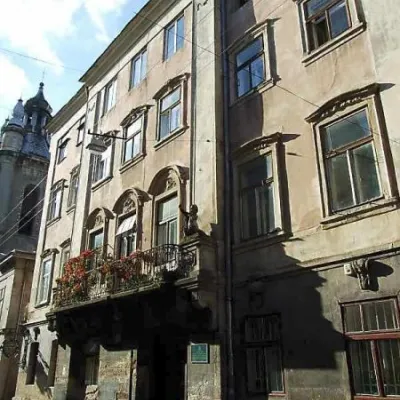 ArchitectureMuratovych's house, Lvivunder 1 km from Armenian Cathedral, LvivMuratovych 's House (also known as the Palace of the Worlds, Palace of the World; conscription No. 118) is an eighteenth-century residential building, an architectural...
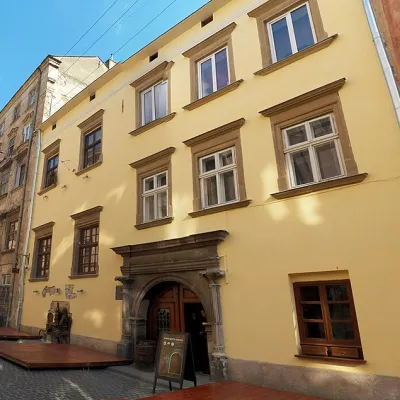 ArchitectureKamianytsia Mykolaievychivska, Lvivunder 1 km from Armenian Cathedral, Lviv"Kamianytsia" means a stone house, this name came from the medieval cities of Europe. Such a structure provided for the placement of craftsmen's premises at the bottom...